

About a month back I purchased Astral Ascent, a game that has quickly skyrocketed up my Game Of The Year list. After following the dev, Hibernian Workshop, on twitter, I was struck by a tweet where they talked about the journey to this point.
In the tweet, they showcased how the steam reviews for their first game, Dark Devotion, were “mostly positive”, and now, with Astral Ascent they were “very positive”. And they said that they learned and improved a lot from their first game.
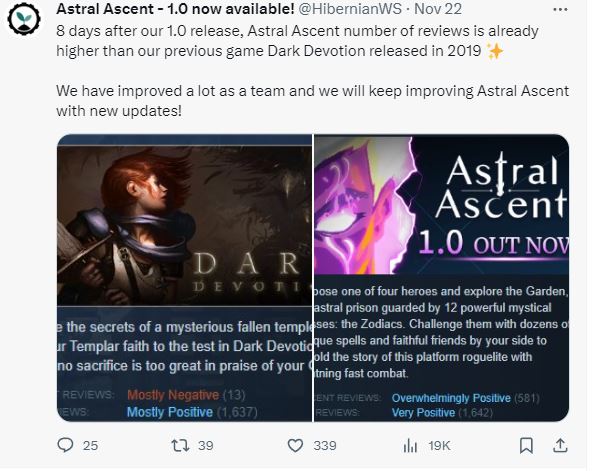
This got me thinking that as a gaming community, if a developer gets something like a 75 on Metacritic, even a rookie developer like Hibernian, we don’t necessarily think to ourselves “Wow, if they get better at animation and sound design, their next game could be really special!”. Generally, if a developer scores a 75, we kind of expect most of their future games to also be around that level.
I’m someone who watches a lot of sports, and it’s common with any rookie to project them out to get better in the years ahead. If a basketball player has elite athleticism, but a terrible jump shot, I will think about how great they might be in a few years if that jump shot improves. Hibernian Workshop has shown me that there is no reason we can’t start thinking about game developers in the same way.
I sent a few questions to Louis, the game director at Hibernian Workshop, to learn more about the process of improving as a game developer. His answers are below and were lightly edited for clarity.
Your studio’s first game, Dark Devotion, received “mostly positive” reviews on Steam, and had a 71 on Opencritic. Not bad, but probably not where you wanted to be. In the internal development bubble, do you have any idea how a game might be received by the general public? And how hard was it to see your game not get the scores you were hoping for?
Louis: Dark Devotion was our first production, at this stage the studio was very very small (we were 4 for a moment but mostly 3 and started with 2) and we were all self-taught. We did it as a hobby at first, but we really didn’t know much about what we were doing. We gave our very best to create the best possible game but we did not have much hopes regarding sales. We released the game with nearly no options, very few quality of life options, you can’t even handle audio options or remap your bindings. Most of these elements are the reasons for the negative reviews we received, but the game code was so unstable that it would have been too complicated to implement these features, and for various reasons we would not update the game more from the release.
We all understand how an athlete can get better at a sport with practice. I feel like those of us on the outside don’t always view game development with that same mindset. What was the process at Hibernian to get better, and deliver a better performing game for your second effort?
Louis: Our first game, Dark Devotion, was coded on Clickteam Fusion 2.5. At this time I did not code very well and I was alone on the code. For Astral Ascent we transitioned to Construct 3 which had a similar coding framework so I was not lost. It took some months being used to it then we started working with another developer who is now Lead Developer on our projects, he is mostly in charge of big systems and I am mostly in charge of gameplay. I would say it was mostly practicing over and over again in order to be better. For example our first spell in Astral Ascent was a fireball, but it was very small and not impressive at all so I remade it much more impressive and we had a similar process on a lot of game elements. We were never afraid of breaking something to make it look even better.
What are the biggest things you learned from Dark Devotion that helped make Astral Ascent as good as it is?
Louis: So many things! From a technical point of view, making Localization a priority and not adding it at the very end, making options early on and focus on playtests and players feedback. From a design perspective we learned that we liked to do bosses for example, and I think Astral Ascent is a much more reliable representation of what we like to create.
Astral Ascent currently has an 87 on OpenCritic, and “very positive” reviews on Steam. What was the teams reaction as some of those reviews started to pour in?
Louis: It felt great and surreal, the initial reception of the early access release back in april 2022 was not that great, it was decent but we had a lot of room for improvements. With the small content we had, we soon had very few players during the Early Access period and during most of the Early Access we had very few feedback on current situation of the game. One good indicator was that we were ourselves having more and more fun playing the game, but seeing the recent reception of the game feels so great as we worked as hard as we could to deliver the best possible game, and we had no idea if it would have more attention than during the Early Access period.
I imagine it’s harder to learn and get better when a game has the reviews Astral Ascent has. How do you think the team can continue to get even better for your next go around?
Louis: We see a lot of room for improvements! Everytime I see someone play I see things that could be improved, but we will keep improving the game and add more exciting stuff to it with a 2024 Roadmap we will share tomorrow. Everything we improved from Dark Devotion to Astral Ascent will be improved again for our next project that is for sure, it was the first project for most of the team and everyone gained experience by themselves and also as a team working together. I cannot wait to see how our next project will shape up!
Thank you to Louis for taking the time to answer my questions, and keep an eye out next week for my Astral Ascent review!
 Big Nerd Gaming
Leave a comment