

One of my favorite parts of last year’s Game Awards was the speech that Abubaker Salim gave to introduce Tales of Kenzera: Zau. In a ceremony filled with random celebrities and dumb bits, this was a moment where a game developer poured his heart out and made me care about his game purely through his passion. Salim discussed how his father’s passing and the ensuing grief were the inspiration for Kenzera, and it was impossible not to root for him from that point forward.
It’s easy for me to see the passion that Kenzera was made with as I played through it. Those moments where you can feel the love Salim had for his father are consistently powerful throughout this game.
But in the end, this is still a video game. It has to feel good to play, and while Kenzera certainly has its moments, it has a few too many hiccups with its basic mechanics to reach the heights that it strove for.
Jumping For Joy
Kenzera is what you might call a Metroidvania-lite. It’s 2D and has plenty of branching paths as you would expect from the genre, but It’s not overly long (about 10 hours). I was able to play it almost entirely like a linear action/platformer game outside of a few special challenges that I went slightly off the path to complete.
Games like this generally have combat and platforming elements. The stronger of the two was easily the platforming for me. Kenzera continuously throws new platforming mechanics as you play through the game, and they all end up being pretty fun to use. Every mechanic is implemented in smart ways, though nothing here is overly unique or complicated. The game has your standard double jump, the classic air dash move, a more powerful air dash that can break through certain walls, a glide mechanic, and a slingshot type move. Kenzera smartly paces itself with introducing these mechanics, so the platforming side of things stays pretty fresh from start to finish. I had some issues with the controls in this game at times, but when it came to the platforming, I found everything to be mostly smooth and responsive. There is a slight animation delay when you try and glide that I found to be a bit awkward, but that seemed to be more of a purposeful design choice over an actual issue with the controls.
These sections also generally do a nice job with their difficulty balance. The main story sections of the game are rarely too difficult, and the side challenges were tough but usually fair. My only complaints are that the insta-kill spikes in the game are different sizes, and sometimes I got killed by a spike that I was pretty confident my character didn’t actually touch. The hit detection seems to assume all the spikes are the same size even though they aren’t. There are also a couple of “chase” type sequences that are very clearly trial and error, and you get sent back to the beginning when you lose. These segments were incredibly frustrating as I didn’t think they were overly hard once I knew what was coming, but I had to pay the price and die quite a few times to get all the knowledge I needed to succeed.
Despite those complaints, I would say that I mostly had fun with all the platforming segments in the game and would probably give them something like an 8/10. Unfortunately, the combat side of the game does not hold up its end of the bargain in the same way.
Fighting My Grief
Early on, I thought the combat in Kenzera was unremarkable but competent enough. You have two different styles of attacks you can use, one that is more melee focused and one that is more ranged focused. You can quickly switch on the fly, so it can be fun to hit a few melee attacks, dash away, use some ranged attacks, and continue to switch styles as needed. I did think the melee style was significantly worse to use than the ranged style, however. Generally, the dash mechanic in games like this is built so that you can melee enemies, dash through them, and hit more melee attacks on the other side to keep a combo going. The dash in Kenzera is a bit longer than most, so if you dash through an enemy, you end up outside of melee range and have to take a few steps back in to attack again. The game also doesn’t let you parry melee attacks. It does let you parry ranged attacks, but only when you are in the ranged attack style. The spear attack is also significantly better in the ranged style, as it freezes enemies, while it’s more of a standard attack in the melee mode. So it makes way more sense to attack enemies from range, counter the occasional attack back, and keep your distance from melee attackers over getting up close and personal.
This is disappointing, but it was still mostly fine. As you get later in the game, though, enemies get a fair bit tougher, and it feels like it takes way too long to kill enemies with the ranged style. You also only get a few new moves from the skill tree as the game progresses, so I never felt like the combat in the game was getting better as I went in the same way the platforming does. Kenzera also starts throwing a lot of enemies at you that force you to attack them with one style or another in the second half of the game, which takes away the bit of fluidity the combat has with switching styles, and forces you to use the less effective melee style more often. This is especially annoying when the game forces you to fight flying enemies with the melee style, which just doesn’t work all that well.
The combat is also the main area in the game where I had the occasional issues with finicky controls. The ground smash move in particular felt really wonky to use. I had a lot of instances where I tried to use it, and it did not work for me. The camera also has some issues. When fighting with the ranged style, I was surprised by how often I would end up attacking an enemy who was slightly off screen, and the camera would never adjust to put the enemy fully onto the screen. The enemy AI would also seem to falter on occasion here, as I had plenty of instances where enemies just stood there and took my attacks and did nothing in return, especially in those instances where they were at least slightly off screen.
Sometimes games can have good boss fights even if the core gameplay mechanics aren’t great, but Kenzera, unfortunately, fares no better here. The few boss fights are about as by the book as it gets, with next to no surprises. There is occasionally some pretty decent build-up to these fights, but each time, they inevitably let me down. The last boss fight in particular had me pretty excited, only to once again be about as generic as humanly possible.
It Still Has To Be Fun to Play
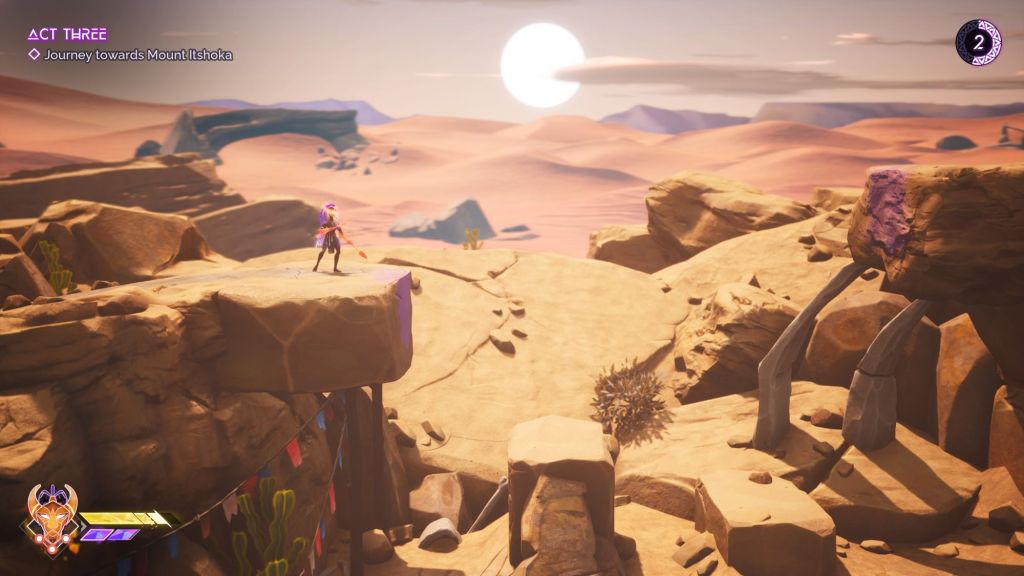
From an exploration perspective, Kenzera isn’t packed with secrets, but true Metroidvania lovers should find just enough branching paths and backtracking to satisfy. I personally did not spend any time backtracking or exploring extra because Kenzera does not have that many fast travel points, and I wasn’t having enough fun with the core game to want to spend way more time in it, but the options are certainly there for those that want it, and the rewards for exploration are usually useful enough where you don’t feel like you wasted your time. The colorful art direction also helps make exploration somewhat fun, as there are a few nice visual moments that come up as you progress.
As stated earlier, one of the biggest draws and selling points of the game was that it was going to be a very personal tale of grief and the struggle that comes with that. I thought Kenzera did a decent enough job there, and it has some pretty poignant moments spaced out throughout the journey. The relationship between the main character, Zau, and the god of death he is traveling with, Kalunga, has some interesting dynamics as well, and I enjoyed their interactions, as well as the voice actors for both of them. I do think that a few arcs of the game work better than others, and there were stretches that I didn’t feel incredibly pulled in by the story. Luckily, the payoff to it all is perfect, and Kenzera absolutely sticks the landing with a moment that I will easily remember for years to come.
That moment works because of all the heart and vulnerability that is present in Kenzera. I think the passion shows through in the world, the characters, and the story in so many ways. It’s just a shame that those things didn’t translate fully into the actual gameplay mechanics. If you like this genre, I’d say Kenzera probably does enough to warrant your consideration, especially since it is “free” on PS+, but it is not a game I would tell anyone to go out of their way for. Heart can only get you so far.
Score: 6.5/10
 Big Nerd Gaming
Leave a comment