
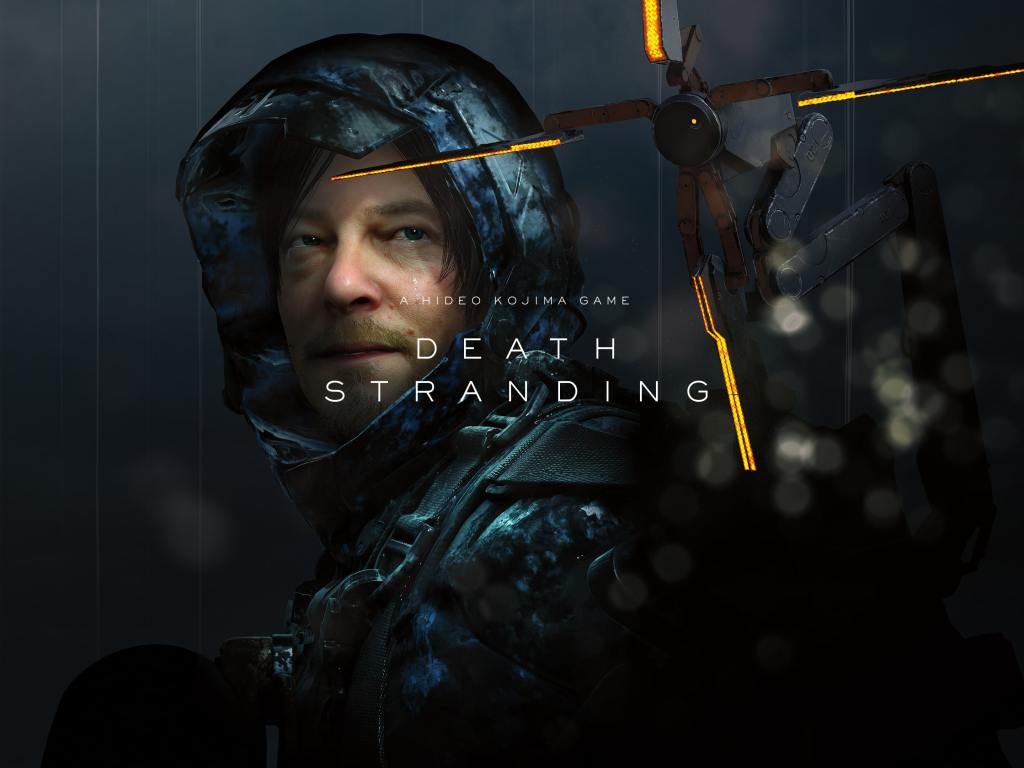
If you watch some footage of Death Stranding’s core gameplay, it can be easy to assume that it is not a particularly engaging video game. You are essentially a delivery man in a post-apocalyptic world. Your mission is to deliver packages from one location to another. The main thing you will be doing in the game is walking. You aren’t super well equipped to do a lot of fighting, so your goal is usually to avoid combat as much as possible. This is not at all how I would traditionally expect to have fun in a video game.
But Death Stranding is different. It does something that few ever video games have done. It turns walking into a highly compelling gameplay loop. Until I played this game, I never really thought about how often I am playing an action-adventure video game, and my mind mostly turns off. After clearing a combat encounter, I sort of mindlessly start running to my next objective, perhaps even taking a few sips of a drink or a bite of a snack with one hand as I go. Death Stranding does not allow this. Whenever I was playing the game, I was fully engaged. Depending on my setup, one innocent rock could send my whole world tumbling down. One seemingly minor river could turn into disaster. One jaunt down a hill could become a complete nightmare. Death Stranding actually has some of the most engaging gameplay I have ever seen in a single-player game, as it truly never lets you just zone out.
Like with any bold new experiment, there are ways in which Death Stranding can falter. But most of these moments come from the times it tries to be more like a traditional action-adventure game instead of sticking to the unique things it excels at. Despite these occasional hiccups, Death Stranding still stands strong as one of the best games I have played in recent years. It’s the rare AAA game that is unlike anything else out there. Death Stranding dares to take the more weathered path instead of the paved road, and it comes out on the other side stronger for it.
Walking Simulator (Non Derogatory)
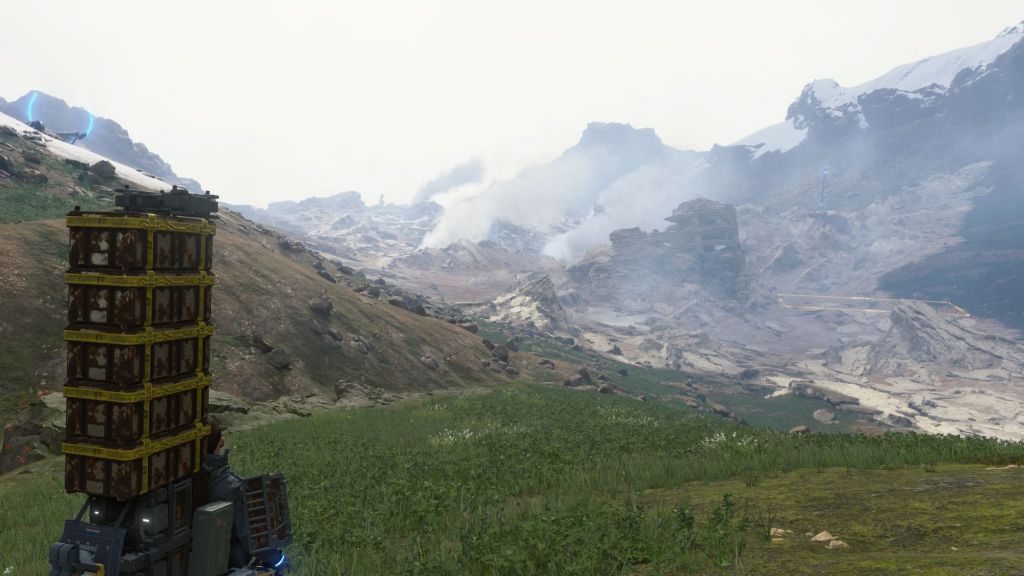
The main reason why Death Stranding is able to make walking and driving compelling is the care that went into crafting its world. Every rock, every slight slope, and every river all feel very purposeful. Early on, you realize that just walking straight to your objective is a bad idea, as walking on a rock when you have a lot of cargo on your back can quickly lead to you losing balance. While you can catch yourself with trigger presses every time you lose balance, it gets scary and can drain your stamina, which is important to keep as high as possible. If you fall in the game, your cargo gets damaged. Cargo getting too damaged is the main way you can get a game over.
As the game goes on, levels get increasingly complex. You’ll start crossing more ferocious rivers, climbing mountains, dealing with snow, and facing other environmental challenges. Whenever the game throws a new problem at you, it is usually not far behind with a new tool or solution. Early in the game, I constantly felt like I was carrying way too much cargo. Sam (the lead character, played by The Walking Dead’s Normal Reedus) would seemingly always be on the verge of falling over, and it was getting annoying having to adjust constantly. Soon after, I was given a motorcycle, which helped a lot until I started coming across really rocky terrain that made the motorcycle a giant pain to navigate. Then I got a truck, which navigated trickier terrain better, but then it got stymied by increasing amounts of mountains. I ended up spending most of the back half of the game on foot, albeit with better equipment that allowed me to carry more cargo.
With all the different terrains and all the different tools you are given to tackle them, each delivery feels like a puzzle. And it’s a puzzle that you are given complete freedom to tackle in any way you want. Oftentimes, the easier routes to the next area are filled with enemies. You can navigate some rocky terrains with a truck, but you might find yourself really zig zagging around to avoid rougher terrain. You can bypass some dangerous areas by climbing mountains, but this can be treacherous in many different ways and can really drain the little bit of stamina you have. Planning my routes, planning the equipment I would bring to tackle the challenges in front of me, and even figuring out in which manner I should carry all that equipment ends up being a constantly satisfying little brain tease.
Death Stranding builds on that satisfaction by allowing you to bypass some of these challenges if you are willing to put in the work for it. The most notable example are the roads in the game. So much of the terrain in the game is very difficult to drive on. However, by accomplishing extra tasks for people and getting resources, you can build roads that make traversing from one town to the next an absolute breeze. You can also level up your relationship with each person that you meet, which usually rewards you with better equipment and other surprises. Doing certain missions can also give you benefits, like increasing the amount of cargo you can carry. If you really go nuts with this stuff, you could spend over a hundred hours in this game and end up with a massive expressway that lets you go almost anywhere that you want to go. Death Stranding lets you shape your world in many unique ways, and there are many rewarding feelings that go well beyond “the numbers went up” that you see in most games.
Unfortunately, I felt that it takes a bit too much effort to see some of the greatest rewards the game has to offer. You have to grind a fair bit to max out relationships with the various residents of the United Cities of America. While building up roads is awesome, it also takes a whole lot of effort to come up with enough resources to rebuild more than a few. The game seems to want you to rely on other players, as they can impact your world in various ways with resources and even provide vehicles and other structures. Early on, several roads got rebuilt in my world by another players contribution. This felt pretty cheap and unearned. But from them on, I seemed to get next to no help on any of my roads, and very few got rebuilt from that point on because it takes so much time. I tried to put the work in to make it happen, and this is when I felt the most burnt out on the game.
Meanwhile, I almost got too much help from the game when it came to other structures. There was always a generator or a safehouse around when I needed one, and I rarely had to craft any new vehicles once I got a little bit into the game. Death Stranding feels very balanced towards getting help from others, but all of these things are so random that it never felt terribly satisfying to me.
The only other element of the game that I found unsatisfying was most of the action sequences that happen in the game. Normally, this would be a devastating critique from me, but because these are semi-rare, it ends up being more of a slight nuisance instead of a deathblow. The main encounters in the game are BT encounters, which are deadly ghosts for lack of a better term, and MULEs, which are the human thieves.
You can only see the BTs in brief spots, so you have to use your “BB” (which is uhh, a baby) to figure out where they are. Avoiding BTs is genuinely terrifying early on, as you aren’t given any means to defend yourself. Once you do get a few weapons, this ends up being a little too easy and mostly just felt like an annoying way to slow my progress. I avoided BTs as much as possible, not because I was worried about them, but because climbing extra mountains can often be a faster way to travel over slowly trudging through BTs and taking them out one by one.
The MULEs are much more traditional action encounters, but the combat in the game is so awkward that they were never fun to fight. The MULEs are comically easy to deal with early on, as you get a gun that ties them up, and they mostly just run straight at you. Once the MULEs start using guns, it starts to get pretty dumb. There is no real cover mechanic, so awkwardly crouching behind cover is usually your best option, but you can’t shoot from there without hitting the cover, even if it seems like you are positioned to shoot over it. Throwing grenades over cover while crouched is also really awkward when it shouldn’t be. A part of me cynically thinks these segments were put in so that the trailers would have at least some glimpses of traditional third-person action games to show in order to help sell it. If that is the case, it’s a real shame, as these are clearly the worst segments in the game.
Unfortunately, Death Stranding leans even more into this with several war sequences that take place at several different points in the game. I won’t go into too much detail to avoid spoilers, but these segments truly go all in on the games’ action elements. If I were to play an entire third-person shooter with elements like this, I would struggle to give it more than a 6/10. Once again, these segments only take up an hour or so of the game, and you do get rewarded afterwards with some great narrative moments, but it’s not enough to make up for how poor the gameplay is here.
The game also has a few too many boss fights that just never felt great. Boss fights in the game end up being mostly running around the map to pick up supplies, as you aren’t able to bring nearly enough to take any of them out (I played the game on hard to be fair). This also leads to several sequences each fight where you have to pause the game, drop a bunch of cargo, and re-arrange it afterwards so that you don’t end up carrying too much weight, as this can have several consequences. It’s all incredibly awkward and onerous. While one notable boss fight really delivers in some crazy ways, it still has some of these flaws, too. Basically, any time that Death Stranding tries to get away from the core walking gameplay, it stumbles in some big and small ways. Once again, it’s just fortunate that none of these segments take up a significant chunk of the game.
Putting the Puzzle Together
Like any Kojima game, the story does take up a large chunk of the game, however, and it delivers in just about every way.
Death Stranding kicks off with one of the wildest first few hours that you will see in a video game, which really helped me get through some of the learning curves associated with the gameplay. This games’ world is so bizarre that it’s almost impossible not to be sucked in as each new weird thing gets introduced. Using a baby to sense ghost creatures. All of the strange tar everywhere. Burning the presidents body. I was truly in awe as this incredibly bizarre and depressing world was introduced to me piece by piece.
The game smartly takes a bit of a break from big plot moments, as it lets you start to really enjoy the general flow of the game. But then it slowly begins to unveil one piece of the puzzle after another. All of these puzzle pieces seem disconnected until the final few acts of the game where they all seem to come together, almost by magic right before your eyes. Every time I thought I knew what was going to happen in a certain sequence, a new wrinkle got added. The reveals are fast and furious, yet not overwhelming in the last 4-5 hours of the game. I was absolutely engrossed, and I’d put Death Stranding up there with some of the most iconic video game endings out there.
Hollywood Blockbuster Production Values
And those reveals are all aided so much by some top-tier vocal performances. Mads Mikkelsen as Carl Unger gave me chills so many times in this game. He delivers two different lines in particular that gave me goosebumps. Tommie Earl Jenkins as Die-Hardman has one monologue that completely blew my mind. I wish I cared more about Norman Reedus as Sam, but I do think the way he is written made that role one where it was almost impossible to really come off as a star.
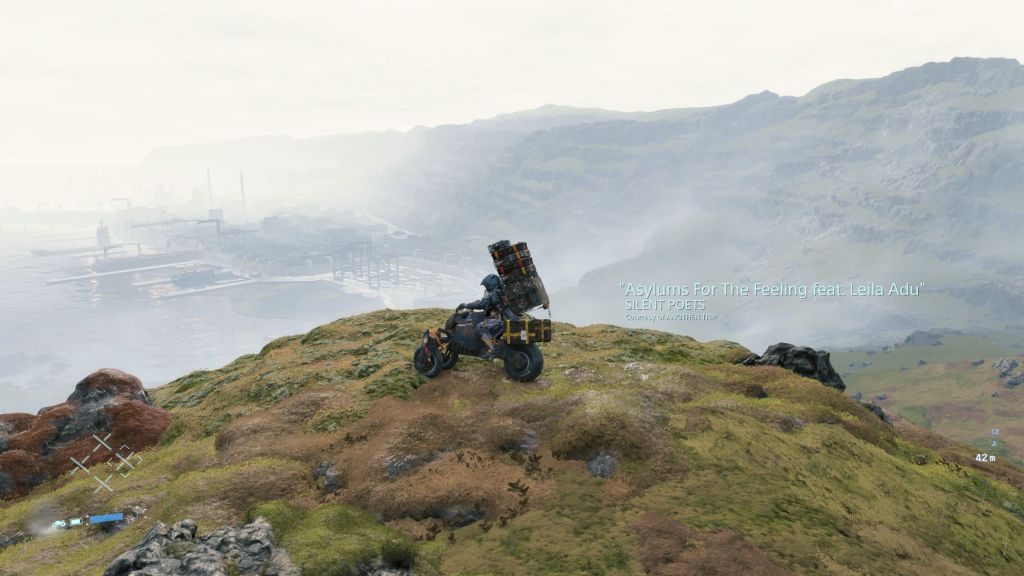
Those top tier production values also extend to the visuals. The Director’s Cut of this game looks absolutely phenomenal. Death Stranding would still get lauded for its graphics, even if it was released tomorrow. The character models and animations look amazing. I thought the facial expressions, in particular, were some of the best I’ve ever seen. And looking out onto the many huge, gorgeous, and abandoned landscapes never got old.
It also never got old when the music started up in the game. Death Stranding is mostly silent from a music perspective, or the music is so quiet and subtle that you barely notice it. However, when you reach key points in the game, and usually a spot of safety, something from its soundtrack would play that perfectly fit the vibe and completely sucked me in. Death Stranding smartly doesn’t overdo it with these moments, which makes them special every time they occur.
The Art of Subtlety
Death Stranding is a game that has mastered the art of subtlety. This game has made walking fun with one little trick after another, which is a truly monumental achievement. I wish it had a few more tricks up its sleeves for some of its non walking segments, but that only takes so much away from a game that has one of the most fun and unique gameplay loops I have ever played, and storytelling that can only be described as a tour de force.
If you have been worried about if you would like Death Stranding, take it from someone who had very similar concerns. This is a game that is worth your attention.
Score: 9.5/10
 Big Nerd Gaming
Leave a comment