
I have a weird relationship with cozy games. I like them in theory, as they often have stealth RPG elements at the very least. Multiple games that are amongst my top 50 all time are cozy games (Harvest Moon 64, Stardew Valley, and Littlewood). But a lot of the slow starts and general sameness that can exist within the genre can often drive me away fast. These days, I need a hook to get me in. My attention needs to be grabbed fast, and I need to see a gimmick that stands out to me.
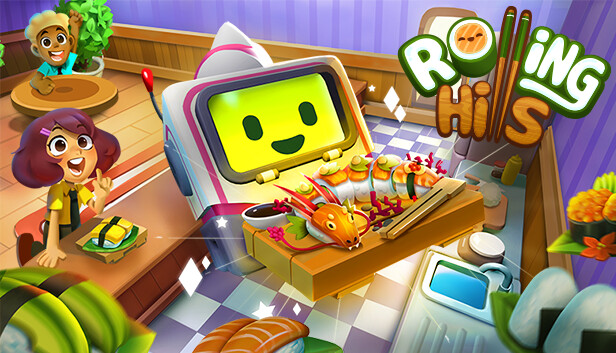
It turns out that having a robot who is trying to become a legendary sushi chef was just enough for me to want to take a peek at Rolling Hills. As you can imagine, this is a super cute cozy game with Diner Dash type gameplay. These elements alone are enough to make it stand out at least a little bit from the typical farming affair. While I do think the game runs a bit too long for the ideas it has, it was still a pleasant ride that won me over for at least 60% of the game, and as a bonus, it really won over my toddler’s heart in particular.
Cute, Fast, and Pretty Fun

One of the biggest things I appreciate about Rolling Hills is that it doesn’t dick around and gets going right away. There is no long introduction that feels similar to many other games in the genre. Within minutes, I was a cute robot serving sushi. And it turns out that Diner Dash gameplay ends up being pretty solid for what it is, too. The core gameplay of Rolling Hills involves serving customer their food as it comes out of a conveyor belt. Each customer has their own preferences for the type of sushi that they want, and they want a certain quality of sushi as well. In addition, they want that food relatively fast too.
In addition to getting customers the right food in a reasonable amount of time, you also will have customers that fall asleep that you need to wake up with your adorable robot honk. Some customers will talk loudly on their phone, so serving them faster keeps other customers from getting upset. And some customers will try and take pictures of you, which can cause you to shut down for a few precious seconds. By staying on top of everything and keeping customers happy and awake, you can earn more money and EXP, which helps you improve your restaurant and advance the game’s story further.
A few factors keep this gameplay relatively engaging throughout. As you can see from the previous descriptions, Rolling Hills puts a decent array of different challenges and tasks in front of you for each session. The pace is fast and keeps you on your toes. I also really enjoyed how the game essentially lets you dictate your own difficulty once you do find things becoming a bit too easy. You have the freedom to add more tables to your restaurant whenever you have enough funds and space to do so. So whenever I got better at the game, or my robot gained some new skills, I could start adding tables to get more customers coming in and to keep things as frantic as possible without it being overwhelming.
Perhaps even more importantly, the restaurant gameplay doesn’t overstay its welcome. Each session lasts something like five minutes. Despite what the game throws at you, it still isn’t the absolute deepest gameplay in the world. While I mostly enjoyed the restaurant gameplay, I was usually pretty ready for it to end by the time the restaurant was about to close up. Thanks to how manageable everything is, I never dreaded opening up the restaurant to serve customers.
Let’s Cut This Menu Down

Whenever you are done with your restaurant work, the business of improving your restaurant begins. After each business day, you can buy ingredients that will improve your recipes, buy furniture that increases various stats at the restaurant, and you can hang out with friends, which gives you some other buffs.
When I first started Rolling Hills, I was incredibly pumped about all of these things. It felt like the game was really leaning into the RPG elements in a way that I greatly enjoyed. Unfortunately, as the game wears on, this all goes from very fun to very tedious.
The worst offender here are the recipes. Throughout Rolling Hills, you continuously accumulate new recipes. After starting the game with just a few of them, you can end up with over 30. Early on, leveling up my recipes was incredibly exciting because I noticed how my recipe quality was increasing, leading to a better experience for my customers. Once you start getting 15-20 recipes, you really won’t notice at all if you leveled up one recipe in particular, so all the reward from doing so gets taken away.
To top it off, leveling up your recipe gets incredibly tedious. You can buy something like 10+ ingredients from the shop each day (and even more if you want later on), and it is super boring to go up to each ingredient to buy them individually, and then go into menus and use each of them on a recipe to help increase its EXP. This is a several minute process that you do each day that doesn’t feel rewarding at all once you are in the second half of the game.
I think Rolling Hills would have benefited greatly from only having 4-5 base recipes that you can upgrade in more detailed ways so that you actually knew what each recipe was doing when you served them. Many of the recipes in the game have special abilities, but the visual cues for what they do are pretty subtle, so I never had any idea what special ability each of my 30+ recipes had by the time I was in the end game. Any of these recipes can show up in your conveyer belt at any point, so it’s not like you can just select your best ones either. This system went from something that I was really excited about to really disappointed in as the game went on.
Decorating your restaurant is a little less tedious, but that too loses a lot of its fun factor as the game goes along. Each piece of furniture you place in your restaurant improves one aspect of it. Some furniture helps you gain more exp, some get you more money, some let your sushi bar recharge faster, and others make it so customers are willing to wait longer for food. This is pretty rewarding throughout the game. But elements of it get unexciting as you get deeper in. This is mostly because the incentives all point to absolutely loading your restaurant up with as much furniture as possible. Early on, I was proud of how cute my restaurant looked, and I was very selective with what furniture I bought and where I placed it.
But if you get too choosy, your restaurant won’t generate as much EXP and money, which can make the game just take way too long to beat (it ended up taking me about 13 hours). As I started to feel ready to move on with the game, I started loading my restaurant up with stuff that could increase my EXP faster. This helped the general flow of the game, but it also made me feel cheap and silly whenever I looked at my wall packed with dozens of disparate decorations.
Luckily, hanging out with friends ends up being a good and rewarding mechanic throughout the game, with lots of great upgrades and incentives for spending time with people in town. I wish that I liked the characters more, as none ended up being particularly interesting, but it was at least enjoyable from an RPG perspective.
All of this makes Rolling Hills a bit of a tale of two halves. The town/upgrade gameplay goes from something like an 8/10 in the first half of the game to a 6/10 in the second half of the game. It legitimately made me sad because I was just so in love with what this game was doing in that first half.
Robots + Hats = Guaranteed Cuteness

Luckily, one thing that stays strong from start to finish is just the general cuteness of the game. Rolling Hills is absolutely packed with charm from start to finish. Your sushi robot is adorable. There are lots of cute sound effects, and even the music is really fun (no music when in town does get a bit weird, though). This game just has those perfect cozy aesthetics.
Best of all, the game lets you equip dozens of different hats that all range from cute to hilarious. This is up there with Little Kitty, Big City, for best cosmetic upgrades of the year for me so far.
That cuteness helped keep me a little more engaged, even as Rolling Hills started to wear down a bit for me in the second half. It also helped complicate my oddly muddled feelings about this game. I enjoyed it a fair bit overall, but I also can’t help but feel a bit disappointed knowing that it truly could have really been something special with only a few tweaks.
Regardless, if you are interested in cozy games at all but want something that at least feels a little different, I think you should give Rolling Hills a shot. Especially with it being on Xbox Game Pass. Its mixture of overwhelming charm and excellent early pacing make it a game that stands out in a crowded genre.
Score: 7.0/10
(My 2 year old daughter, who affectionately calls this “robot game,” would probably give it a 9/10. She loved it from start to finish)
 Big Nerd Gaming
Leave a comment