

I could talk about Eiyuden Chronicles: Hundred Heroes for hours. I could write about it for days. This is one of the most fascinating video games I have ever played.
I say that because Eiyuden is a game of incredible extremes. I’ve never played a game where, seemingly, everything about it is either fantastic, jank, or awful. At times, Rabbit and Bear Studios crafted something that made me feel that same magic I felt when I played some of my favorite PS1 JRPGs as a teenager. And at times, it somehow makes mistakes that even games back then didn’t.
I will usually forget about games that I give scores in the 7 range within a few months. But I will remember Eiyuden for a long time to come. I loved it. I hated it. I can’t believe it exists in both good and bad ways. But in the end, I’m still very happy I went on this bizarre ride.
That Suikoden Magic is Here… Sorta
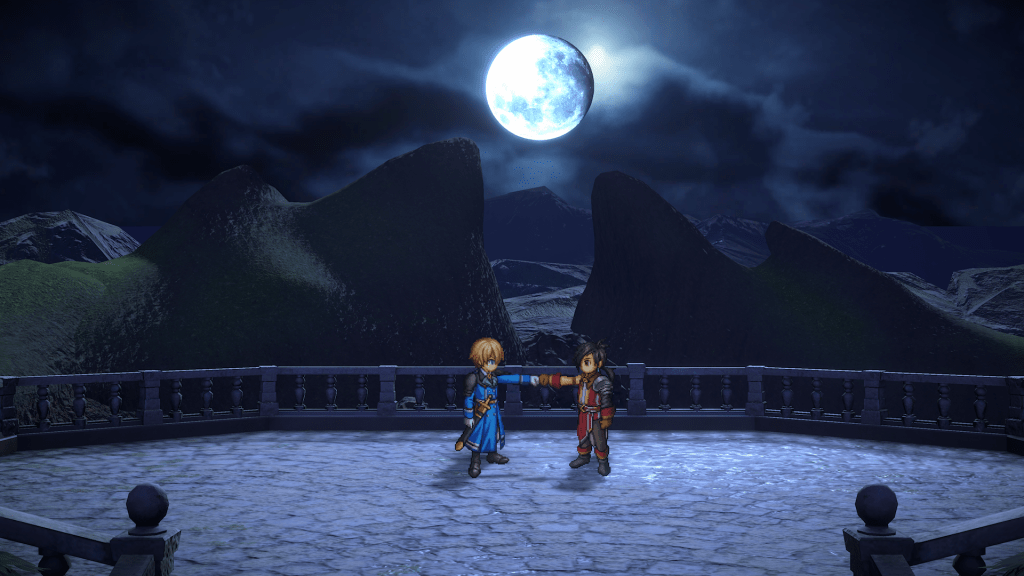
Eiyuden is essentially the next iteration of the famous Suikoden series that started almost thirty years ago. Many former developers from those games were involved in the making of this one. Much like those games, and like the title of the game implies, the big hook is that there are 100 different characters that you can recruit to join your party. Most of them can be used in battle, and some are there solely in support roles. By recruiting more characters, you can continuously upgrade your base, which can help you out in a variety of ways. These games also try and mix up the gameplay more than your usual JRPG does. There are very light strategy RPG fights where you use the army you’ve recruited in battle. Certain big battles against bosses end up being in a special one on one duel format with different battle mechanics as well. And then there are minigames and the aforementioned base building. I always felt like the Suikoden games recognized how much of a grind the standard JRPG could be, especially back then, and they wanted to do something about it by keeping things fresh in so many ways.
For many playing this game, these elements might be more important than anything else the game has, including the combat. Unfortunately, I thought all the “Suikoden elements” were pretty hit or miss. The recruiting aspect of the game ended up being the biggest disappointment for me. Eiyuden is extremely old school with how it handles its recruiting. Outside of a character that tells you where you can find other characters to recruit, there are pretty much no quality of life elements added on to the recruiting in this game. If you discover a character but do not fit the requirements to get them yet, there isn’t anything that saves in a menu reminding you that you still have them out there to recruit. You have to go back to your base each time to see which characters you are missing. Some characters require you to have a certain stat, like speed, at a specific level in order to recruit them, but you have no idea what that stat number is, so you just have to go back and check periodically to see if you can recruit them. A lot of characters require you to give them a certain item in order to recruit them, but it’s rarely clear exactly where you can find that item. And due to a very strict item carry limit, you can’t really hoard items and then just go back eventually and hope you have the right thing. I just found the recruiting requirements for too many characters to be either obtuse or annoying.
One of the worst examples of this comes from a fishing character. He is pretty important to recruit for your base skill tree (more on that in a bit). You need to catch a very specific fish to recruit him. After much frustration, I finally looked up a guide and found the very specific spot where you have to go to catch this one fish. And it took me something like 20 minutes worth of fishing to finally get that fish. If I wasn’t using a guide there, I would have assumed the fish just wasn’t at that spot.
It’s funny because the first two Suikoden games are some of the main video games that made me decide that I wanted to avoid using video game guides as much as possible. I played those games absolutely glued to a GameFAQs guide so that I could recruit all of the heroes. It was so annoying constantly stopping my game to check the guide and make sure I wasn’t missing something. Many modern video games have enough quality of life features where I personally don’t feel the need to use guides very often at all. But if you want to get the most out of recruitment in this game, you will almost assuredly have to use a guide. There are plenty of people who are fine with this, so this won’t bother them like it did me. Because I personally dislike constantly consulting a guide, I pretty much abandoned trying to recruit characters after a certain point, which led to me being way happier with the game.
Because I abandoned recruiting, I wasn’t able to explore the base building as much as I’d like. The base building that I did end up doing impressed me much more than any other Suikoden game I had played before. Eiyuden gives you a huge skill tree for your base. You can then level up your base by collecting certain resources and recruiting certain characters. Because the base is built like a standard RPG skill tree, not recruiting one character can really hold up a decent amount of the base building you can do, which was why I didn’t get to dive in as much as I wanted. But it was undeniably satisfying to watch my base get more active and full the longer I played the game, and I think fans of the classic series will be very happy here.
Let’s Fire Up The Ol’ Auto Battle Button
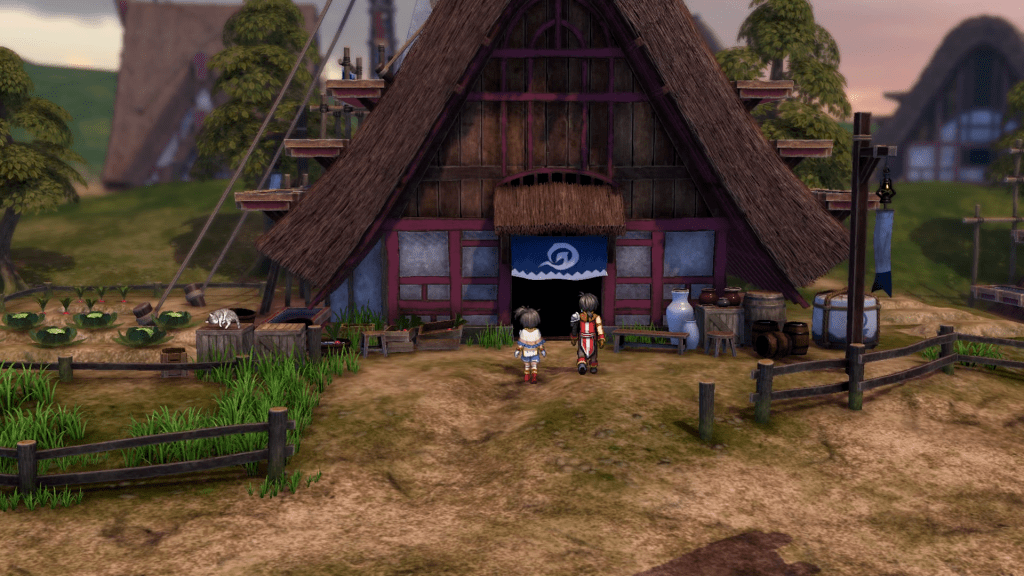
I’m not as sure if fans of the Suikoden games will be quite as happy with the battle system. While it isn’t overly offensive, I thought it was aggressively mediocre. My favorite part of the combat ended up being before the fights even started. Unlike most JRPGs, you carry a team of six into each battle in Eiyuden. With all the party members you have, there are tons of options for how to format your party. The game often forces you into at least 2-3 party members, and based on story events, some characters will be unavailable in stretches. It was a lot of fun to try and format my team into the most ideal fighting formation. It’s especially satisfying when you decide to test out a new character, and then suddenly realize that they are someone that you want on more teams going forward. Creating my teams was a little puzzle that I always found to be satisfying.
However, the actual fights are generally a lot less satisfying. There are a few different things that bugged me throughout the game. First off, despite the game giving you the turn order at the top of the screen, the game forces you to input all six of your characters’ commands before each turn starts. This often leads to a guessing game when it comes to deciding which actions each character should take. If you are at full health but facing a tough enemy, it’s a complete guess as to if you should command someone to use a healing spell after the enemy attack that turns. It feels a bit silly to command that if the boss just ends up charging an attack that turn. But that is the situation you are often in. This system never let me fully maximize my strategy in battle, which really annoyed me. If the game just let you command each character once they were up, this would have been easily solved. My other minor annoyance with this was that the game has you input all of your commands in a pre-determined order that does not line up with the actual turn order. It’s a small nuisance, but most games let you pick actions in order of who is going first. Because of this, I kept having to reference the turn order to make sure I was doing the right thing. This slows an already slow battle system down even more.
The game is also extremely punishing when it comes to its MP balancing. Almost every spell in the game that is any good at all takes up a pretty ridiculous amount of MP. You might only be able to use certain spells 3-4 times before you run out of MP. Eiyuden is also very limited with magic healing items, and you can’t even recover your MP at save points in the middle of the dungeon. What this basically means is that you will fight the vast majority of random battles the exact same way every time. You will use basic attacks, which charge a few special attacks that you can equip, and that’s about it outside of the rare healing spell or maybe an attack or buff spell for if you end up in a tough spot. Bosses are not pushovers in this game, so if you use the combat system to its fullest outside of those fights, you will be in a terrible position once you get to the actual tough fights.
I will say that when I was in a position to actually use all my magic and abilities, I did have fun with the combat. It’s very tough to get over-leveled in Eiyuden since you switch party members so often, and because of the way EXP scales. Because of this, I found the boss fights to be very fun and satisfying. Some of these battles are pretty damn tough, and with six party members, there is a lot of decision-making done each turn. Trying to balance out your magic so you don’t run out of MP is stressful in good ways here. It’s just a shame that these fights are the only ones where I felt like I actually got to use the battle system to its fullest.
The other battle systems in the game, which are the war strategy fights and the duels, are equally hit or miss. The “war battles” are incredibly simplistic. Your movement is so limited that there isn’t much to do besides go straight into the enemy and use all of your skills once you engage. There was next to no strategy there, and they really aren’t difficult in the slightest. However, these fights can often feature a lot of the most intense moments in the game’s story, which is why I still kind of enjoyed them despite the mechanics being lackluster.
The occasional one on one duels in the game also feature some nice story moments, but I really did not enjoy these at all. Your enemy will take certain actions depending on their dialogue, so it’s just a trial and error game to figure out which lines of dialogue come before each action your enemy does (much like classic Suikoden duels). Annoyingly, the game has terrible visual cues for success in these duels, too. Every fight sequence in the duels looks like a 50-50 encounter, so you can never tell if you did any damage to your enemy until the health bar is revealed after the attack cutscene that plays. There aren’t a lot of duels in the game, which is good because they were frankly pretty awful.
Game Of Thrones And Final Fantasy 16 Comparisons Are Made In This Section

Despite all the complaints that I just listed, I still managed to enjoy my time with Eiyuden a fair bit. Maybe some of that was nostalgia from my youth, but there was genuinely a lot of love poured into this game. The story, in particular, is where this game really shines. If you are into the kind of political intrigue that you see in Game of Thrones or Final Fantasy XVI, you will love what you see here. Alliances are made and broken. There are intense backroom negotiations made between nations. Schemes are constantly being hatched. There are enough plot twists to keep you on your toes from start to finish, and I was completely all in. I became much happier with the game when I stopped recruiting as much and just focused on “mainlining” it, in part because the story was so engaging.
It also helps that I grew to actually care about a lot of the characters as well. In a game with one hundred characters to recruit, I generally expect there to be a lot of mediocre characters. Thus, I was surprised at how many characters I ended up actually feeling a bit attached to. I felt like at least a few dozen of the characters you can recruit were pretty nicely fleshed out, which is a dang near herculean feat. The game does an excellent job with the lead characters in particular, and I felt invested in seeing their story finished. Almost all the important characters in the game are really well voiced as well, with my personal highlight being Andrew James Spooner, who plays the lead villain in the game. I’m not going to discuss who the villain is, as it is a minor spoiler, but his voice helped make this my favorite lead villain in any video game this year (yes, I’m including Sephiroth in there).
That heart also comes through in the visuals and the music. Eiyuden has some really strong art direction. The game manages to make most of the towns feel distinct in various ways. I also love how it will play with camera angles as you walk around in certain towns, with my favorite example being the way it does a huge zoom out when you first walk out of your base so that you can take in some of the work you’ve done to build it back up. Meanwhile, the music might be the strongest part of the entire game. Eiyuden has an absolutely beautiful, soaring soundtrack that is easily one of my favorites this year. Even during the times when I wasn’t necessarily in love with the game, sometimes I just kept playing because I was enjoying the music that much. The music truly enhances the experience here on a level that I consider genuinely rare.
Unfortunately, while a lot of love was put into this game, I didn’t always feel like the care was there. Eiyuden launched with some pretty serious bugs that were all mostly fixed by the time I picked it up, but there is still an undeniably level of jank and other weird decision making that pops up through the experience. Eiyuden has one of the weirdest looking running animations of all time. The game constantly has cutscenes, then has you walk two seconds, and then another cutscene starts. The camera can randomly miss showing some attacks during combat, which is one of the weirder things I’ve ever seen in a game like this. The voice acting is mostly good, but there are a few terrible performances in there, too. The rune system that lets you equip magic is really awkward and a bit of a nuisance. There are so many moments while playing Eiyuden where I truly could not comprehend why a certain design decision was made.
The worst offender when it comes to the developers’ questionable decision-making probably comes from the story of the game. While I still loved the story overall, the story has all the momentum in the world, then just kind of loses it in the last few hours. The way they built towards the conclusion of the game makes absolutely no sense. Even when Eiyuden excels at something, it seems to find ways to stumble over itself at random moments.
Don’t You Dare Criticize This Game. Only I Can Criticize This Game
Despite that, and despite all my other various complaints and misgivings, I still genuinely enjoyed this weird ass video game. Eiyuden can be a janky mess at times, but it’s my janky mess damn it. Every time I started feeling tired of this game or fed up with something I didn’t like, an epic moment or intense fight happened that drew me back in. Yes, the lows are low, but the highs are undeniably high. In the end, if you love JRPGs, those peak moments are worth the struggles to get there. And if you are a true blue JRPG sicko, some of my complaints here might even appeal to you.
Eiyuden is a call back to a time long past. It’s a time I remember fondly, but there are also reasons many video games do things differently now. If you ever booted up a PS1 JRPG in your room as a kid, I think you’ll find something to enjoy here. And if you didn’t do that, I still think the things that are good here are strong enough to be worth experiencing. You’ll just have to get through a few headaches to get there.
Score: 7.5/10

 Big Nerd Gaming
Leave a comment