
I feel like gamers are always overusing certain games as comparison points. We use the most popular games in a genre to help describe just about everything, sometimes to a ridiculous effect. Every difficult video game seems to be a “soulslike” these days. Any big open world game without tons of objective markers is like Breath of the Wild. And pretty much any roguelite game is basically Hades.
I’m guilty of this too at times, but in general, I don’t want to do that. If I invoke a famous game as a point of comparison, I want it to be undeniable.
So when I tell you that TMNT: Splintered Fate is basically Hades-lite with turtles instead of gods, I think that truly sums it up well. While Splintered Fate doesn’t come close to reaching the highs of that game, it still has quite a few things it does well. Not only is it an enjoyable experience for adults, but it might be a great way to introduce someone younger into a genre that is often very demanding and frustrating, and there is a lot of value in that.
Hades, but Turtles… and Uhh Maybe Not Quite As Good
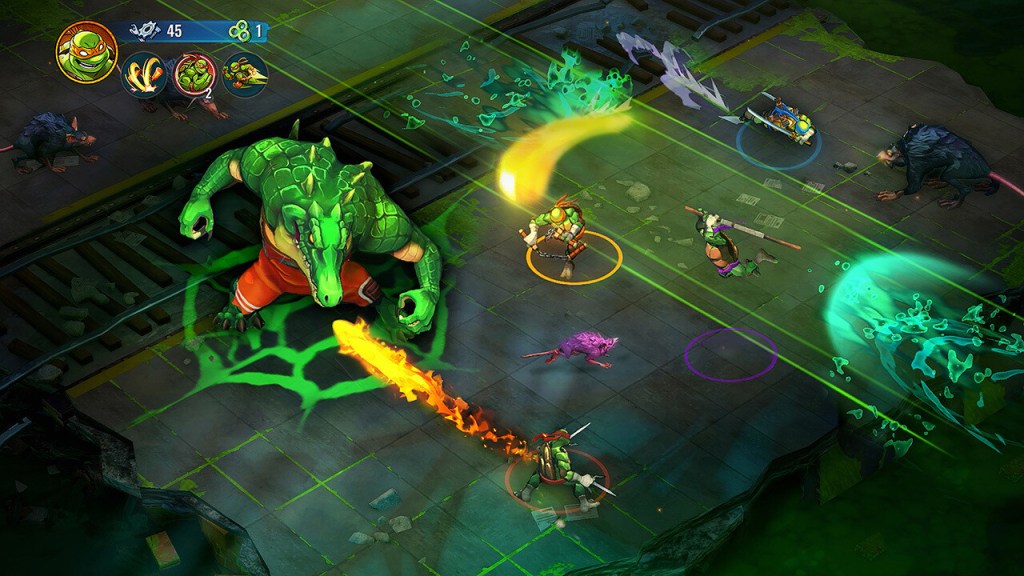
Splintered Fate follows the basic roguelite formula to a tee. Combat takes place from an isometric perspective much like Hades. Your goal in the game is to get through roughly 30 minutes of increasingly difficult combat encounters and several boss fights until you beat Shredder. If you lose, you go back to the beginning. You need to beat Shredder eight times to beat the game. You can upgrade your characters in a variety of ways in between each run as well.
More than anything, I would describe Splintered Fate as consistently competent. The game does all of the most important things pretty well, and that especially goes for the combat. You start each run by picking one of the four iconic ninja turtles to play as, and then it is off to the races. Once again, if you’ve played Hades, you kind of know what to expect. Each of the characters has a basic attack, a special attack, and then a tool. You also have the ability to dodge through attacks, but there are limits on that, so it can’t be abused. You recharge the special attacks and the tools through your basic attacks, so you can’t just spam those as well.
Pretty much every element of the combat works quite well. The basic attacks feel good to use thanks to responsive controls and solid sound design. Hitting sweeping sword attacks with Leonardo’s sword and then finishing foes off with a dash attack or poking at enemies with Donatello’s staff before hitting four enemies with his spinning attack never got old. There is almost no time wasting here, as you will constantly be mowing down dozens of robots and enemy ninjas. Those enemies and the bosses all have pretty good and diverse movesets that keep fighting the same enemies over and over engaging. While there are four main bosses that show up every run that each have their own quirks and interesting elements, there are also random minibosses that pop in each run to help keep things fresh.
With all those enemies, the action can get pretty chaotic, but there are clear enemy attack indicators that keep things fair, even when things get wild. You will spend a lot of time dashing through enemy projectiles and away from melee attacks. There are times when the action was so chaotic, that I felt a little annoyed that I couldn’t actually complete any combos or special attacks because I had to be so laser focused on dodging, but I think the chaos leads to excellent pacing that kept me enjoying the combat overall.
There were a few small quirks with the combat that did annoy me on occasion, though. First off, while there are a few special tools that can give you ranged attacks, overall, the game is almost entirely melee focused. While this isn’t necessarily a bad thing, the game’s enemies do have several attacks that cause elemental damage if you go onto a certain part of the map for a while. Whenever this stuff happened, I was pretty much forced to retreat and just wait a bit for an opportunity to present itself to enter the fray again. This is the one time when the pacing of the game’s action segments isn’t relentless and it was always a bit annoying, as I just didn’t have any real way to attack enemies when this happened. There are also a few small technical glitches that can pop up here and there. The biggest one is occasional slowdown when the screen really gets full of enemies, but that usually didn’t last for very long.
My main issue with the combat mostly comes from the turtles just not being differentiated enough. When it comes to roguelites, you are on the same map and facing the same bosses every single run. Because of this, it greatly enhances the game if you have characters or weapons that make the combat feel significantly different depending on what you pick each time. This is something Hades and the recent Astral Ascent were both great at. Splintered Fate falters mightily here. While there are differences between each of the turtles, they aren’t major. I played close to the same way no matter who I was using. Two of the four turtles even have an almost identical spinning special attack. While the core combat was good enough to stay engaging for the roughly 12 hours it took for me to get the “true ending”, I definitely preferred playing the game in short bursts because of that lack of playstyle diversity. The maps are also really bland, which contributes to that feeling of the game getting old if you try and play for longer stretches.
Despite this, I still had fun with the combat and enjoyed it quite a bit overall. But I actually think the game does an even better job with its roguelite elements. There is a surprising amount of depth here that makes every run feel rewarding.
If You Think About It, Pizza And Roguelites Have A Lot of Similarities

Each run in Splintered Fate allows you to acquire two different currencies that help upgrade your character in a variety of different ways. There are “dreamer coins,” which upgrade more elements of loot and luck, and then there are “dragon coins” that upgrade your more standard stats like health and attack power. There is a pretty robust amount of upgrade options, with quite a few unique ones that made me really think about how I wanted to spend my resources after each run. And there are enough options where I could generally upgrade something after each session, so no run I did ever felt wasted.
There are also a lot of great options presented after each combat encounter in the game, too. After each combat section, the game will offer you character upgrades that will help you out for just this run or for just a few rooms. They will also offer you those aforementioned dragon and dreamer coins. You can also get “scrap,” which can be used to buy health and other upgrades specifically for the run you are on.
I had a lot of fun picking my upgrades and creating a build for each run. There are quite a few options, so while I was disappointed with the turtles not being differentiated enough, I could make each run feel a bit different with some of the modifications I could make. The builds are standard fare, but still well done. Some runs I went hard on upgrading my basic attack so that it did more damage or caused damage to nearby foes as well. Sometimes, I really upgraded my special attack or my tool attack. I learned over time how the subtle differences between each character could be used to make better builds. For example, Raphael has an attack that is much more rapid than the other turtles, but the range was very short on it. Whenever I used him, I loved to pick upgrades that enhanced the basic attack since I could hit a lot of those fast. I also gravitated towards upgrades that enhanced the range of my attacks, so I had a little more space to work with. I was a big fan of Donatello’s tool and special attack, so I put all my resources towards upgrading those whenever I played as him as another example.
The game also has some fun decision-making in terms of prioritizing your current run or future runs. When I was earlier in the game in particular, I would often forego some of the upgrades I could get in favor or getting those dragon and dreamer coins so that I could make my character stronger for future runs to come. It’s all really well executed and kept me engaged throughout.
Unfortunately, after beating my first run, the game does not do as good of a job of making subsequent runs more fun as you head towards the finish line. You don’t need to make the game any harder after each run you win in order to beat it, so I ended up just winning something like six runs in a row to unlock the ending. While you can make the game harder in various ways, the only benefit to this is that it unlocks some other special upgrades, which I imagine would just make the game even easier in the end. Because of some of the aforementioned issues with the game being repetitive, I felt pretty content after roughly 10 hours anyway, so I was fine just sprinting to the finish line. But many roguelites do more interesting things with modifying the difficulty after you beat your first run, and I wish there was more here with that.
Baby’s First Roguelite
Splintered Fate also falters pretty badly with its story. I certainly wasn’t expecting anything interesting here, but the game’s story doesn’t even resolve in any sort of significant way. The whole story of the game feels like it is building up to a sequel of some sort. Kids who like the series might find references and things they enjoy here, but I ended up mostly skipping through dialogue as fast as I could.
The way the story almost purely builds to a sequel kind of reflects my thoughts on the game as a whole in some ways. I like a lot of elements of Splintered Fate. The combat isn’t perfect, but there are some really strong systems there that could be even better with a few tweaks. The roguelite elements are great overall, but a few things could be done better for after you beat your first run. The turtles are fun to play as, but they’d be way more fun to play as if they were more differentiated as well. The setting is fine, but it’d be way better if there were settings that stood out more in some way (à la Turtles in Time).
The core elements are all here to have a truly fantastic TMNT roguelite game. Instead, this game is merely good. There is nothing wrong with that at all. But hopefully, with the game’s story clearly building to a sequel, we get those tweaks next time around and end up with something truly special. Regardless, this is still a fun roguelite game and might actually be the ideal entry point into the genre for kids who like the TMNT universe. The game that got us into a genre tends to stick with us, and there’s no shame in being baby’s first roguelite.
Score: 7.5/10
 Big Nerd Gaming
Leave a comment