

One of the worst people that you can possibly come across is the guy who thinks he is funnier than he actually is. Every conversation suddenly becomes this persons attempt at a stand-up comedy routine. They love their own humor a little too much. And maybe this person can be funny on occasion, but eventually, you just want to move on and actually have a real ass conversation.
Playing The Plucky Squire can feel a lot like interacting with this kind of person. This is a game with a lot of charm. It’s brimming with some creative ideas, and it has fantastic art direction. The problem is that it knows that it has a lot of charm, and it really wants to show it off. The game stops constantly for cutscenes and dialogue that are cute but increasingly frustrating as you go along. Combine this with combat and puzzles that I found to be a bit overly basic, and The Plucky Squire comes across as one of the biggest examples of “all style, no substance” that I’ve seen in recent years.
OK, Here’s The Pitch. Zelda Combat But Make It Worse
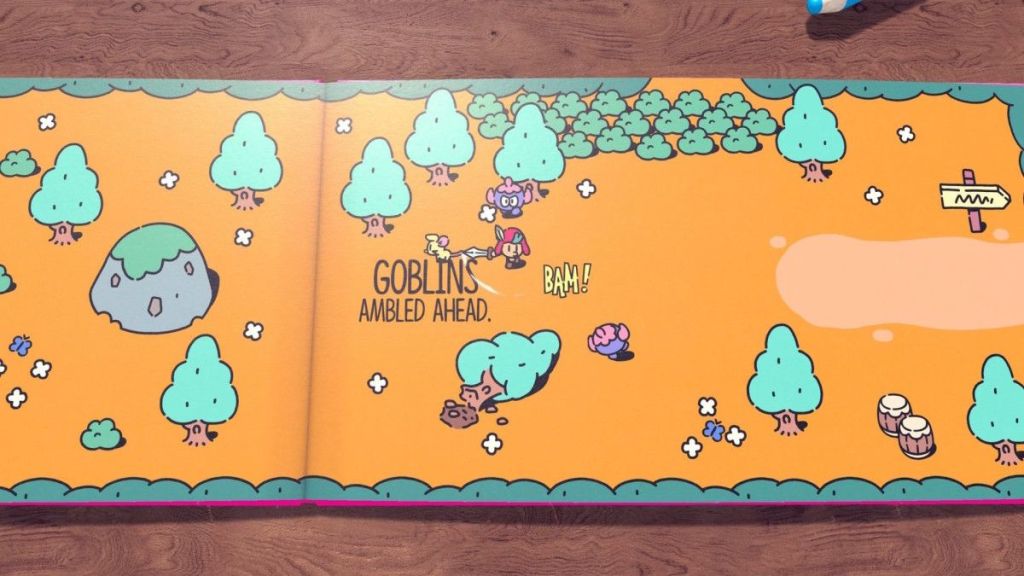
The Plucky Squire is essentially a light Zelda action adventure game with a meta twist. The main character, Jot, is the hero of a book. The villain of that book discovers the way to re-write the book to make it so he is all powerful and the new main character. Jot has to journey both through the book and outside of the book in order to return the story to what it originally was.
The vast majority of the game takes place inside of the book. In these sections, the game has vibrant storybook colors and some really fun and clever animations. The Plucky Squire is mostly linear, so there isn’t much exploration like a Zelda game has, but there is a pretty even mix of combat and puzzle solving like those games.
The Plucky Squire uses its production values quite well when it comes to combat. There are some excellent animations and pretty satisfying “thunks” with every strike of the sword. Unfortunately, that is about all that really works with the combat. There just are not many options here. For the most part, you are going to mash the attack button and occasionally roll. There is a sword throw attack, but even fully upgraded, I didn’t feel like it was that powerful and it takes your sword away from you, which isn’t great if you have other enemies nearby. There is also a spinning attack like Zelda, but it was a bit slow and left me a bit too vulnerable sometimes.
Sometimes, good sound design and visuals can carry combat even when it’s kind of basic if the enemy design is interesting enough (see: Crypt Custodian a few months ago). That also is not the case here. The enemy variety in The Plucky Squire is extremely lacking, and there are next to no interesting enemies that tested me or even made me think all that much about how I needed to come at them. From start to finish, I found the combat in this game to be extremely lacking and unremarkable.
Now I Know How My Toddler Feels When I Make Her Hold My Hand In Parking Lots
The Plucky Squire does a bit better with its puzzles, though there are still some holes there. The game leans hard into its book setting for its puzzles, and it does manage to create some interesting scenarios with that. Being that this is a book, many of the pages of the book have words on them, naturally. The game has many puzzles where you can switch words on the book in order to advance. For example, there might be a page with a gate that is shut in front of you. The words on the page will say, “The gate was shut.” By simply finding the word “open” elsewhere on the page, you can swap that with “shut,” and suddenly, the gate is open.
That may sound pretty basic, and honestly, a lot of these word puzzles in the game are. The game has a very limited number of words when it does these puzzles, so it’s usually pretty simple to figure out how to solve them. Luckily, The Plucky Squire throws in a few extra elements to its puzzles with its “stamps.” These allow you to alter what is going on inside of the book by leaving it. You can stamp certain items on a page to either make them blow up or freeze in time. You can also tilt the book in different directions to make certain items move, or go back a few pages to find words that are missing on your current page.
While a lot of puzzles in the game are somewhat straightforward, when you put all of these elements together, there are actually some pretty clever puzzles tucked into the game. Unfortunately, for roughly half of the game, there is often a piece of dialogue or narration that practically reveals the solution before you can even get to solving it. It’s a level of handholding that is incredibly frustrating because the game already has a pretty helpful hint system in place for if you get stuck. Thankfully, the game chills out on the blatant hints a bit once you get about halfway through it. Because of that, I did encounter some pretty clever and occasionally tricky puzzles as the game wore on. But the handholding really put a damper on a large chunk of the puzzles in the game.
At times, the game also takes you outside of the book for excursions in the child’s room where the book is located. These are kind of cool at first, and give you some of the wonder of being a small thing in a big world like a Pikmin or Tinykin. They tend to be a bit more combat heavy and are serviceable, but it is mostly far less interesting than the gameplay inside of the actual book.
The Plucky Squire also mixes things up with its minigames, which mostly end up being fun little distractions. One minigame has you playing a modern version of Punchout. There is also a rhythm counter attack game, some shmup-esque sections, and even a straight-up puzzle game. While none of these blew me away, they can at times provide some of the challenge missing from the main game and mostly succeed in what they want to do.
You’d Be More Charming If You Didn’t Know That You Are Charming
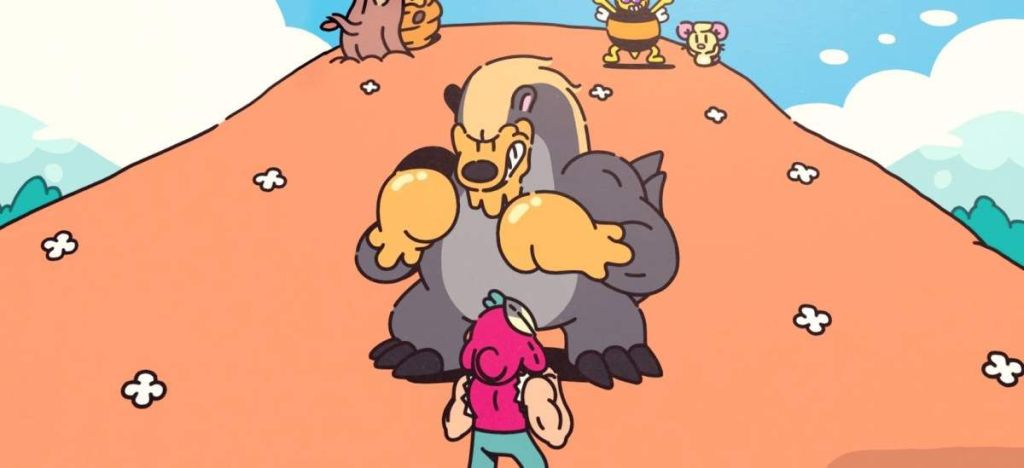
For as hit or miss and basic as the gameplay can be, I still think I could have enjoyed The Plucky Squire off its pure style and charm… that is, if the game wasn’t so patently aware of the charm and style that it has. When you are inside of the book in The Plucky Squire, you navigate by getting to the end of each page. When the page turns, you enter the next page in the book. It seemed like literally every page turn, the game would stop for at least some dialogue. Sometimes, it was only a few lines, but it is constant. Occasionally, a page turn leads to a mini cutscene as well. These are also done in a storybook kind of way that is incredibly impressive. But I rarely felt all that impressed when these cutscenes happened. They mostly just added on to how annoyed I was as I played. Playing The Plucky Squire means a lot of moments where you will sigh and say “Just let me play your fucking game.”
It’s really unfortunate too because the writing in The Plucky Squire isn’t bad at all. It’s clever and doesn’t take itself too seriously. Several lines in the game got little chuckles out of me (which isn’t always easy for me!). But the constant breaks for handholding or mundane events just made me sour on the stoppages to the point where I couldn’t enjoy any of them. Just like the overall handholding, this gets a teeny bit better as you move into the second half of the game, but much of the damage had already been done by that point.
Please Shut Up
There’s a reason a lot of people were very excited about The Plucky Squire. This is easily one of the most creative games I have played this year. It also has some of the best art direction of 2024. These elements combined for some absolutely mindblowing trailers that had me convinced that it was at the very least an indie game of the year contender.
Similarly, if I put together a 90 second clip of the best jokes from the guy who tells way too many damn jokes, you might think that person is a really hilarious guy.
Then, you actually meet them. And all you want to do is tell them to shut the fuck up.
There is good stuff within The Plucky Squire for sure. There was a lot of potential here for me to really like this game. But sometimes, the best way to be liked is to be someone who is willing to shut up once in a while.
Score: 6.0/10

 Big Nerd Gaming
Leave a comment