

It’s tough to walk away from a good thing.
I’ve been working at the same company for over 10 years now. I like my job. I think I’m good at it, and it generally takes pretty good care of me.
But there have been many times that I wondered what it would be like to do something else. Perhaps there would be even more opportunities at a different company. Maybe I could thrive and be happier in a completely new occupation altogether.
But I’ve always stayed. Because as much as I think about how it could go right, I think even more about how it could go wrong. I don’t want to look back and think that I made a terrible mistake. To me, the risk isn’t worth the potential reward since things are still relatively good for me.
So I have a lot of respect for Studio Zero as I look at how Metaphor: ReFantazio came to be. This is the team that is famous for making all of the most beloved Persona games. They have a giant built-in fanbase, and they know exactly how to make a great game with all of those kinds of systems. With Persona 5 in particular, I thought they reached the pinnacle of their formula. The easiest thing to do would have been to buckle down and make the next Persona game.
Instead, they walked away from a good thing.
For one reason or another, the developers at Studio Zero decided it wasn’t enough to just make the next Persona game. The guaranteed sales and likely slightly easier development cycle weren’t what they wanted. They wanted to go in a different direction. They wanted to be bold and fresh.
Thus, Metaphor: ReFantazio came to be. While Studio Zero kept many structures in place from the Persona games, this is a bold innovation on that established formula. Not only does Metaphor leave the school setting, but it also has many other fresh changes to the formula and to the tone that makes this a game that easily surpasses any Persona game for me. Metaphor is not only being discussed as one of the best games this year, but as one of the best of all time. Between the sales figures and reception, it seems like changing direction was the right call.
Metaphor: ReFantazio deserves to be praised not only for being a great game but for the bravery that allowed it to come to be in the first place.
An Election To Crown A New King. And Yet, No Electoral College?
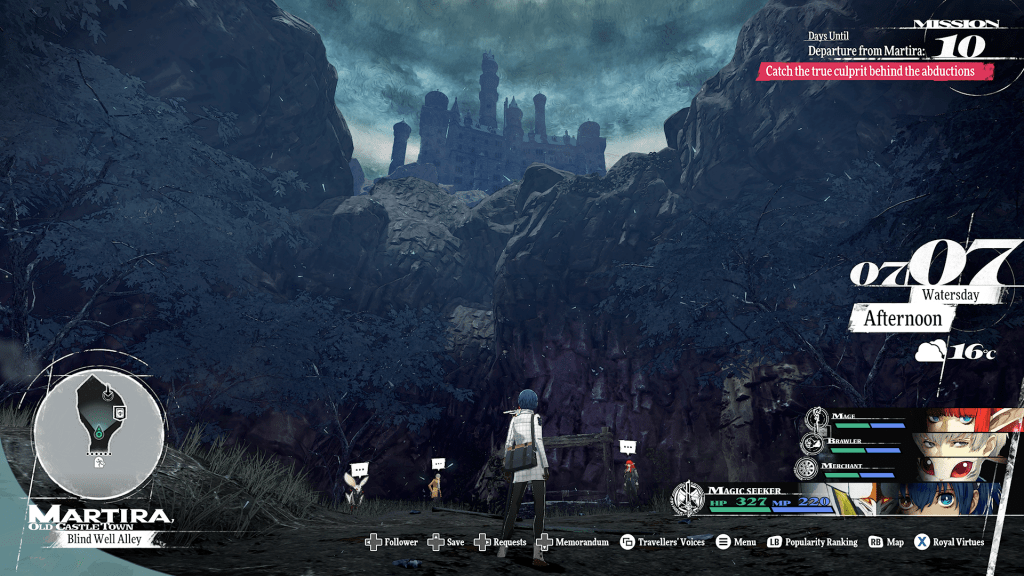
Metaphor kicks off dramatically, with a cutscene showing the main villain in the game murdering the current king. Long story short, this ends up kicking off a tournament to “elect” a new king. The person with the most public support will end up winning the crown. The main character is one of the people attempting to win this competition for his own unselfish reasons. Thus, you are off to complete challenges and beat up evil opponents in order to reach your goal.
Persona veterans will recognize the familiar formula implemented in a slightly different way with Metaphor. At each point in the story, there will be a challenge you must complete or a foe you must take down. The game functions on a calendar system, and you must complete each task before a certain day hits. You have the freedom to tackle dungeons or hang out with a friend on almost any given day. Doing either of these things makes you stronger in various ways.
The dungeon diving is simple enough, but it is made interesting by a lot of cool systems built around it. Combat is the first highlight. Metaphor has a turn-based system built on exploiting enemy weaknesses. You get a “turn” for each ally you have on the field. You use up one of those turns for each attack you do. However, there are a lot of ways this can change. Almost all of the enemies in the game have a weakness of some sort. This can be an elemental magic weakness or to a specific kind of physical attack. Whenever you hit an enemy with their weakness, you only use a “half-turn.” This means building well-balanced teams (more on this later) is super important. Having a team that can exploit any weakness is vital to winning fights.
There are also some other fun twists in the equation. If you miss an attack, you end up losing an extra turn. Because of this, if an enemy builds up their evasiveness, it is urgent to address that. Otherwise, you will constantly be losing extra turns each time you miss. This works both ways. So covering up your own weaknesses or building up your own evasion can be extremely valuable in combat. Attacks that hit all enemies can be really important but also dangerous, as there are more chances to miss attacks, which will cost turns. There is a constant tug and pull of risk/reward with Metaphor that leads to a lot of interesting strategic decisions, and some fun (and occasionally frustrating) luck elements that can drastically alter how a fight is going.
If an enemy is giving you issues, it is super easy to completely change up your party thanks to a very robust class system. There are 14 different classes in Metaphor (and multiple evolutions for each of those classes). Each class offers different stats and different skills that you can unlock. As you go through the game, you can also “inherit” more skills from other classes into the class of your choice. So, as you get further into the game, you can really fine-tune each class to make them significantly more versatile.
Despite having so many options, I never felt overwhelmed with this class system. A few times in my journey, I came across a foe that I clearly was not well-equipped for. Within minutes, I had a whole new party ready to fight. I don’t love spending tons of time in menus in games like this, and I was so impressed that Metaphor was able to have a lot of depth while still being extremely accessible. I did hate that certain bosses almost demanded very specific classes and strategies to beat, but that was a rare issue, and it was made a little easier by how well done the entire class system is.
When you aren’t in turn-based combat, Metaphor also has light action combat elements, too. You can see every enemy before you engage in turn based combat with them. You can start a turn-based battle whenever you want, but it generally behooves you to attack them with the action combat first. If you do enough damage, you can stun the enemy and then start the turn-based combat with 1-2 full turns to attack before they can respond. If the enemy is several levels lower than you, participating in action combat can even fully defeat foes where you don’t have to go into turn based combat at all. It really helps the dungeon flow greatly when you don’t have to stop and do a turn based battle for every single enemy you face (especially since I thought a lot of the turn-based fights were a bit too long, particularly in the late game). Quickly dispatching an enemy in the overworld and seeing your experience and money go up is always a great feeling after multiple tough turn based battles.
I do wish that the action combat felt better, though. You only have a basic attack and a dodge. Neither feel terribly responsive. The attack that you have switches depending on which class the main character is using, and some of those attacks feel really awkward and not fun to use. This can be especially frustrating with tougher enemies, where it is vital that you stun them before getting into combat or else you are going to have to take a lot of damage and use a fair amount of MP to recover and get back into the fight. The action combat is still a plus that enhances the game greatly in several ways, but it also could have been a whole lot better.
Winning the action combat is vital as well because MP management is one of the biggest core elements of Metaphor, much like the Persona games. Due to the importance of the weakness system, Metaphor isn’t like an old school JRPG where you can get through battles by spamming the attack button. You really have to use your skills and magic to even get through a lot of standard battles. Metaphor’s main dungeons are also massive and will probably take multiple in-game days to get through. In addition, Metaphor is extremely stingy with MP healing items. Because of all of this and the time deadlines in the game, if you want to do everything, it’s important to get through dungeons as quickly as possible. In order to do this, you need to save your MP whenever you can. Once you run out, you pretty much have to leave the dungeon for the day. This once again leads to a lot of interesting risk/reward systems in every battle. I was constantly debating whether an enemy had low enough health where I could win with lower MP spells or with basic attacks on any given turn. Getting by even one turn without using MP felt like a big accomplishment and allowed me to get that much further in a dungeon without having to end my exploration for the day. I did think that the game was a bit too punishing when it came to withholding MP recovery items though. I thought it was odd that the game didn’t at least let me buy MP recovery items whenever I wanted. They could have done that and just made them really expensive so that the core MP preservation mechanics were still there. I just thought this mechanic was a bit too taxing at times. I did play on hard, which is probably part of it, but I’ve heard similar complaints from those who played on normal.
My other issue with the dungeons is just how generic they feel. I understand that making dungeons as unique as those in Persona 5 was going to be a tough ask in this more traditional fantasy setting, but for as much time as you spend in dungeons in this game, I was surprised at how few did anything all that interesting from a design perspective. These are all about the most basic fantasy dungeons that you can imagine. Combine that with being long and leaning into maze elements a bit too much, and I found myself really wishing that they did SOMETHING to spice things up a little bit. This may be an unfair criticism based on Studio Zero’s track record, but I think they could have at least done a little better here.
Do You Ever Think About What Level Your Friendship Is With People You Know? No? OK, Nevermind.
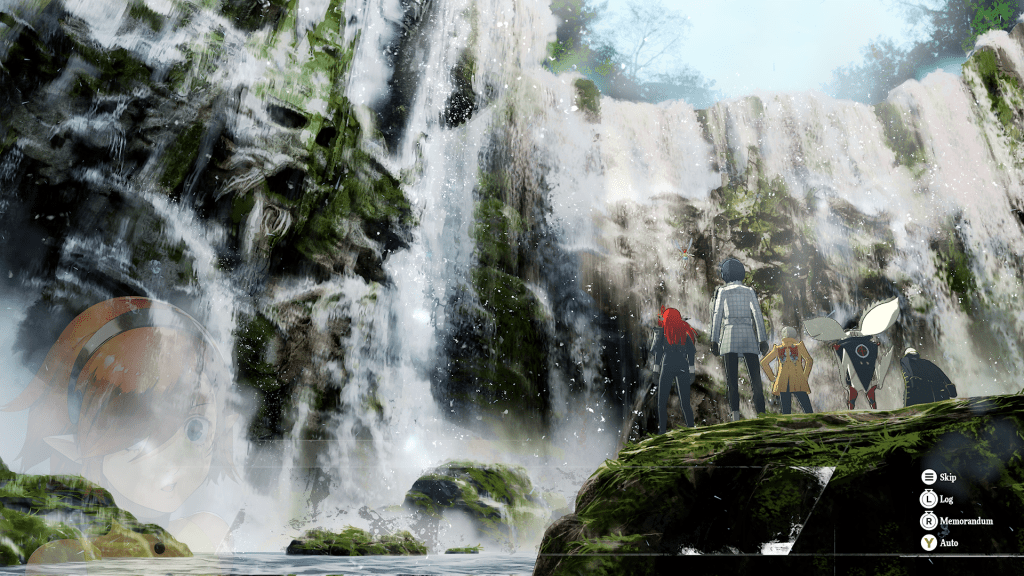
When you aren’t fighting monsters, you’ll be spending time hanging out with friends. No one wants to live their life entirely for work, after all! Much like the Persona games, each time you hang out with certain people (these are called “social links”), your rank with them will grow. Doing this will enhance the different classes in the game and give you other interesting perks.
There is also a little story arc attached to each character that will continue as you keep ranking up with them. Some of these bring about the most impactful moments in the entire game. One involves helping a party member decide where to bury his son’s ashes. Another involves rebuilding a party member’s destroyed hometown. These get very heavy and are rewarding both from a story perspective and from a gameplay perspective. I loved how random but useful so many of the perks could be from leveling up each of my social links in the game. The ability to always have the option to flee from battle may not sound like an amazing perk, but since I was playing the game on hard, it was actually a very vital skill for me. There are others that make you more resistant to certain status effects or that help recover MP. I was always excited to do a social link because of both these perks and for the stories. Not every single social link story arc is a total banger, but I found them all to be at least pretty good.
The value of the social links is what makes being efficient with dungeon diving so important. If you take too many days to do each dungeon, you probably won’t have enough time to max out every social link. Playing on hard forced me to work on my dungeon diving a little more than I probably would have normally, so I missed out on maxing out a few of my social links. Overall, though, I think the game does a good job of making maxing all of these out very attainable without a guide. That is not something that can be said of every Persona game in the past, and it is very nice to see.
Metaphor Is An Escape From Reality… But Also… Kinda Real. Maybe Too Real?

While there are some great stories in those social links, they all pale in comparison to the main story in Metaphor. Simply, it is a masterpiece and easily my favorite story of the year. The game has some big moments early on that drew me in fast, and it never lets go of that momentum.
The story succeeds for several reasons. First off, Metaphor ends up being an excellent allegory for our own modern world. I was shocked by how clearly the game addresses many of our own real-world issues with discrimination and mental health. It manages to tackle these things in a nuanced way that attacks them from multiple angles as well. The best fiction makes you think our own world, and Metaphor easily accomplishes that. Metaphor also makes you think about the role of fiction in our lives, something that should be near and dear to any gamers’ heart, and it also discusses that in some very smart ways.
It’s not just the themes, though. I was constantly blown away by how well-written every aspect of this game was as well. The localization is one of the best I’ve seen. There is a constant barrage of smart but realistic feeling dialogue from all of the characters in the game. And the narration elements have a flowery language that always had me captivated. I see a lot of gamers shitting on localization constantly these days, but this game is a perfect example of how important localization is. They absolutely hit it out of the park here.
Another big strength is that the game never loses sight of its main objective and always ties it to everything you do. I’ve played many big RPGs in recent years that don’t necessarily have a great overall story, but have a lot of fun “episodes” that only seem loosely tied to the greater goal. That is not the case here. The big picture is always in sight with Metaphor. A big part of this is that the main villain is very present from start to finish. The game opens with the main bad guy Louis killing the king, and you never go too long without seeing him again. He is not only the most compelling villain of the year, but I’d argue one of the best of all time. His evil charisma and consistent ideals had me intrigued but also pumped to take him out.
The entire cast of characters can be just as captivating as Louis as well. The main character gets seven other companions during his journey, and they are all great for different reasons (though I’d argue the early ones are easily the best). These characters have their own arcs that tie into the main story and to the protagonist. They are all extremely well written and have strong voice acting. Unfortunately, I can’t say the same for the main character. He doesn’t have much of a personality, and he clearly has the weakest voice acting of anyone in the cast. This is a step up from past Persona games where the main character was silent, but it was still kind of disappointing. I felt a real attachment to many of the characters in this game, but if I felt a similar connection to the main character, I think my drive to see him triumph would have been much greater.
Despite that complaint, I still loved everything to do with the story. My biggest hope for this game is that it would capture much of the Persona feel, but feel a lot more “epic” thanks to the fantasy setting and atmosphere of war. I think the game more than succeeds here. I will remember one moment in particular for a very long time to come, but there are a pretty consistent stream of big or emotional moments that kept me coming back for more.
The story is also aided greatly by the music. Metaphor has one of the best soundtracks this year, with soaring sounds that capture both the hope and despair present throughout the game. The soundtrack is much more traditional than something like the Persona series, but it has enough unique elements where it still stands out as something entirely its own, and it is a massive achievement.
I personally was not quite as big of a fan of the art direction, however. There is a really cool storybook aesthetic throughout, and I enjoyed a lot of the character designs, but the color palette feels so overly drab throughout outside of brief exceptions. There weren’t many areas that stood out as much as I’d like, and the muted design is at least one part of my overall issue with the generic feeling dungeons. It’s not bad at all, but not something I would consider for awards at years end the same way I would have with Persona 5’s art direction back in 2016.
We Are Never Going Back! (Until Persona 6 Drops, Then We Are Definitely Going Back)

There is little else about Metaphor where I would say that Persona 5 fares better, though. Metaphor: ReFantazio is a tour de force that boldly takes the Persona formula and graduates it. It captures that perfect mix of feeling like something familiar and yet completely fresh at the same time.
And despite how much I loved it, I feel oddly encouraged by how many small nitpicks that accumulated for me as I neared the end of my nearly 95-hour journey. It’s natural that a new venture will have the occasional misstep. None of the mistakes that happened with Metaphor are fatal. All of them can very easily be fixed.
That means that the next Metaphor game will likely be even better. And the one after that will likely be even better than that. This seems like a series primed to become one of the most popular and highest acclaimed in all of JRPGs.
Until one day they decide to walk away all over again.
Score: 9.5/10
 Big Nerd Gaming
Leave a comment