
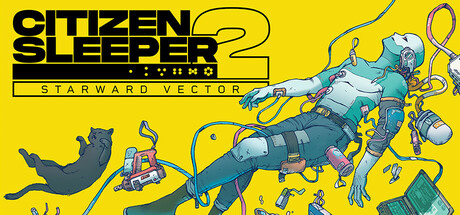
A review code for this game was provided by Fellow Traveler
I’ve always loved dice mechanics in video games, as I’m not sure if there’s a mechanic that better replicates how real life can be. No matter what you do on any given day, elements of luck follow. Everything is a bit of a dice roll if you will. We control much of our lives, but there’s always that outside chance that everything can go to shit at any given moment, through no fault of our own.
You play Citizen Sleeper 2 as someone who might have the worst luck of anyone out there. You are a sleeper. This means that you have a robotic body with a human mind. That mind was taken from someone else (who likely owes a lot of money to a certain corporation) and put into that robot to do extremely hard work that humans couldn’t easily do. All past memories are wiped from that previous person. Yeah, not the best luck to wake up that way (whether this is the same person or not without those old memories is an interesting debate).
Citizen Sleeper 2 is a story about one of those Sleepers trying to break free from a life of permanent servitude. The only way out is a whole lot of good dice rolls from you, the player. As with so many things in life, it feels really good when the dice are rolling your way. And it gets pretty frustrating when the dice are not rolling your way. Luckily, Citizen Sleeper 2 mostly rolled a lot of 5’s and 6’s with me, with only a few 1’s and 2’s along the way. If a narrative sci-fi game with lots of reading is something you are up to, Citizen Sleeper 2 is sure to reward you for your efforts.
This Is A Lot Like Las Vegas, Rolling Dice For Hours In A Dystopian Setting

You play this game as a Sleeper who recently escaped captivity from a very evil man. That man is trying to hunt you down, so you need to stay on the move in order to get away from him. In order to stay on the move with your ship, you’ll need a steady stream of cash, fuel, and supplies. This setup basically allows Citizen Sleeper 2 to logically become an “open world” game of sorts. This is a big change from the first game, where you were on one location for the entire game. Citizen Sleeper 2 has 10 locations that you can travel to at will once your ship is upgraded enough and if you have the supplies. This added scope plays in nicely with the sci-fi space setting and made the world feel much more alive to me.
Each day, you wake up with 5 dice rolled to various numbers 1-6, much like the first game. You can use these dice to roll for success at various tasks around town to get all of those things you need. Once you run out of rolls, you can go to sleep and wake up the next day with 5 dice again. Higher rolls will gain you more money or supplies. Bad rolls can cost you energy. If you lose all of your energy and don’t refill it, you start to gain stress. Stress is the number one enemy in Citizen Sleeper 2. If you let stress accumulate, it can start to damage your dice. If your dice take too much damage, they become broken, and it is costly to repair them. Waking up with 4 or 3 dice instead of 5 makes life significantly harder in this game, so this is a major factor in everything you do. This is especially vital once you encounter objectives that need to be accomplished within a set amount of time. Every die can matter when you are coming up on a deadline.
Luckily, stress is very easy to manage when on one of the various stations in the game. It can be lowered very quickly. Stress gets much trickier when you set out on the new missions that the game has. Citizen Sleeper 2 has dozens of “contracts” that take you outside of the stations in the game to complete tasks, generally on a pretty strict time limit. These end up being the most intense parts of the game, both narratively and gameplay wise.
You go into each mission with two crew members (who have their own dice to use). You are then given objectives to accomplish. You need to choose which dice that you or your crew members have to roll on each objective. When you have successful rolls, you gain progress towards the objective. When a roll is neutral, it can be a little good and a little bad. Negative rolls can hurt you in a myriad of ways. Sometimes, the best course of action is to not roll some remaining dice and hope for better dice to use on the next day.
If your crew has bad rolls and accumulates stress, they can quickly be knocked out of the mission. If you as the player have bad rolls, your stress builds up, which can make you lose your dice if they lose enough health. If you can build up enough stress related to the mission objective, the whole mission can fail. Unlike many games, if the mission fails here, the game goes on, and you just have to live with the consequences, however major or minor they may be.
There is a whole lot to juggle with each of these missions. There is serious intensity with every roll of the dice. This can be a lot of fun, but also a bit frustrating, as anything built entirely around luck can be.
I loved how much there was to manage, and I loved all the tough decisions I would have to make each and every mission. My mindset is usually all about risk mitigation. I want to take the least amount of risks possible when raw luck is the biggest factor. But in each mission, you run into points where it’s risky not to take a chance. I’d inevitably have to try and roll dice that were less likely to be successful once it was clear that I might run out of time on the mission if I didn’t.
I did have minor qualms with the missions, as much as I enjoyed them for the most part. First off, you might have picked up that there are a whole lot of mechanics here. I haven’t even talked about the glitch or push system yet. The game does have tutorial screens, but I didn’t feel like the game did a tremendous job of really introducing you to each mechanic in the game. As you continue to play, you will definitely figure everything out, but Citizen Sleeper 2 is also a game all about living with your choices. There is no manual save option, as the game just autosaves constantly instead. This means that making mistakes can lead to a more difficult playthrough even in the early going when you are just trying to figure things out.
I did not fully understand how devastating stress could be when I was doing an early mission in the game. I was utilzing the “push” mechanic, which enhances certain dice at the cost of more stress. Long story short, this led to me failing the mission and losing three of my dice. At this point in the game, I had next to no money or resources, so it was almost impossible for me to build my way up. I also had acquired a “permanent glitch,” which was going to cause annoyances for the rest of my run, so I just restarted the game entirely. My second run had absolutely no issues, as I fully knew what I was doing, but I think as players try and experiment with these new mechanics, it could be really easy to make a mistake that they will regret in the early going.
The missions can also be a bit frustrating from a planning perspective. As I said previously, I try and avoid taking major risks until I know I have to. Many of Citizen Sleeper 2’s missions don’t allow you to fully calibrate for that risk. As you complete objectives, new ones will pop up, and it isn’t always clear how many more objectives will happen before you get to the end of the mission. This makes planning things difficult and crippled my ability to plot things out strategically in certain missions.
I will say that while the unpredictability of the missions can be frustrating from a gameplay perspective, it can be a whole lot of fun from a plot perspective.
It seems like every mission in the game has at least one twist or turn that keeps things interesting. While I was at times wishing that I could plan out the risks that I was taking more thoroughly, I certainly enjoyed how often the plot in each mission kept me on my toes.
You Can’t Call This Game Woke, Because It’s About Sleepers
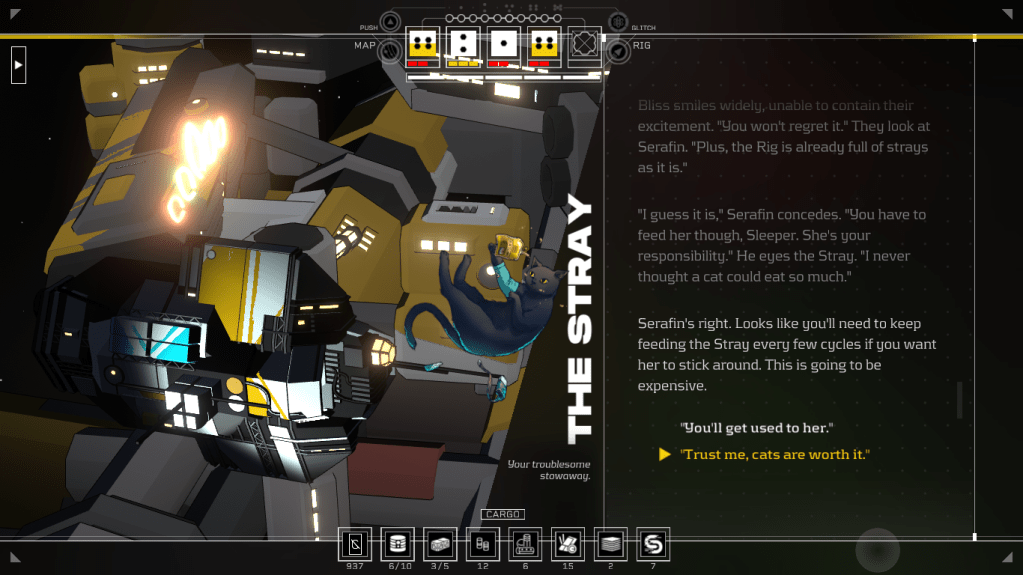
It’s not shocking that the strength of the missions ends up being the plot over the gameplay. As you may have picked up from the screenshots in this review, Citizen Sleeper 2 is a full-on visual novel. Everything from the dialogue to descriptions of characters’ body language to descriptions about the stations you are walking around are all done with the quality I’d expect from any well written science fiction book. There is no voice acting here, but the visuals of the ships, the stations, the portraits of the characters, and the moody music all lead to what I would say is an increased level of immersion over picking up a standard book.
The strength of the writing for me easily comes down to the fact that Citizen Sleeper 2 is able to use its science fiction setting to tackle so many interesting questions that can also be drawn back to our present day. This game tackles the nature of existence, existentialism, capitalism, identity, and plenty of other themes that I think will resonate with anyone thinking deeply about where our society is headed today. As I hinted earlier, I think interesting conversations could be had for hours just about the existence of the sleepers themselves and what their identities are. The game teases some of these conversations, but never really full-on goes there.
I actually think this is one of my favorite elements of the writing in this game. Citizen Sleeper 2 has a lot of respect for the player’s intelligence. I never felt like there was any dialogue in the game where the writer presented an issue and then immediately told me what the correct answer was. I often felt like there was no correct answer. Interesting scenarios are presented, and it seemed like it was generally up to the player to decide how to interpret those events. You wouldn’t think a game where the world is mostly controlled by pretty evil corporations would feel this way, I would generally expect some slightly hamfisted writing when certain themes come up, but it somehow stays incredibly disciplined from start to finish in this regard.
As strong as the writing is, if I were to pinpoint any weakness with it, I did find it disappointing that I didn’t really resonate with any of the characters I met. Since you have a ship in the game, your goal is also to accumulate crew. Having more crew gives you a lot more options when you set out on each of the missions. I certainly liked most of the characters I met and found all of them at least moderately interesting. But I think you are presented with way too many crew options for a 10-hour game. I believe I had something like 6 choices of crew members once I reached the end of the game, and that doesn’t even include a crew member that I lost, and some crew members that were temporary additions at different points during the game. I think I would have connected with the crew members more if they focused on a few characters over giving me as many options as they did. I just don’t think there was enough time to make as many crew members as there are work here.
I think having all of that crew to recruit also holds back the main plot a bit in spots. I am not venturing into spoiler territory here, but much of the early plot in the game really just comes down to surviving and recruiting new crew members. There’s a lot of interesting smaller plot arcs here, but the main plot feels slightly at a stand still for a while. It’s certainly not bad, but I wasn’t as engaged with the main story as I wanted to be. Once I got to around the midway point of the game, things heat up big time, and I was absolutely hooked until I made it to the finish line. Citizen Sleeper 2 absolutely cooks once the plot gets going, but it does take a little bit to get there.
Much like the first game, Citizen Sleeper 2 also has heavy elements of choice scattered throughout. Your choices will dictate which crew members you have with you and which paths the story takes. I felt there were a few too many choices in the game that are presented as important but don’t end up mattering all that much. Despite this, I still found the elements of choice to be an overall positive addition to the game. There are plenty of options that really had me thinking before I made a call on what to do.
If You’ve Read This Far, I Guess You Can Stop Reading Now. But It’d Be Kinda Nice If You Kept Going

If you’ve made it to this point in the review, I have good news for you. Apparently, you don’t hate reading. In fact, as luck would have it, you might even like to read! If you also happen to like science fiction and don’t mind dealing with a bit of good and bad luck, Citizen Sleeper 2 is a pretty easy recommendation. This is a visual novel that manages to set itself apart from the pack with interesting gameplay mechanics, and especially sharp and powerful writing.
Not everything hits. At times, building out the scope of the game can hurt the pacing when compared to the more focused original game. A few of the new gameplay mechanics do more harm than good at times. But once again, if you have the patience to read an independent game blogger’s thoughts on this game in full, this is probably a game that you will get a good enjoyment out of. Much like the first game, even if I don’t love absolutely everything about it, this is something I will be thinking about for a long time to come. This was a tremendous start to gaming in 2025.
Score: 8.5/10

 Big Nerd Gaming
Leave a comment