

If you have ever played a Yakuza or Like a Dragon game, you know that in that series, sometimes the minigames are actually the game. I don’t think it’s an exaggeration to say that I often spend 1/3rd of my time in those games just playing minigames. Each game also has one “minigame” that feels like its own standalone release. In Infinite Wealth last year, I easily spent something like 8 hours on Dondoko Island. I wouldn’t have minded paying $10-$15 for that as its own game. However, to this point, Ryu Ga Gotuku Studios has resisted releasing any of these minigames as a standalone release.
So, if they won’t do it, I guess it was up to someone else to take on that mantle. Enter Promise Mascot Agency. This game feels like it was built in a lab to be a Like A Dragon minigame. It has a story with Yakuza politics attached to it. It has plot twists. It can be serious but also goofy as all hell. It even has the same voice actor that voices the Japanese version of Kiryu in the Yakuza games. Everything about this feels like it was crafted by people who love that series but wanted to do their own spin on it.
Luckily, they pulled it off. Yes, Promise Mascot Agency feels like a Like A Dragon minigame. And I don’t think it’s quite good enough to fully escape that shadow. But it is good enough to be well worth purchasing if you are someone who enjoys the vibes and minigames of that series. And as much as it is clearly inspired by the Like A Dragon series, playing it made me hope that RGG gets inspired in kind by Kaizen Game Works to take their next big minigame to another level in the next Like A Dragon game.
Pokemon Meets Yakuza Meets Card Battler Meets What The Fuck??

You play Promise Mascot Agency as Michi. Michi is a prominent member of a Yakuza family, and he is tasked with delivering a large sum of money to another family in an attempt to form an alliance of sorts. Michi is ambushed before he can deliver the money, and it is all stolen. This could mean the end of his Yakuza family. In order to protect the family, they are forced to fake his death. Additionally, they desperately need to earn more money in order to prevent other families from coming after them. After faking Michi’s death, they send him to an old declining town so that he can run the family’s defunct mascot business. This means that he needs to recruit “mascots” (who in this game, appear to be people born that literally look like an advertising or sports mascot), and find events to send them to in order to make money for this agency. Yeah, it’s a weird game. But the concept is so bizarre that you can’t help but be intrigued by it immediately when you jump in.
Running the mascot agency is pretty simple. It doesn’t take tons of strategic genius, just patience and hard work. As Michi, there are two basic things you can do to make money and enhance your business. You can send mascots on jobs or drive around a small open world to advance the story. You can also do other various things that will make you money and enhance your business.
While Promise Mascot Agency is a lot of things, I’d probably say that it is more about exploring its densely packed open world above all else. This map is absolutely loaded with things to do. There are tons of little dots on the map showing you where certain items and upgrades are, and then even more little tasks that aren’t shown on the map. That might seem like the kind of open world design that could invite every Ubisoft complaint in the book, but it just works here. I think the biggest thing is that none of these activities actually require you to do much of anything. In games like the new Assassin’s Creed open world games, each icon on the map probably involves anywhere from a little bit to a lot of work. That is not the case here. Pretty much all of the icons in the game either start a conversation or just require you to pick up an item. As you drive, you can run over political signs or trash in an effort to clean up the town and earn money. You can also pick up items that help you finish side quests or enhance your “hero battler cards” (more on that later). It’s all so easy that even that I never felt overwhelmed when I saw the hundred or more icons on my map.
One of the many things you can find on the map are upgrades that enhance driving your car as you explore the world. You never leave your car in Promise Mascot Agency, so this is important. You can eventually unlock upgrades to go faster, go into the water, and even glide through the air. While I love getting upgrades like this, my one issue with this was that I didn’t find the “glide” upgrade until the last few hours of the game. While you can’t use it all of the time, it is a blast to use when you do happen to end up at high elevation. I thought it was a mistake to hide something that enjoyable for such a large portion of the game (I could have maybe lucked into finding it earlier, but in general I think it should have been placed in a more obvious area).
Despite that, I mostly enjoyed the way the car controlled and driving it around while picking up every item and quest item that I could find. My only other issue is that while I had the ability to run over all of the trash and political signs in the game, a simple light pole would stop me in my tracks, as well as various barriers. I understand that this is an indie game, and fully destructible environments aren’t easy to do, but given how over the top the game is, it was pretty goofy to be speeding through the countryside, deploying boosters and gliders, and running over political signs on the road only to be stymied by a light pole.
Regardless, I enjoyed driving around the town of Kaso-Michi because all of the stuff you can do or find helps your business in various ways. Driving through the open world and cleaning up trash or picking up a new item all just feels constantly rewarding. You get that “numbers go up” dopamine hit a few times a minute whenever you are driving through the open world. There isn’t much actual challenge to it, but that’s OK. It’s pleasant, weird, rewarding, and fun. That is the perfect combination for a game like this.
You then use all of the resources and recruits that you find in the open world to actually manage your mascot agency. This is all mostly done from a menu, and it’s pretty simple. As you explore the world, you also unlock more potential jobs to send your mascots on. Whenever you have mascots available, you can open the menu, select a job, and then pick a mascot to go on it. Ideally, you want to pick out a mascot that has compatible traits with a job in order to maximize your earnings, but that’s about all of the thought that goes into it. After you send a mascot on a job, you have to wait for in-game time to pass for the job to finish and to get your money. There are a few considerations with the mascots in terms of negotiating their contract, time off, bonuses, and managing their fatigue, but I found almost all of these mechanics pretty half-baked. You really don’t have to think too much about the mascot business in order to run it effectively, and I think that is actually for the best for the most part.
When you send mascots on jobs, there is also always a chance that something will go wrong. The things that can go wrong are often as weird and hilarious as you might expect from a game like this. One of the first issues that I ran into on a job was that my mascot was too big to get through a door and got stuck as an example. In order to get the most money possible from a job, you need to help the mascot on with something called “hero battler cards.” Basically, you need to win a very simplistic card battle game in order to clear whatever issue the mascot is having.
Much like pretty much everything else in the game, you don’t need to put almost any effort into winning these. If you’ve been exploring the open world and upgrading your cards, they are mostly winnable without thinking or trying. You only have to play cards that reach a certain value within 60 seconds. Outside of deciding whether to redraw your opening hand, there is almost no thought that goes into it. Unlike everything else in the game, that actually did start to get a little bit annoying as time went on. I think the beauty of most of Promise Mascot Agency’s gameplay is that it is simple but also efficient. You are constantly doing easy things and progressing, and nothing ties you down for too long. The card system forces you to sit through a 15-20 second cutscene and then go through a mindless 30-60 seconds of card battling every single time there is an issue. And the weird scenarios the mascots get into are funny at first, but get increasingly dull as you keep seeing repeats and similar bits used over and over. I actually think the game would have been better without this at all, but it wasn’t present enough to significantly detract from my experience.
When you aren’t worried about bailing your mascots out of a jam, I really enjoyed the general flow between managing your mascots and dealing with open world activities. After sending your mascots out on jobs, you have to wait for them to finish in order to send them on more jobs, so the only thing you have to do at that point is explore the open world. Exploring that open world unlocks new mascots and gets you other resources that can help you do things like upgrade your business operations. It all works together in a really cohesive way that keeps the rewarding feelings coming.
The feeling of making money is especially rewarding because Promise Mascot Agency is surprisingly tricky with its budgeting early on. You have two things working against your money each day in the game. First off, you have nightly bills that keep going up as you play. Second, you have to periodically send money to your family so that you don’t get a game over. There is a meter that shows how close your family is to getting killed if you don’t send money, and in my first several hours with the game, that meter was often dangerously low. In my first 4-5 hours of this 11 hour experience, I was broke almost all of the time. I really had to think hard about budgeting and what upgrades I was going to purchase. I wanted to expand my business and invest in it, but I also needed enough money to keep the lights on and to keep heads from getting chopped off.
I actually really loved how hard I was sweating about managing my money in the first half of the game. That tricky balancing is what makes everything so rewarding. Every dollar I earned through various means felt vital for my survival. I don’t think I was ever in serious danger of a game over, but I was sweating just enough where any breakthrough felt like a very big deal.
As the game goes on, it slowly starts to unveil more revenue sources. You unlock the ability to sell merch, which is tied to a decent enough crane minigame (have I mentioned that this game is pretty weird?). You also unlock the ability to hire subcontractors, who earn a lot of money for you each day after you pay a pretty large upfront sum to hire them. That mechanic, in particular, seemed to kind of break the game for me. As I started to hire subcontractors, I got a lot more comfortable and had a fair bit more money to play with. By the last two or so hours of the game, sending my mascots on jobs almost felt pointless, as I was making more money than I possibly needed with the subcontractors alone. I upgraded everything in the game that I could and still had millions and millions of yen left over. This might have been a good thing because managing the mascot agency slowly gets more annoying once you have a dozen mascots to send out on jobs. Once you have a big roster of mascots, there is just a lot of menu management that I didn’t find terribly compelling. While I had a few flaws with the gameplay in Promise Mascot Agency, I still had a total blast with it until the last 2 hours when everything started feeling a bit too pointless and cumbersome. It’s a shame that the balancing kind of falls apart, but I still recognize how much fun I had with it overall.
We Are Going For Cute But Disturbing Vibes
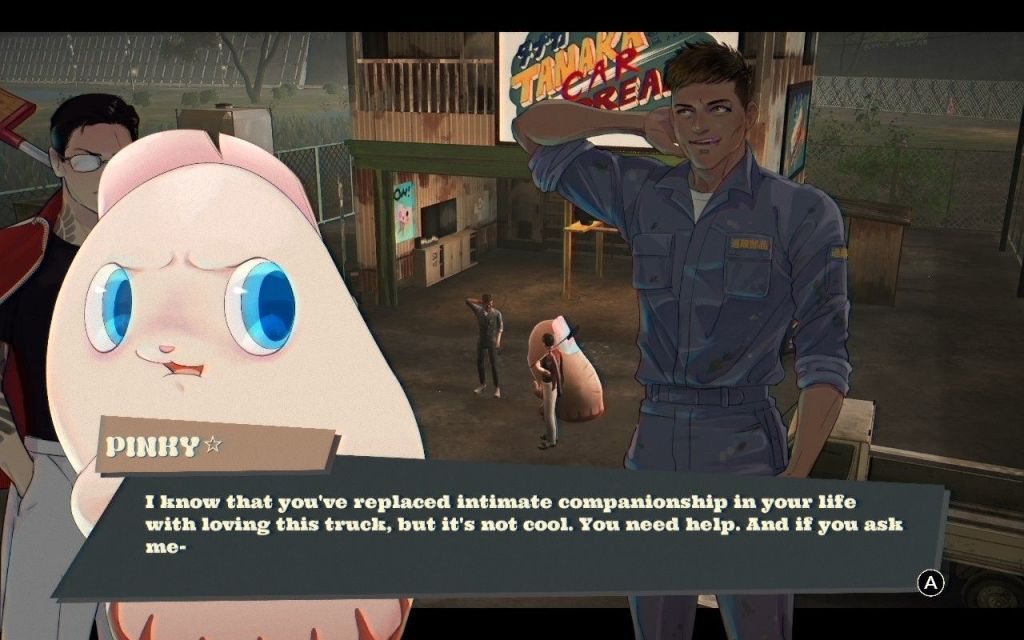
When you aren’t managing your business or driving around the open world, there is also a classic Yakuza-esque story in Promise Mascot Agency. Michi spends a fair bit of time trying to figure out why the job that forced him to fake his death went wrong. He also works on investigating a curse that is said to kill any Yakuza that sets foot on the island over time. I thought the story ended up being OK. There are a few good moments and plot revelations, but it never felt like it strayed too terribly far from anything I’d expect from this type of story. I definitely found myself fast skipping through plenty of dialogue when I felt like things weren’t really progressing. I think telling these kinds of Yakuza stories is a lot harder in the almost purely text-based format that this game employs as well. The Yakuza and Like A Dragon series have some great moments and plot twists, but they really land in those games because of the direction, production values, and music. Promise Mascot Agency doesn’t have those higher budget tools at its disposal, and I didn’t think the writing was on the level to keep me as engaged without those bells and whistles.
Promise Mascot Agency does succeed with some of its side stories and general goofiness, however. The real star of the show in the game are the mascots, and they consistently deliver in big and small ways.
The main sidekick that Michi has is Pinky. Pinky is a mascot that literally looks like a finger. She even has bloodstains at the bottom of her body, implying that she is a finger that was cut off from a hand. Pinky is easily one of my favorite characters this year. She’s sweet, mischevious, and consistently very angry. She has dozens of one-liners throughout the game that made me chuckle. And she’s not the only mascot that won me over. One of the first mascots you recruit is “Tofu,” who literally looks like plain tofu. He is also almost permanently crying and lacks self-confidence. There is a mascot “Oh” that looks like a pair of legs and tries to seduce Michi at every turn. It’s REALLY fucking weird, but it works!
Outside of occasional funny moments where the mascots pop up during the main story, they also have little side stories that you can unlock that have multiple parts to them. Not all of these hit, but some of them are quite excellent. Regardless of anything else, the weirdness, wackiness, and general humor shine through consistently in this game. The tone of the game is very reminiscent of the Yakuza games, with serious moments punctuated by a lot of wackiness on the side, and I think it’s great how well they captured that same essence.
That Was Weird As Hell. Exactly What I Wanted.
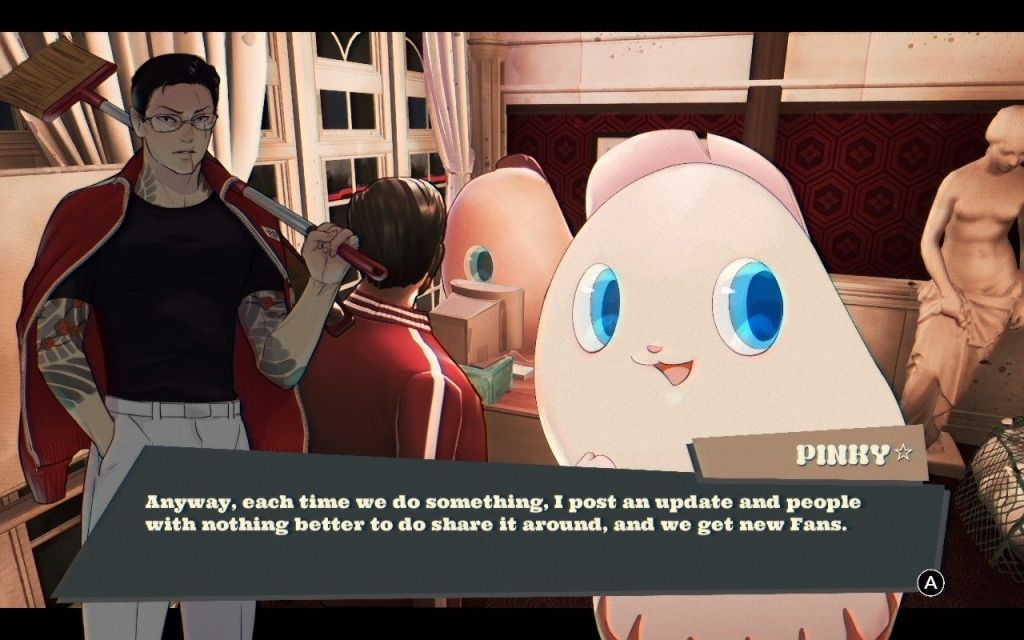
Visually, the game is pretty plain looking in the open world, but I did greatly enjoy some of the character models for the mascots in particular. They almost all manage to be very weird looking yet quite cute. It’s like the perfect kind of bizarro Pokémon. The music is similarly hit or miss, but there were a few songs in there that surprised me with how good they were. I didn’t absolutely love playing the crane game, the mostly optional side mission the game has to make extra money, but the song that plays during it was so good that I found myself playing it way more than I normally would have.
It all comes together to form a game that I found to be really solid, despite a few missteps, mostly near the end of the game. Promise Mascot Agency does something right in almost every category, and I think it was a few balancing design decisions away from having an even higher score than what I’m giving it. I am someone who really loves diving into the major Yakuza/Like A Dragon minigames, so having a standalone game that I could jump into with some similar gameplay and tone appeals was extremely enjoyable. I’d love to see Kaizen Game Works attempt something like this again for their next game, as there is clearly a lot of talent and a lot of insanity in that studio that I’m excited to see more of.
Score: 8.0/10
 Big Nerd Gaming
Leave a comment