

We all have that one friend.
The guy who just has a great all-around vibe. He’s easy to talk to. He can light up a room. He’s funny. He’s just a good hang and a solid friend.
But when it comes to the basics of life, god damn, he does not have his shit together. He moves from job to job at a whim. He’s behind on his bills. And if you spend too much time with him, he is going to start asking you if he can borrow money all of the time. He’s fun to hang out with in spurts, but then it’s best to get out of there.
I’m not full on saying that South of Midnight is that friend, but damn I wish it fully had its shit together.
South of Midnight is brimming with personality. It thrives by showing off a deep southern culture that is relatively rare to see in the realm of video games. It looks beautiful, and it has soulful music that will move you. But it’s also a game that was tough to spend too long with because so many of its core mechanics are just not fleshed out the way that they should be. All the ingredients were there for South of Midnight to be a very special video game. Instead, it’s just a good hang in short sessions, but not much more.
The Biggest Thing I Learned In South Of Midnight Is That The Point Of Folklore In The Deep South Is To Give Out Childhood Trauma

You play South of Midnight as Hazel Flood. She is an 18 year old living near New Orleans with her mom, Lacey. As can happen in that part of the United States, there is a big storm coming. After Hazel gets into a fight with her mom, she leaves the house. The house ends up getting washed away in the storm with Lacey still in it, so Hazel sets out to find the house and her mom. In the meantime, Hazel also discovers that she has the ability to be a “weaver.” This means that she can see magic in the world and also use it to fight bad spirits and to help heal spirits and mythical creatures who are in pain. As Hazel sets out to find her mom, she will encounter several of these creatures and other tragic situations that she needs to help mend.
This plot premise is really interesting and tackles a folklore that many of us are likely completely unaware of. Throughout each section of the game, as you continue to chase after your mother, you encounter creatures that are a part of “real” stories if you grew up in a certain parts of the south. I think the cool thing about almost all of these creatures is that they are scary but also tragic. There’s a reason why they all turned into the monsters that you see before you. It gives you a sense of sympathy and an added layer of nuance to each encounter. This is important as Hazel is supposed to be a healer, not a killer. My only complaint is that most of the backstories of the people and creatures that you encounter in the game are told in these odd spiritual areas. A narrator describes the tragic events, and you just see spiritual outlines that help show what happened. South of Midnight has incredible visuals, and I think telling some of these stories while actually showcasing the visuals of the game would have made them hit even harder, because there are some really heartbreaking and surprisingly dark events that happen. Perhaps it’s on purpose, as they didn’t want the game to feel darker than it already is, but I thought there was a missed opportunity for even more emotional impact.
That trend continues throughout the story of South of Midnight for me. There’s tons of potential everywhere here, but it constantly felt like they were missing small things that didn’t allow for things to click nearly as well as they could have with me. This starts in the early going. One of the points of tension between Hazel and Lacey is Hazel’s grandma, Bunny. Bunny isn’t present in their lives at all, and Hazel wants to know more about her. Lacey seems to shut down almost any conversation about her, which, of course, makes Hazel even more curious about what is going on with her. As the game goes on, it turns out that Bunny does indeed have a very fascinating backstory. Revelations about Bunny also reveal things about Hazel’s father, who died years ago. These moments are both interesting for the main plot, but also uncover more about Hazel and her family. Hazel’s dynamic with her mom is also pretty compelling. Despite this, these plot threads just go missing for large portions of the game. As cool as the folklore in the game is, I actually think the most potential with the plot was to really dive deep on Hazel, and it seems like every time the game was close to really doing that, it pivoted back to its folklore instead.
I felt like the game also missed opportunities with some other characters as well. As the game goes on, you end up meeting one of Lacey’s ex-boyfriends, and it seems like Hazel is quite hurt about the fact that he left them. This is an interesting point of the story, and I really liked the ex-boyfriend, but he completely disappears after his arc. There is also a villain of sorts in the game that is teased throughout. He is very fascinating when he starts to get fleshed out, but he ends up having way less screen time than I would have expected. Every time that I felt like the game was really starting to cook with its plot, the most interesting elements feel like they get thrown away or somewhat overlooked.
I also wish that we got more of these characters, because the character that Hazel ends up spending the most time with in the game is “Catfish”, who I kind of hated the more I saw of him. Catfish spends quite a bit of the game helping Hazel to get around the swamps as she navigates from one area to another. He also consistently seems to know more than he will let on. He constantly scolds Hazel and tells her not to do things, likely because he knows more than she does about all of the “weaver” business. He also almost never tells her why she shouldn’t do those things, even though there’s really no reason for him not to. I could understand when this dynamic existed between Hazel and her mother, but it never really made sense here.
There’s a few other small oddities with the plot. Early on in the game, I felt like Hazel was somewhat lacking in urgency around finding her house that washed away, and everyone seems weirdly nonchalant when told about it. I get that people can be in denial in these kinds of circumstances, but it seemed like another level of delusion for me. Hazel is also consistently upset with herself in the early going enough because she wasn’t fast enough to catch a house that was washing away in a massive storm. I get that she is 18, and she is also a track star at school, but it kind of made me roll my eyes. At that point in the game, she was just a normal person, not some sort of superhero. It felt a little beyond belief that she was blaming herself for not being able to do superhuman shit. I’m usually able to suspend my disbelief on plenty of things, but these both felt so off to me that it made it harder to get into things in the early going.
Despite all these complaints, the plot still manages to have its moments. As stated previously, South of Midnight is a fair bit darker than I expected, so there are a lot of very tragic and emotional moments that happen throughout, especially with some of the folklore it dives into. While I was frustrated at certain characters not getting enough time to shine, it also can’t be denied that I wanted more of them because they are extremely interesting and well voiced. Yes, there are missed opportunities throughout, including at the ending, but some of those missed opportunities are a byproduct of strong work that was done to get to that point. The story was disappointing to me, but it still had merit, and some of the individual arcs in the game were superb, even if the overall plot felt uneven.
Haint Nobody Got Time For Mediocre Combat

That unevenness also extends to the gameplay in South of Midnight. But unlike the story, there aren’t as many high points here. South of Midnight is a pretty standard and linear action-adventure game. There are bits of combat, platforming, and some light exploration mixed throughout.
The weakest element of the game is the combat by far. As you travel through each area in South of Midnight, you will come across various battle arenas where you will fight off Haints, which are basically evil spirits. You have a basic attack, a dodge, and a few special skills that you can use after a cooldown. This system is incredibly basic and actually manages to feel annoying even though it isn’t particularly hard. The game likes to throw 3-4 enemies at once at you, so staying in one place for too long will usually get you hit quite a bit. I was in a rhythm of using my skills, then attacking a few times, and dodging away before I even saw an attack coming because if you stay in one spot, you will almost always get hit. I spent an annoying amount of time rolling around even when I didn’t see an enemy attack on the way. Hits also don’t feel particularly impactful, and the skills in the game are as basic as it gets. To top it off, there is almost no enemy variety in the game at all, so you’ll be fighting the same foes over and over. The bosses are pretty underwhelming as well, which I guess was to be expected. My friend Zack from Sight-in Games recommended putting the combat on easy. Sadly, stubbornness forced me to continue on normal. I only died maybe once or twice ever, but I think the easier difficulty at least allows the combat to go quicker and be more of a very brief distraction instead of a nuisance. The game actually has options to completely turn off the combat, and honestly, there’s a part of me that would consider doing that if I wasn’t reviewing the game.
Luckily, the other elements of the game fare a bit better, even if they aren’t particularly excellent either. South of Midnight features a fair bit of platforming. You have a double jump, an air dash, a wall running ability, and eventually a grapple hook type mechanic. It at least all controls well enough, even if it’s a bit slower than I’d like. The game only throws the most basic of platforming challenges at you, but it’s competent and inoffensive. It does just enough to break things up and not get too in the way.
The one element of the gameplay I did actually find enjoyable was some of the exploration. Each level in South of Midnight is absolutely packed with things to find. There are various notes that help flesh out the story and upgrade materials that help you enhance your skills or gain more health. You can press a button at any point in the game and get a trail as to where the next main objective point is, so it’s pretty easy to just go to the other branching paths in order to find those upgrades. There usually might be a bit of exploring or a small platforming challenge, and it’s yours. It’s not super hardcore, but it’s very breezy and enjoyable.
The Catfish Would Definitely Try And Ask If They Could “Borrow” Money. Fuck That Guy.
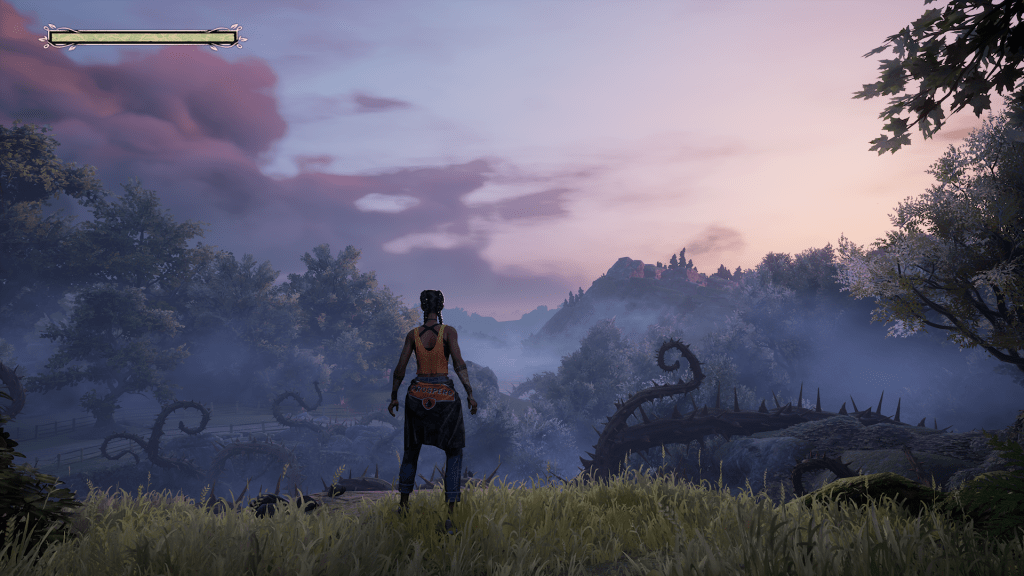
I think I also liked the exploration in the game in big part because South of Midnight is just drop-dead gorgeous. The game has a stopmotion style and clay character models that give it an incredible unique feel (somewhat reminiscent of Harold Halibut from last year). But it doesn’t just feel unique, it also is legitimately beautiful. There are a stunning array of environments, perfect art direction, and excellent lighting effects that make every area feel alive. There really isn’t much else like it out there. I’d say South of Midnight is easily one of the best-looking games this generation. Exploring is a treat in the game because every single area is so much fun to take it. It’s truly a bummer that this game doesn’t have a photo mode, as I would have used the hell out of it if so.
The music also makes spending more time in the world enjoyable. There are lots of jazzy and soulful tunes here that give the game a unique flair, as you’d hope from a game based in the New Orleans area. The music is especially cool during main story moments, as there are multiple songs that actually have lyrics that give you backstories on various characters in the game. It was always a treat whenever these would pop up. The music and graphics are a huge part of the “vibe” that makes South of Midnight a cool experience, even if I didn’t always love it as a video game.
But it stings that I look at this game as a great “experience” more so than a great video game. There aren’t a lot of games out there with the unique style and flair that South of Midnight brings to the table. There’s also very few games that explore this subsection of American culture. But those elements get diminished greatly when everything in between is so unremarkable. Luckily, the gameplay doesn’t really get in the way enough to completely destroy this experience, even if it diminishes it quite a bit. South of Midnight has enough personality where I still found it to be a breezy and enjoyable enough experience. But I’m also glad the game was short enough (about 10 hours) where I could get out before it started asking me to borrow money.
Score: 7.0/10
 Big Nerd Gaming
Leave a comment