

I will likely be talking a lot about Rematch in the coming weeks. This is the new arena soccer game from the developers of Sifu. I am not someone who gets sucked into multiplayer games. I am also someone who never plays sports games despite loving sports. But I am completely hooked on this game. This is the most fun I’ve had with a multiplayer game since Overwatch. I’ve had a few spells with Helldivers 2, Halo Infinite, and Apex Legends in the past decade or so, but this one has sucked me in way more than any of those games did.
I think one of my favorite parts about Rematch is that while it is very much an arcade oriented soccer game, it actually has shockingly grounded physics. Getting away from defenders and defending a man with the ball both feel a lot like the many times I have played indoor soccer over the years (usually as a goalie, but I’ve played the field on occasion). Outside of a few unrealistic things, the entire game kind of feels like the best indoor soccer simulator I have ever played.
However, one thing is decidedly not at all like indoor soccer, and that is your teammates. Generally, when I play indoor soccer, I play with teammates who are focused on winning and who have an inherent understanding of strategies in soccer. Whenever I team up with randoms in Rematch, that is decidedly not the case. Even in ranked games, I’m almost always with a team that fully rushes forward on offense and then desperately tries to sprint back on defense as the other team gets one easy opportunity after another. I also encounter loads of people who try and take the ball down the field all by themselves and completely ignore their teammates.
I think there’s a good chance some of these people are assholes. Some of these people are also clearly idiots. But I do wonder if a lot of these people also just don’t quite understand what they need to do. Slocap built up tons of acclaim for their past games. I think Rematch has tons of Sifu fans in there who are curious to check out the next game from a developer that they really like, but they also genuinely don’t understand the sport.
I’m not going to sit here and say I am a soccer expert (though, I did host a local soccer podcast for almost 2+ years, believe it or not), but I have played enough indoor soccer in particular where I feel confident that I know how to play that particular game. A lot of concepts in indoor soccer apply to other sports, too.
This post’s goal is to help people who don’t understand soccer out. If you follow these principles, even if you aren’t great at the game, you will likely still help your team out. Here are four simple soccer concepts that will make you and your team better at Rematch.
Offensive Spacing

This is a very simple one, and probably the one I don’t have as many issues with. Spacing is important in so many team sports, from soccer to hockey to basketball. So I think most people get this one. But I do run into the occasional person who doesn’t seem to understand this.
When you play Rematch, you should really think of the field as having three “zones” on each side. You have the right wing, the left wing, and the center. Simply, you should almost never be in the same “zone” as any of your teammates. If you hang out in the same zone as one of your teammates, it makes life significantly easier on the defense. We will talk about defense in a bit, but generally, in this game, it makes more sense for the person not pressuring the ball to guard a “zone” instead of any one individual person. When you have multiple people in the same zone, it allows one defender to essentially “mark” both people. This means that other defenders are free to double team whoever has the ball, or maybe even have someone ready to leak out and start a counter attack.
In the 3 v 3 mode, this rarely seems to be an issue. If someone has the ball on the right side of the field, most people seem to get that they should be in the center or on the left side, depending on the defense. But I have seen plenty of these issues in 5 v 5. When I’ve been in goal, even during ranked games, it’s not uncommon to see all 4 non-goalies decide to enter the furthest reaches of the attacking zone, and they end up getting in each others way all of the time.
It makes much more sense for three people to be on the attack in each “zone” and for one person to be closer to the center on the midfield line. A 4th person entering the attack isn’t hard to guard for the defense, as they already have defenders in each section if they know what they are doing. It’s much better if this 4th person is a nice outlet for the offense to kick out to if they get into trouble, and they can also put the ball back into the attacking zone. Once again, we will talk about defense more in a bit, but this 4th person is also there to help stop a counterattack where your goalie ends up having to face a 1 on 1 by themselves. It has been stunning in my 5 on 5 games that so few people are willing to be that 4th person around midfield.
Defensive Spacing
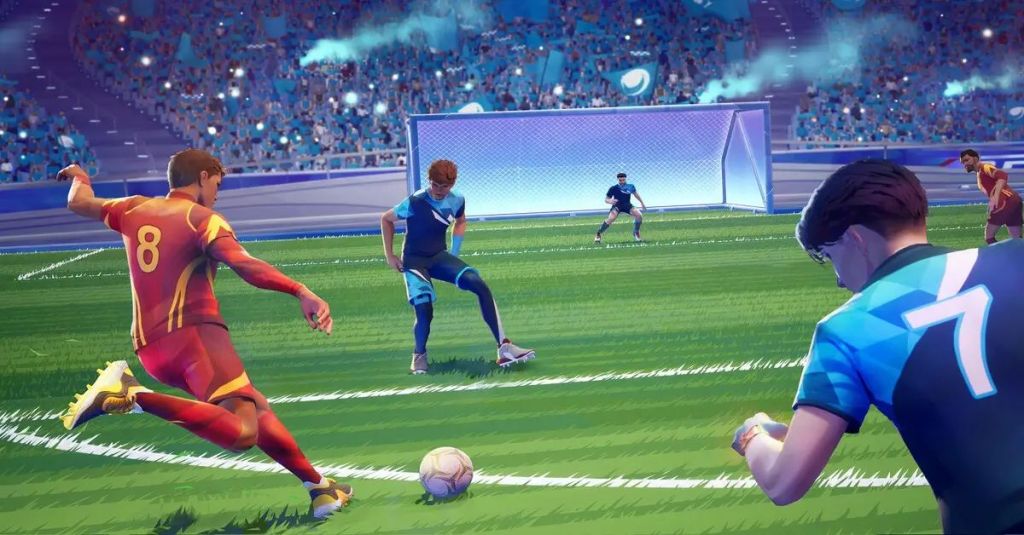
Admittedly, spacing isn’t always as cut and dry on defense, but unless you are playing with people who you can communicate with, and who can cover for you if you decide to get aggressive, it’s probably best to be more conservative on defense.
Simply, the biggest defensive issue I constantly see in this game is multiple people deciding to chase after the ball. I can’t tell you how many 3 v 3 games I’ve played where both of the non-goalies decide to pursue me when I have the ball, and I simply pass the ball through them to my teammate who is now 1 v 1 with the goalie.
First off, if you aren’t communicating with your teammates, be aware of your surroundings. If you are the closest person to the ball, you should almost always be the person to challenge them. In general, you pretty much always want someone to at least be in a defensive position in front of a ball carrier. Space is important. Every free inch you give your opponents gets them that much closer to a goal.
If you are not the closest person to the ball, you can probably assume that one of your teammates is going to go challenge them. Hell, two teammates might challenge them. If I see a ball in the corner, my general goal is to let my teammate run after the ball and instead guard the middle of the field so that no free passes can be given. I also think that it makes more sense to guard a “zone” instead of specifically deciding to mark a man. It’s really hard to keep the camera on an opponent and also keep an eye on the ball. You don’t have quite as much vision in this game as you might in real life since you can’t peek through the corner of your eyes at your surroundings. So look at what areas of the field your teammates are defending, and then defend what they are not.
If you decide to play 5 v 5 ranked in solo queue, I have bad news for you. All of your teammates are likely about to prioritize offense over defense. I talked about being that 4th man on the midfield line in the offensive spacing section, but this is also very important for defense. If the goalie saves the ball, it is very easy for them to pass the ball out to a leaking man and start a counterattack. By being on the midfield, not only can you help the offense more than you would if you crowded up the zone, but you are also extremely important defensively. You will almost assuredly not have sexy stats when playing this role, but if your team wins, you might actually be the biggest reason why.
Passing is Good!
Rematch was clearly designed to really make it so it is hard to play hero ball. You have a sprint button, but your sprint meter will fade out well before you can sprint the length of the field. There’s a “super” sprint button, but it takes a bit to recharge. The game also purposefully doesn’t give you a lot of dribble maneuvers when you have the ball. You can do a basic dribble that gets the ball off your feet to avoid slide tackles, and there is a rainbow dribble that is very effective, but also pretty slow if you are in a crowded space. You can also pass the ball off a wall to get around defenders (one of the best strategies in real life indoor soccer as well).
With all these limitations, your best strategy is almost always to PASS THE BALL. Solo heroics can occasionally work, especially in 3 v 3, but they get harder and harder the more people are on the field. In general, passing is just a better strategy.
EVERY TIME you have the ball, your first instinct should be to look at who you might be able to pass the ball to. The best way to score a goal is to get it by each defender and end up in a 1 v 1 with the goalkeeper. Passing the ball is much quicker than dribbling, obviously. Ideally, your objective when you have the ball should be to get one defender to commit to you enough where they won’t be able to get back once you pass the ball, and then pass it off to the next person.
Also, as you get into 5 v 5 games, don’t underestimate how effective it can be to pass the ball backwards if you are fortunate enough to have someone actually playing a “holding midfielder” type of role. When I do this in 5 v 5 (since no one else will), I will occasionally have someone pass the ball back to me when the defense double teams them and they get into trouble. When this happens, I’m usually able to very quickly pass the ball to the other side of the field, where there are fewer defenders. Suddenly, we have space and a potential scoring chance.
The other best part about passing the ball is if you do it enough, you will see the defenders slowly get more timid about challenging you. I have had many games where the opponent is pressing me hard in the first 30 seconds of the match. After getting burned multiple times by my willingness to pass, they suddenly back off more. This allows me to push the ball even further upfield without being contested. This will often lead to me taking more shots later in the game. Being unselfish early can easily lead to personal glory later on. Always look to pass first.
Be The Sweeper Keeper
Being a keeper in Rematch is tense, just like in real life. All the eyes are on you. Every goal often feels like a personal failing, even though 90% of goals are generally due to defensive failings (this is my biased keeper math).
Obviously, the first thing to figure out as a keeper is how to save the ball. It’s an art learning when to dive and when to read when the opponent is about to shoot the ball. With practice, it gets easier.
But the best way to be a keeper whenever possible is to make it so those shots never happen in the first place. It can be scary, and mistakes will happen early on, but being aggressive with leaving the net is one of the best ways you can succeed. Outside of your goalie having a diving range that no human can possibly have, playing keeper in Rematch feels a whole lot like playing it in real life indoor soccer.
First off, you almost never want to be glued to the goal line when playing keeper. If someone comes up to challenge you 1 on 1, you will generally want to slowly move up and cut off their angle (while staying in the box so you can still use your hands). It’s also vital to not commit to a dive until you are absolutely sure, as diving early is one of the most deadly mistakes that you can make.
When your team has the ball, you should, at the very least, be standing around the edge of your box. As you gain more confidence, I’d say it is good to even be a couple of feet beyond the box. That way, if your opponents try to initiate a counterattack and end up passing it a bit too long, you can get to it before an attack even happens. You can then pass it back up to your team and perhaps initiate a counterattack of your own. If your opponent is dribbling up the field and you have no chance to make anything happen, it’s easy enough to retreat back to your line. You can’t get lazy when you do this, as you don’t want to be caught off guard and see a moonshot go above you and into the net, but if you are aware, this is easily the best way to play.
Also, in 3 v 3 in particular, it is absolutely vital to dribble the ball up a little bit as a goalie. Your opponents will generally be focused on guarding your two attackers. With the limited number of opponents, it’s very easy to gain space for your team by dribbling the ball up yourself. The second an opponent starts to commit to defending you, the right play is to pass it off to your open man and let them work, and then retreat back to your usual spot.
There are assholes out there who play as the goalie and then ignore it and just attack. When I leave the net as a goalie, my goal is always to pass the ball at the first opportunity. I’ve had several 3 v 3 games where a teammate will freak out when I leave net and rush to cover the net instead. While I appreciate the commitment to defense, this is not a good move. If you see your keeper leaving the net in 3 v 3, you should really let them work and get yourself open. By retreating, you will completely cripple the advantage you are getting. If the goalie ends up proving that he is just an asshole, then yes, retreat back and cover for them, but I highly recommend not doing that at the start.
Obviously there’s way deeper stuff that can go into this, but even if you don’t consider yourself great at Rematch, if you follow these easy principles, I am confident that you will be a positive force for your team. Thank you for reading, and I will have more very soon on this game!
If you enjoyed this post, make sure to follow me on my other platforms!
 Big Nerd Gaming
Leave a comment