
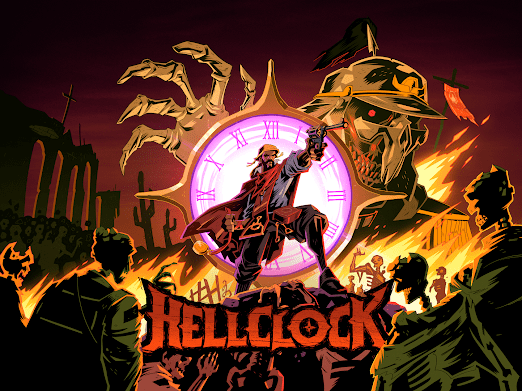
A review code for this game was provided by Keymailer and Mad Mushroom.
When my wife and I went on our first date, we both pretty much knew afterward that we were going to marry each other. Neither of us had ever felt that way about anyone before.
Sometimes, both parties connect immediately, and it all works out perfectly. But it doesn’t always go that way for everyone. Sometimes, only one person feels that way. There are many love stories that end before they start. There are others where the love blossoms unexpectedly. Situations where one person wants to make it happen, but the other person doesn’t feel the same until later on, perhaps after they got over a different rejection. Despite it not seeming like the perfect fit, it all works out just as well as the “love at first sight” scenario.
Hell Clock makes me feel like I understand the “unexpected love” romance path better now.
I’ve had my eye on Hell Clock for a few weeks now. I had some friends who played the demo and enjoyed it, but it was honestly not the game I was looking to play this past weekend. There are a lot of indie games that I’m really looking forward to coming out in late July and early August, and I’ve been trying harder than usual to see if I can review some of these games before they release. Because I was holding out for those games, I didn’t apply for a Hell Clock review code, even though I had interest. I sadly waited day after day and received no response for any of my review code requests.
But then, I got an offer of a review code from Hell Clock just a few days ago without asking for it. After being spurned by others, I decided to give Hell Clock a chance. And now I’m wondering if things worked out better for me than they may have if I got my first picks.
Because it’s only been a few days, I’ve only been able to put about five hours into Hell Clock. But after five hours, I’m already confident that I will be playing this at least until I complete the main story. Hell Clock is an ARPG that feels quite good to play and has some of the strongest roguelite progression systems that I’ve seen in the genre. Hell Clock makes you feel like you accomplished something every run. There’s a few nitpicks that might hold it back from reaching the highest highs of the genre, but I am already excited to finish writing this so I can jump back into it. That says a lot to me.
A Diablo-Like Roguelite

Hell Clock’s ARPG influences are pretty clear from the moment you start playing. The screen has a skill bar at the bottom with 5 different abilities that you can equip, each with various cooldowns and mana usages. You also have a circular mana and health bar. It looks a lot like Diablo. Obviously, that’s a big name to live up to. Luckily, the combat mostly lives up to that prestigious name for me so far.
First off, the core mechanics are rock solid. There is a satisfying crunchy sound design as well as crisp animations that make every gun shot and strike feel great. The performance of Hell Clock is also excellent. This game gets chaotic, with dozens of enemies on screen at once, as well as all of the attacks I’m throwing at those enemies. Even with all the carnage, I’ve had very little slowdown and no real other glitches to speak of. My only nitpick is that the feedback when you take damage can maybe be a bit too subtle, and sometimes death really sneaks up on me fast because the action is so frantic that it’s tough to look away from the fighting to look at my health. This is a very small complaint, though.
I’m still in Act 1, and I currently have about 10 skills to use, and I’ve tried using seven of them. Since you can equip five, it’s really easy to put together a combination of skills that works for any playstyle, even though the game appears to be somewhat built around using a gun. In my current setup, I have a basic gun attack, a machine gun type attack, a dash skill (that can be offensive, but I mostly use defensively), an attack that hurts enemies that get close to me, and an attack that drops a giant bell on foes.
Thus far, every skill (outside of the basic gun attack that doesn’t use mana) seems to be a skill that you can potentially build your run around, which is awesome. You can equip “relics,” which can enhance various skills, and then you can also upgrade those skills during your run. Additionally, as you kill opponents, you will “level up” during your run (this particular mechanic resets each run). You then get three different options for various upgrades to one of your skills. Thus far, it seems wisest to just try and put every upgrade into one particular move if you are lucky enough to have it continue to pop up with each level up. If you do this, you can turn a decent move into a devastating one, and it’s glorious to watch happen over the course of 10 minutes or so.
The aforementioned bell move was one that I didn’t unlock all that long ago. When you use it, it immediately drops a bell on enemies and does pretty decent damage to them. It also does area damage to other nearby foes. The move also has a very small cooldown, so it’s easy to spam it. The downside is that it uses up a decent amount of mana. Early on in one of my latest runs, I got an upgrade that reduced its mana cost by a nice amount. I then got multiple upgrades that enhanced its damage. I then got one that nicely increased its area of effect. I had also just equipped a relic before the run started that increased the bell’s damage. Suddenly, I could use this skill almost nonstop, and it was absolutely wrecking foes that had given me trouble the run before. It was amazing. I’ve had a few moments like this with all of the skills so far, but that was the best. It made me excited to go for this setup again if I saw the opportunity. It also made me want to continue to mess around with other skills to see if I could also produce similar results with them.
Side note, I am playing this game on my Steam Deck, and if you decide to do so, the game feels so much better when you remap your gun skills to your triggers. The game defaults the skills to the normal A/B/X/Y buttons. It’s usually best to hold down the button when you are using a gun skill, and it is much more satisfying to hold down a trigger than it is to hold down on a more “standard” button.
This Is A Roguelite Ass Roguelite
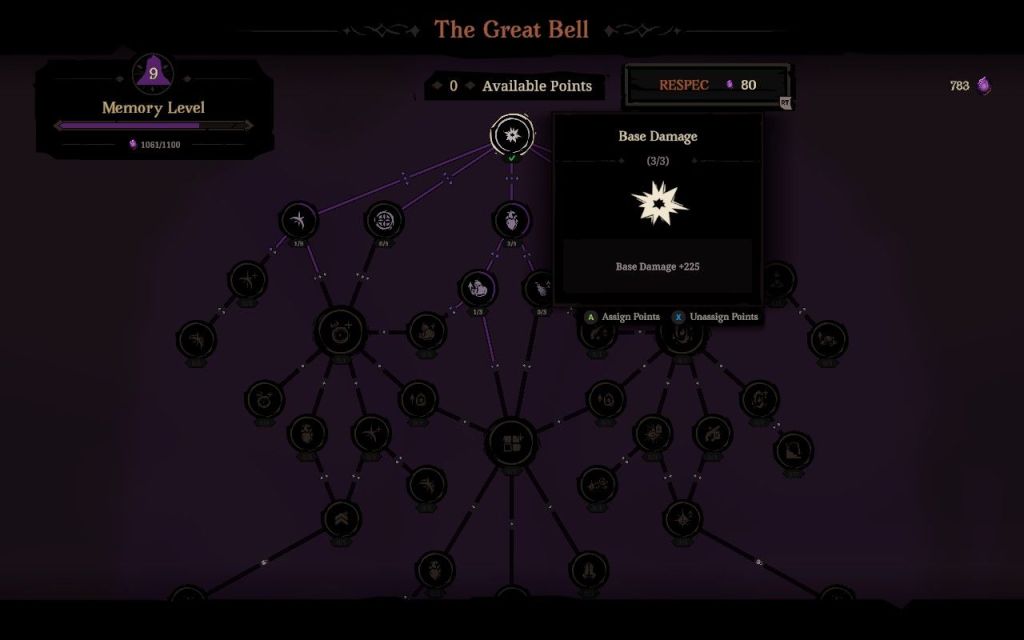
The amount of progression systems in Hell Clock is another reason that this game is comparing itself to games like Path of Exile. The game has a very big skill tree to buy upgrades from for a roguelite. You can equip “relics” that enhance your stats and your combat abilities (and these can also be leveled up over time). You can also equip some basic gear that improves health, attack, etc. Basically, unless you die super quick, you are probably going to get out of every run with the ability to upgrade your character in some sort of way. There are definitely ARPG vibes with all of this stuff, but it mostly just feels like a roguelite ass roguelite to me. This, at the very least, is up there as one of the more intense roguelike progression systems that I have ever seen, and that is a great thing. To me, this genre is at its very best when you can walk away from every run feeling like you at least got yourself one step closer to your end goal, even if it was a small step.
I think the skill tree has a really fantastic set of choices, and lots of branching paths that could make for a fun little puzzle if you really want to be efficient with getting to the skills you want. I like that there are basic upgrades, and then some other ones that feel like a big deal when you make it to them. I recently reached an upgrade that increased my relic bag, which allows me to equip more relics. That definitely had me excited to reach when I had been eyeing getting to that skill for a half dozen runs.
I mentioned the relics a few times because, as I talked about with the bell move earlier, these can really be a big step towards creating some truly powerful builds. My only complaint so far is it doesn’t seem like there are all that many options here. Within a few runs, I was getting a lot of repeats on these. so I haven’t had tons of luck finding new ones after the initial ones I equipped outside of small ones on the fringes that don’t affect my builds as much. The game also has basic equipment, which I also wish felt a little less limited. The shop is almost always selling equipment that I already have on, and you don’t find tons of upgraded equipment in the field. I feel like the basic equipment in this game mostly uogrades when you get to a new section of the story, which is kind of lame. These are definitely nitpicks, though. I overall think that they did a lot of great work here.
The Hell Clock Can Be A Real Cockblock

Hell Clock has one other feature that is going to make it stand out, but this one feels like it will be a bit more controversial. In the default setting of the game, each run has a timer associated with it. This only pauses when you fight bosses and during battle arena type challenges. Once the timer runs out, your run is over, no matter how well it is going.
I have to assume there’s other roguelites with a timer mechanic, but I can’t recall ever playing one personally.
In some ways, the timer goes against one of the biggest appeals of the entire genre. One of the best parts about roguelites is that electric feeling of everything breaking your way in a run. Those runs where you suddenly have an unstoppable build that is finally winning for you after many failures. I have already had a few very strong runs end because of the timer. I can see how it might be tough to swallow to have an awesome build and lose it through a timer and not through actually dying. I haven’t felt that frustrated, but it definitely feels a bit anticlmatic at the very least sometimes.
But also, it fits the way the game was designed really well. Within a run or two of upgrades, the very first area in the game gets laughably easy. I can cut through the first 7 floors while barely taking any damage, and the first boss fight takes me less than 10 seconds Once again, this was already happening within an hour or two of starting the game. Normally, this would suck. I’d be bored out of my mind just beating these floors with no challenge, and I’d call this bad difficulty balancing. It’s inevitable with roguelites that have good progression systems that the first area gets pretty easy, but it shouldn’t get this easy this fast.
Thanks to the timer, these sections actually still feel like a challenge. My goal is to kill as many enemies and find as many chests as I can without milking too much of the clock. The quicker you go, the more clock you’ll have for the harder levels. But you also do want to kill some enemies, level up, and at least pick up a little bit of gold for purchasing mid-run upgrades. It’s a fun strategic mix and creates an interesting flow that is not usually present in this genre.
If I’m being real, I also appreciate that this mechanic keeps the runs in this game short. I definitely love a well-made action roguelite with 30-minute to 1 hour runs, but I feel like too many in this genre go that route. Having runs that go something like 10-20 minutes gives Hell Clock a slightly unique flair.
The good news is that you can turn off this mechanic, but with the way the game is made, I recommend keeping it on, even if you don’t fully love it. Personally, I’ve decided that I’m happy with the timer on.
I’m not fully reviewing Hell Clock until I finish it, but I wanted to get some thoughts out with today being when the embargo lifted. If I were to review the game right now, I’d probably give it an 8.5/10. I feel like I’m actually enjoying the game more the deeper I go, so this could very well make it to a 9. I can’t see it going below an 8 because the core mechanics feel so solid. I hope to have more thoughts about Hell Clock in the coming weeks.
If you enjoyed this post, please consider following me on social media!
 Big Nerd Gaming
Leave a comment