

It seems like rage rooms are becoming more and more popular these days. These are rooms that allow people to destroy a bunch of fragile objects in a safe way.
It’s a funny concept to me because when I see clips of people destroying all of the glass objects and other things in these rooms, they aren’t actually mad. They are filled with joy. For whatever reason, destruction seems to give us pleasure as humans as long as we aren’t hurting anyone in the process. We love fireworks. We love rage rooms. We love watching controlled explosions. My three year old thinks it’s awesome to destroy the forts I spend 15 minutes making for her. I’m not sure what it is, but we are hardwired to love this stuff.
Obviously, this carries over to video games. Video games are beautiful because we can destroy things without actually dealing with the real life consequences (unless you like to throw controllers when you get mad). Nintendo seemed to understand the joy that could stem from destruction when they made Donkey Kong Bananza.
Bananza is essentially the greatest rage room simulator ever made. You are plopped into a world as Donkey Kong and have the power to destroy almost everything you see at a pretty unprecedented level. It’s satisfying as hell and a remarkable game development achievement.
However, much like when you’ve gone to fireworks shows for your whole life, which is one of the ultimate shows of destruction that we have, you eventually reach a point where you kind of feel like you’ve seen all that there is to see. This never stops me from going, but there is a point of diminishing returns.
Someone On Bluesky Told Me That OH BANANA Is The Linchipin To The Entire DK: Bananza Experience And I Can’t Stop Thinking About That

Donkey Kong doesn’t travel alone in Bananza. You also travel with a young girl named Pauline on your back. Your goal in the game is to escape an underground area that you have been trapped in after a mining incident. You need to travel further into the ground and reach the planet core in order to make it back to the surface.
This underground is separated into different levels with a solid variety of environments (yes, you are underground. Let’s just not think about it too much). As you navigate through each level and continue to work your way further down, your goal is to also collect as much gold as and as many “Banandium Gems” as possible. These things are occasionally needed to advance further in the game, and they can also make Donkey Kong stronger in various ways.
The way you navigate each level and find various collectibles is with one of the most fun core mechanics that I’ve seen in any 3D platformer, and that is with pure destruction. Donkey Kong is able to destroy almost everything in front of him in Bananza. If you have a cliff in front of you, you can obviously go around it, but also, you can usually just literally punch the cliff and slowly work your way through it. It’s insane, unbelievable, and it freaking works. Obviously, it’s amazing from a technical perspective. I can’t imagine how much work it was to design this system. But it’s not just an impressive feat from the developers. It’s a lot of fun in practice, too. As we discussed in the intro, destruction is fun, and Bananza nails it.
I think there’s a few reasons why the destruction works so well. First off, the sound design is perfect. There are different crunchy noises depending on the type of terrain that you are tearing apart, and they all sound just right. Donkey Kong’s animations are also entertaining, and it’s cool to look back and see the damage you did after tearing apart a little mountain for a few minutes.
The destruction also leads to a lot of tangible rewards that give you an extra bit of satisfaction while you already feel good tearing stuff apart. Pretty much anytime you start tearing into the ground, you will consistently find gold and start seeing that build-up. The game also has dozens of its banana gems in every single level, so almost anytime you use your sonar move that helps you find hidden objects, you will probably see a banana underground in the nearby vicinity.
The gold in the game allows you to buy things like apple juice and balloons that save you if you fall into a pit or if you lose all of your health. They also let you set up beds in each level, and the more you set up, the more health you can get over your maximum health. Gold also recharges the meter that lets you transform (which we will get into later). There are also a few sections of the game where you need to spend a certain amount of gold to progress, which was actually pretty annoying, but it also goes to show that gold is pretty much always valuable to find. Every time I dug into the ground and heard the “cha-ching” that comes with gold, it added to my satisfaction that I was already feeling from destroying the ground.
The even bigger reward and main benefit to exploring and destroying the world is the hundreds of bananas hidden everywhere in each level. These are hidden in special puzzle and combat rooms, as well as deep underground and in plenty of other spots in each level. These bananas can be used to upgrade Donkey Kong in a nice variety of ways. Unless my memory is failing me, Bananza is the first Nintendo platformer with an actual full-blown skill tree. So exploration isn’t just for the sake of being a completionist. It really rewards you this time around. There’s a nice variety of skills that enhance Donkey Kong in a lot of useful ways, from basic things like increasing health or the speed at which he can destroy certain terrains. Each banana you find also elicits an “Oh BANANA!” sound clip that somehow never gets old, despite hearing it hundreds of times over 20 hours or so.
Donkey Kong Bananza Is A JRPG
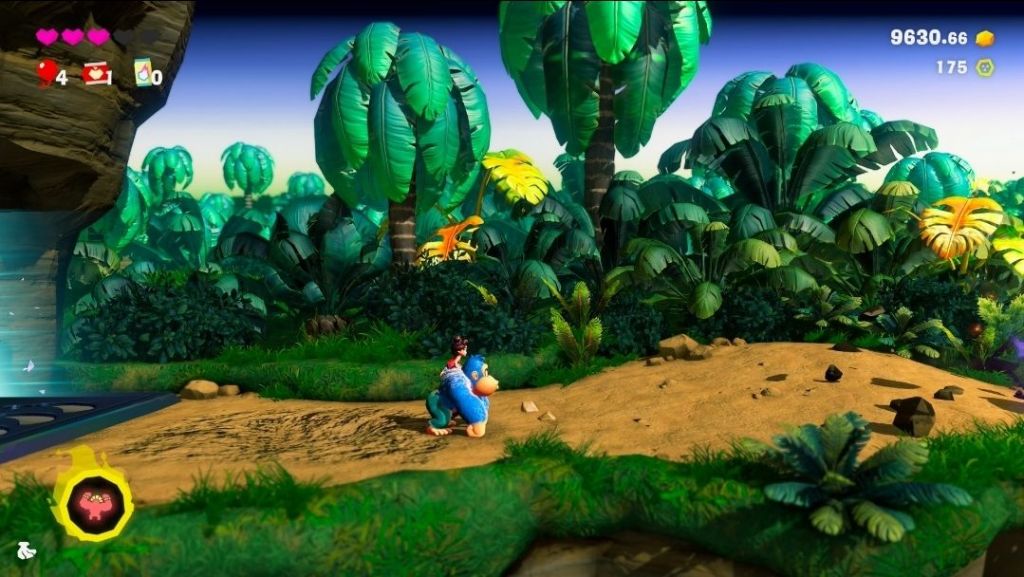
Despite the many rewards to finding bananas, I didn’t try all that hard to find them over the course of my adventure. I found plenty of them naturally, but the game just felt too easy most of the way for it to be worth it to really grind for every single banana out there. Most of the enemies in the game can be defeated by mindlessly smashing the attack button, or by throwing a piece of the ground at them (yes, you can throw almost every piece of the ground that you can grab if you wish). The platforming challenges are also rarely all that difficult. So, increasing my health or other stats was nice, but I never felt like I needed to go out of the way to upgrade myself.
The boss fights are perhaps the worst offenders in the game at being just a bit too simple. I had several boss fights that ended up being shorter than the cutscene before the fight. The game’s last boss ends up being inexplicably way harder than anything else in the game to an annoying level, but beyond that, only one other boss even gave me a little bit of trouble.
In some ways, this is fine, as Bananza is a game truly meant to be enjoyed by all ages. This feels like the kind of game that you should be able to give to a young child to be their first major video game. So, in that way, it’s not terrible that everything from combat to puzzles to platforming are all pretty easy. But there are ways to split the difference and make things accessible for kids while also letting platforming sickos get their fix. Astro Bot showed that last year with a relatively easy main campaign, but very tricky challenge levels on the side. As I mentioned earlier, Bananza does have little optional challenge levels as well, but most of them are not far off from the simplicity and ease of the main path.
The general lack of interesting puzzles, combat, or platforming challenges made me almost feel like Bananza might be almost more akin to the appeals of an old-school JRPG than an actual 3D platformer. The beauty of Bananza for many will be the grind. There’s a lot of bananas and gold out there to be found, and there are many who will just enjoy finding every single one for the sake of it.
The one big difference between an old JRPG and Bananza is that the grind feels a lot more fun. I’ve never enjoyed grinding in old JRPGs because running around, waiting for a random battle, and then mashing the attack button wasn’t particularly interesting. But thanks to the core gameplay mechanic of Bananza being so satisfying, even I found myself occasionally hunting for a few extra bananas when I didn’t have to, even if it wasn’t all that often.
Fuck The Snake Transformation

Bananza does try to make things a bit more interesting with its transformations. As you go through the game, Donkey Kong unlocks the ability to turn into a stronger ape version of himself, a zebra, an ostrich, an elephant, and a snake.
Outside of the snake, which I despised, these transformations do a decent job of changing things up on occasion. The ape transformation is pretty fun and basically turns Donkey Kong into a superpowered version of himself. It is also a pretty vital transformation against certain enemies. The zebra transformation allows for extra speed, the ostrich transformation lets DK glide in the air, and the elephant lets him suck up certain objects and terrain and then spit it back out. The snake one helps Donkey Kong jump higher in a super awkward way and allows him to slow down time.
I was in a weird spot with these transformations. I did enjoy using these as a way to mix things up on occasion. The gliding portions of the game, in particular, are some of the slightly more fun platforming challenges in the game, even if they are pretty basic and par for the course for any game with a gliding mechanic. The ape transformation is always pretty fun as it just takes the already fun destruction elements to another level.
Despite this, I really didn’t find myself using the transformations all that much outside of when they were specifically needed to advance. Mostly because once again, the game is kind of easy, and I rarely saw the point in using them. While it’s not hard to refill the meter that lets you transform, it’s never much fun when you need to use a transformation, but can’t because it’s not full, and you end up having to dig around for some gold first. I found it mostly easier to get by without them.
In NBA Terms, This Game Feels Like If Steph Curry Was Only A 38% 3 Point Shooter Instead of A 42% 3 Point Shooter. Still Great, But Not At The Caliber It Should Be With The Raw Skills. This Is A Great Reference For My Audience That Everyone Will Understand.
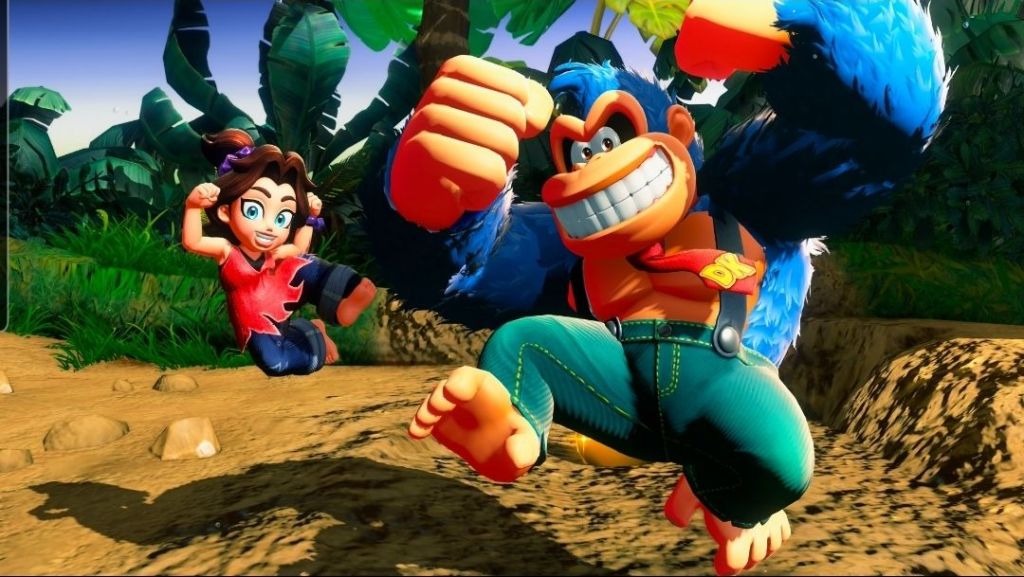
There is also an element of a story with Bananza. Outside of the quest to get to the planet core, the game also centers around Donkey Kong’s new friend Pauline, who rides with him throughout the game. As they progress in their journey, she tries to overcome her fear of singing in public (despite having a great singing voice). The game does a decent job of building the relationship between Pauline and Donkey Kong during the adventure as well. Each time you sleep on a bed, you can do some optional dialogue where Pauline talks to Donkey Kong a little bit. I thought these were pretty cute in spots, but there are a lot of these conversation bits, and I thought they kind of ran out of ideas after a while.
From a production values standpoint, the art direction is solid as you would expect. The music has a few moments, but it didn’t have quite as many bangers as I would have hoped. At the very least, the sound design delivers and then some, and I’d expect this to win that category at The Game Awards as things currently stand.
All of this leaves Bananza in an interesting spot for me. It’s a game that I had quite a bit of fun with, but that also left me a bit disappointed. I really enjoyed this experience because its core mechanic of destruction is that good, but the core mechanic is so good, that it feels like this should have been a true game of the year type of contender for me. Unfortunately, I just don’t think everything built around the game’s destruction really lives up to how freaking cool and well done that destruction is. This creates an undeniably fun experience that doesn’t live up to its potential. There’s only so long that breaking glass in the rage room stays as fun as it was from the first swing.
Score: 8.0/10
 Big Nerd Gaming
Leave a comment