

I despise waiting.
Whenever I see a line at a store, I’m willing to do whatever it takes to avoid it. I hate sitting in the waiting room at my dentist. I hate being in drive-thrus if there are any cars in front of me. I stopped buying physical video games because the ability to play a game I want immediately is too hard to pass up.
So when I discovered that the new game from former Telltale employees, Dispatch, would have episodic releases, I couldn’t help but be a bit disappointed. I have been very excited for this game from the first trailer, and the thought of jumping in and then waiting for each new episode annoyed the hell out of me. This was always something I disliked about past Telltale games.
But then, I discovered that the game would release 2 of its 8 episodes each week. In Telltale’s prime, it would be months in-between episodes, and that could often kill a lot of momentum for me. Weekly seemed much more manageable. So, I decided to suck it up and jump in on launch day this past Wednesday.
And man, I could not be happier with my decision. Episodes 1 and 2 of Dispatch are an amazing time. Both episodes are filled with great characters, sharp writing, and many legitimately funny moments. I’m also a fan of the “dispatch” gameplay loop so far.
But as good as the game is, the other thing that it’s offering is something almost impossible to fully find in the gaming space, and that is a true shared experience. Yes, when a game launches, it’s exciting to be playing the same game that everyone else is and to be able to talk about it. Within days, the shared experience of most video games dies. People who have some days off will get way ahead of others. Some will game hop like myself and take months to complete it. Suddenly, no one is in the same spot, and most are doing their best to avoid spoilers. So, while it’s a “shared experience,” it’s a rapidly diminishing one with a very short shelf life.
By releasing 2 episodes a week (roughly 1 hour an episode) for 4 weeks, AdHoc Studio is giving us an experience akin to an actual TV show. I am so excited to continue to discuss this game every week with my friends who decided to jump in right away. I can already tell you that this element is enhancing a game that I’m really loving so far.
For once in my life, I’m feeling just fine with a bit of waiting.
Brooklyn Nine-Nine Meets My Hero Academia Meets This Is Sportscenter?Sign Me Up Immediately.

You play Dispatch as Robert Robertson III (yes, the name is a bit of sorts). Robert used to be a superhero called “Mecha Man.” There’s a whole backstory behind it, but he ends up ditching the superhero life and eventually gets pulled into being a superhero 911 dispatcher of sorts. Essentially, this society seems similar to that of My Hero Academia, where lots of random people have superpowers. Robert is now leading a team of former villains turned heroes to stop various crimes. In the meantime, he is hoping to rediscover his purpose and potentially get back to being Mecha Man.
If you’ve ever played a Telltale game, you probably know what to expect out of Dispatch. This is a narrative game with elements of choice and some QTE minigames during its action sequences.
Before anything else, the first thing I expect everyone to notice about Dispatch is its art. It’s just so damn good-looking. I love the colorful art style and how detailed everything from the movement to the facial animations are. There are so many small visual touches that they shine through even if you aren’t really looking out for them. From there, you’ll notice how sharp the writing is and how efficient they are at storytelling. I constantly feel like I’m learning a lot when I play Dispatch. The game is always unveiling new details about both its world and characters, but it also never feels overwhelming. You’ll also likely be enamored by the voice acting, which is very high quality all around. The chemistry between a lot of the main characters in the cast feels pretty damn authentic to me, and I love it. They perfectly capture some of that real-life flow of conversation that happens when two characters are pissed at each other or when they are awkwardly flirting.
As good as all this stuff is, I wasn’t absolutely all in on Dispatch from moment one. The first episode is a lot of fun, but it’s also a somewhat generic “downfall of a superhero” story. It’s well executed, and the production values stunned me the whole time, but I wasn’t fully locked into the actual story yet, as much as I was loving the experience.
Episode 2 ends up showing what Dispatch is really all about. It’s actually a freaking workplace comedy mixed with the superhero stuff. Apparently, Dispatch was in part inspired by old Sportscenter commercials, and the developers captured the vibe of those commercials perfectly. There’s a lot of goofy humor, but also a lot of funny observations about real-life workplaces. Now, unlike Sportcenter, it also has a lot of profanity and some more raunchy bits too. I think they do a good job of sprinkling those elements in and not making them too much of the focus. It makes it more impactful when a character bluntly asks if two other characters had sex or when another character randomly drops 6 “f-bombs” within 10 seconds. Almost every element of this game feels like it is on an elite level for the narrative genre.
The one way where Dispatch hasn’t totally won me over yet is with its element of choice. Obviously, we are only through two of the eight episodes so far, but the choices so far have all felt pretty low stakes. Nothing has had me thinking all that hard, and no choice has felt like it would significantly alter the story to this point. I think the most compelling part about releasing this game in episodes is being able to debrief with friends afterward. There was no decision in episodes 1 or 2 that had me curious what my friends picked. I hope that changes in future episodes. I would generally expect the early episodes of a game to have the less impactful choices, so I’m still optimistic that this will get better.
Why Does No One Ever Get A Superpower That Makes Them Really Good At Being in Human Resources Or Something
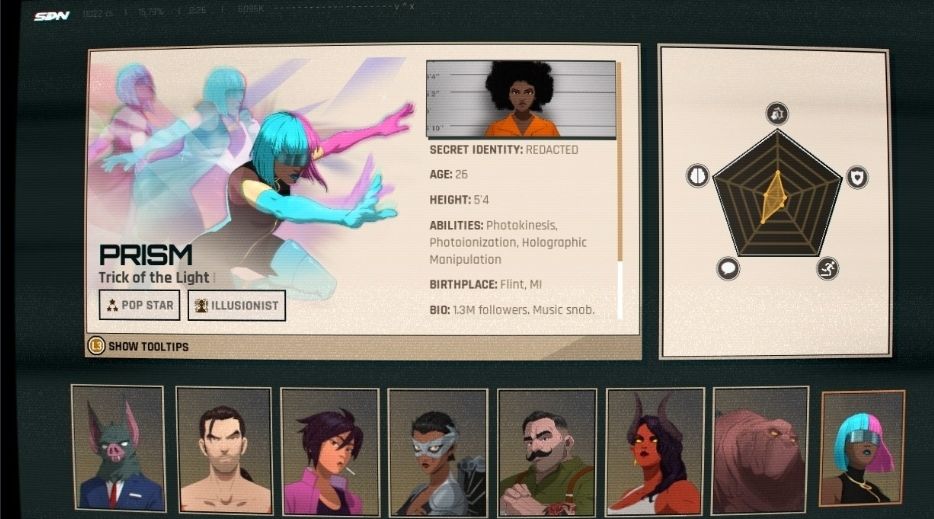
The game also adds some fun twists on the usual Telltale formula. The biggest one is the strategy game that you play when Robertson is dispatching.
Each time Robertson works a shift, he has to send his superheroes to different incidents and crimes in town. Each superhero has different stats that make them better at different jobs, so he needs to use the information he has to figure out which superhero he should pick based on the description of the incident. When you send heroes on jobs, they are occupied while on that job and need to rest afterward. So there is a balance of trying to send the right heroes to each job (you can send multiple heroes to most of them), but you also want to be efficient and not send too many heroes to overpower a job, as that could leave you vulnerable when other crimes happen. This system has a lot of fun little logic puzzles attached to it.
The system also has some RNG elements, as the work you do usually only gives you so much of a percentage chance to succeed. So despite your good or bad efforts, sometimes you’ll just get lucky or unlucky. This does a nice job of adding a little extra intensity after every decision, as nothing is fully guaranteed. But the game also doesn’t appear to be punishing in a way where this would get frustrating.
As you use your heroes, they gain experience and level up. You can pick one stat to upgrade each time this happens. This leads to a lot of fun decisions where you can mold each character into a specialist or someone more well rounded with their stats.
I don’t think the onboarding was the absolute best in the tutorial. But once I started playing the first “real” dispatch in episode 2, I was completely hooked. I was really surprised at how clever this system was, considering that this doesn’t really feel like something in this developer’s wheelhouse. Shame on me for underestimating them!
I Guess I’m A Wednesday Guy Now

There’s some other small touches I love as well. The stats at the end of each episode are really fun to look at. I like that they have stats about both the story decisions and your gameplay performance (I was in the top 20% for my first real mission. I’m a STUD).
If Dispatch wasn’t coming out in episodes, I can almost guarantee I would have exclusively played this game and beat it all within a few days. I already stayed up a bit past my usual bedtime to beat episode 2 on launch day. I have a bad feeling that might be happening to me on all four of Dispatch’s launch days.
As much as I’d love to just rip through this game and enjoy every second of it, I am secretly glad that the game is making me savor it a bit. I’m already having a blast discussing the game with friends, and the wait between episodes has me thinking about what happened a lot more deeply than I would if I was just marathoning through it. I have a lot of time to think about all of the small moments that happened in the first two episodes, which I think will just continue to enhance the game for me as I play through it. It’s also a fun way to get through “hump day,” which is usually an overall mediocre day for most. Instead, for the next three weeks after this one, Wednesdays might be the best night of my week, and there’s something really exciting about that.
I already can’t wait for next Wednesday.
If you enjoyed this post, please consider following me on social media, or checking out The Big Nerd Gaming Podcast!
The Big Nerd Gaming Podcast on Youtube
 Big Nerd Gaming
Leave a comment