

Like most people, I have many concerns about the seemingly rapid advances of AI into our society. One use of AI that has disturbed me the most is when I see people use it to try and essentially bring back the dead. People now have the ability to easily insert a deceased friend or family member into pictures or even videos with them. It allows them to imagine for a brief moment that their loved one is still there. It feels like a path that could quickly become very dark and unhealthy.
Yet, this desire to reconnect with the dead is not new. It has been with us for a long time. While there is occasionally an intellectual desire to know more about what happens after we die, more often than not it’s something completely born out of grief. Losing someone who means a lot to us is difficult to deal with, and the wish to see them again is not surprising.
Before AI, one of the main ways to give in to this desire was likely with a seance, which is a way to “connect with the dead,” generally via a medium. The Seance of Blake Manor puts you right in the middle of a seance in the late 1890s. This particular seance promises to communicate with the dead in a way that has never been done before. In the buildup to this seance, someone has gone missing, and you are called in by an anonymous person to investigate.
It quickly becomes apparent that this seance is likely going to be a very bad thing, and that grief is clouding the judgment of the vast majority of the people in attendance. Your goal is to investigate Blake Manor and everyone currently there to find out who the culprit is, and to help stop as many people as you can from attending this seance in a limited amount of time. Playing this game made me think about how often time is a flat circle in its own way. But I also couldn’t stop thinking about how impressive the execution of very difficult gameplay and story concepts was by such a small studio. If you like “whodunits” in any capacity, The Seance of Blake Manor should be firmly on your radar.
Retraining My Gaming Brain To NOT Investigate Literally Every Stupid Object In Every Single Room
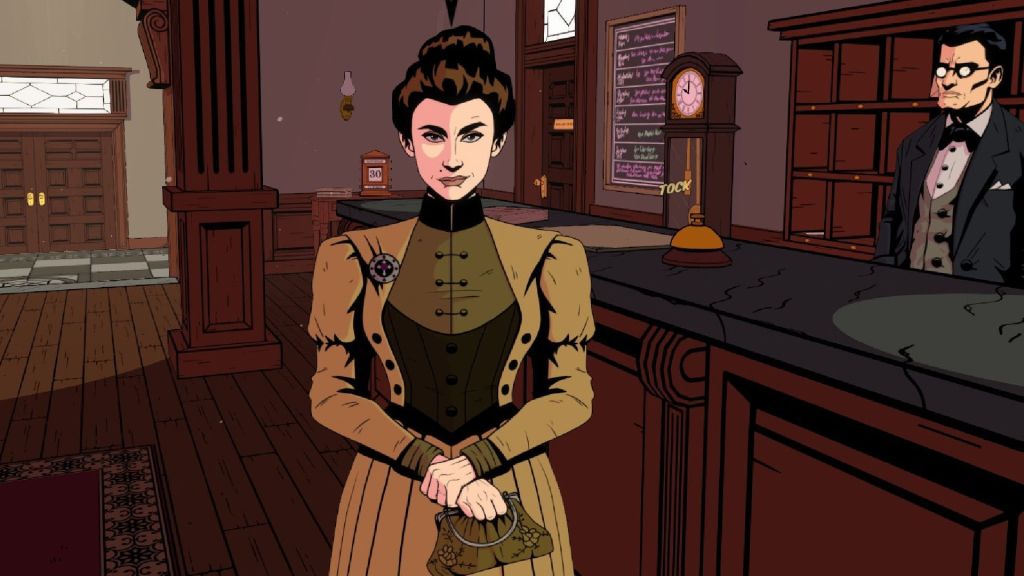
Despite all of the supernatural elements, The Seance of Blake Manor is a detective game above all else. It basically feels like if Knives Out took place in a more gothic setting and had ghosts (also, the super sleuth doesn’t have a goofy accent). You play as Declan Ward, a famed detective from this era. Your goal is to figure out the mysteries of the manor by investigating various incidents in order to slowly discover what traits the culprit has. You are also investigating each individual in the manor in order to uncover facts about them, to see if they match up with the characteristics of the criminal.
After a smart introduction, the game allows you to mostly investigate the manor and its people at any pace you want. However, you can’t afford to just dick around, as you only have about two and a half days to figure everything out.
Those two and a half days create a time mechanic that pretty much the entire experience is built around. I found it to be mostly compelling despite some early misgivings, but it was also occasionally frustrating. Essentially, every action in Blake Manor costs you a minute (with special events that can cost more). So each time you talk to someone in the manor about a specific topic, or investigate a letter, or a picture on the wall, it costs you a minute.
Early on, this led to a ton of stress for me, as I had no idea how valuable each minute would be. I don’t think it would be an exaggeration to say that there are thousands of different things you can do with each minute, which can make it a bit frustrating when many of the things you can investigate or talk about will not help your investigation. If you enter a room and there are five different letters on a desk, you pretty much have to investigate all of them, with no idea if any of them will be useful to the investigation. You can talk to every person in the manor about dozens of different topics as the game goes on, and many of these topics don’t lead you anywhere. There are also hundreds of items in the manor that don’t help in your investigation at all. I felt a sting and a bit of stress every time I wasted several minutes on things that were leading me nowhere.
Luckily, as the game progresses and you get accustomed to things, that stress diminishes a bit. You quickly learn that if an item seems incredibly generic, it is likely actually generic. I investigated “stationery” in several rooms because I wondered if there might be a half-written letter within it, before accepting that this was never going to be a worthwhile thing to examine. I stopped investigating every picture hanging on the wall in the manors unless there was something clearly off about it, or if I had a different hint that compelled me to investigate a specific one. You also slowly start to realize that the game mostly gives you plenty of time to complete its main quests and most of its side quests with time to spare.
Once I reached those realizations, I quickly found myself absolutely locked into this game. This game fulfills the detective fantasy in a way that almost no other game I have ever played does. It offers you a boatload of both freedom and tools to figure out a big mystery. I was consistently impressed by how many different topics I could discuss with each person in the manor. The time mechanic is also used in some really cool ways. Each suspect has their own set schedule in the manor, so they are in different locations almost every hour (there are ways to discover people’s schedules, so it’s not hard to find them when you need them). There are also big mandatory events that happen at certain hours, and smaller optional events that you can attend to gain new info at the cost of more time than usual if you desire.
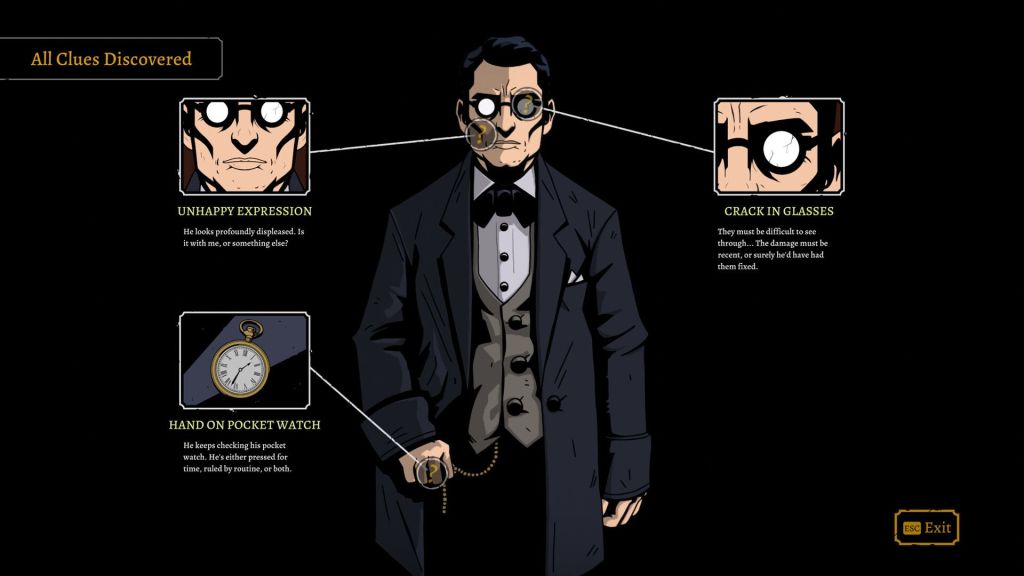
Investigating in the game is absolutely addictive because there’s so much to uncover, and the game lays out everything so well. Each resident in the game (and each “main mission” type of case) has their own mini “mind map” menu that unlocks new elements as you continue to find out more about each of them. Each person in the manor also has their own mini quest line, and seeing it through to completion will finish their arc and save them from attending the seance (or will protect them from any harm in some way). Obviously, finishing these arcs also gains you lots of information on each person, which is vital for ruling them out as the criminal as you continue to gain more info on who they might be.
Those menus might honestly be the best designed element of Blake Manor. Despite the fact that the game gives you an a ton of info, the mind maps help put everything together, and give you light clues on where to investigate next. The menus also put a nice bullet point list of information together on each person in the manor as you continue to discover more about them. Despite all of the options the game gives you, I never felt overwhelmed, because all of that information gets distilled in such a nice way. This isn’t one of those games that are getting increasingly trendy where they want you to play with a notebook next to you. There’s a lot of quality of life here, and it is much appreciated.
“Hurry Up And Wait” Is The Genuine Detective Experience
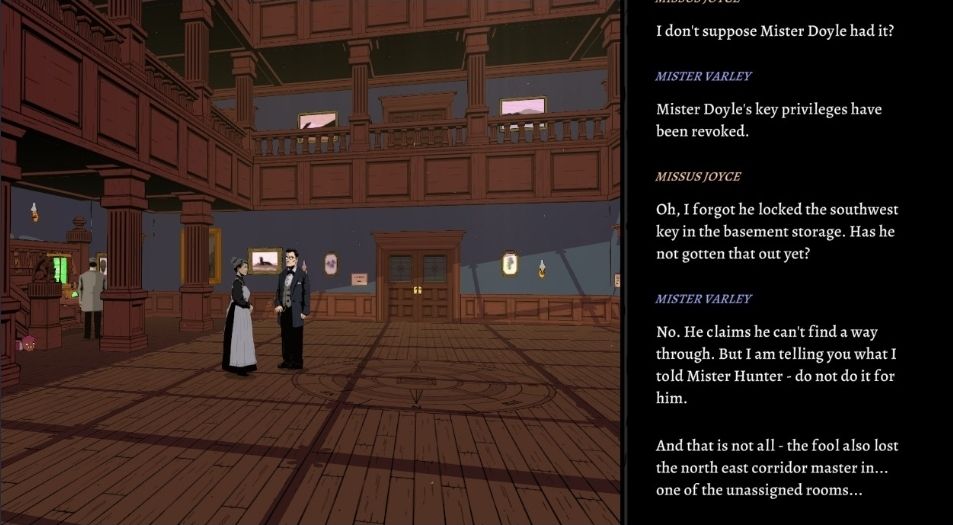
Despite mostly being won over by the time mechanic in the game, I still had a few misgivings with it. Weirdly, my problem with the time mechanic often ended up being the opposite of what I expected. There were several occasions where I felt like I had a bit too much time, and I had to skip time in order to get to a point in the clock where more elements of the manor would unlock. Despite feeling like I had too much time to burn in several spots, I still had a lot of stress that I was going to miss things, so I spent a lot of time combing through the entire manor and the same places several times in my paranoia. Doing a second or third run through of areas you’ve already seen gets increasingly less fun each time you do it, but I really didn’t want to miss anything. Sure enough, I was right, as despite feeling like I was pretty thorough, I missed out on several events and bits of information that made it so I wasn’t able to complete every side quest arc in the game. If you don’t find certain elements of information within certain amounts of time, it can completely ruin an investigation.
In one case, I found a note talking about a meeting between two characters in a discreet location, only to realize that the event had already passed. That seemed to be enough for me to not be able to complete that particular side quest. Luckily, I think no matter what, you have more than enough time to figure out the answer to the main mystery in the game, but it could still be disappointing in spots.
This is a minor complaint, but the open ended nature of the game can occasionally lead to some weird bits of conversation with various people in the house. There were a few times where I talked about a topic with someone after I had been through certain events with them, and their dialogue seemed like it was written to be discussed with them before that event had actually happened. Perhaps I just encountered a few weird ones, but the dialogue doesn’t seem to dynamically change much, if at all, after big events in the game happen that you might expect to change how things are discussed. There are an insane amount of options for discussing different topics with each person, so it’s a bit understandable, but it can mildly break the immersion at times.
We All Have Our Own Ghosts, Just Not Usually Literally
That disappointment with dialogue that doesn’t change with events, or with it being somewhat easy to miss certain smaller stories, mostly comes from the fact that the writing in the game is so tremendous. I simply hated missing certain things or not seeing more dynamic dialogue when the writing in the game delivers so consistently. Blake Manor has over 20 characters in the game, and they are all extremely well crafted. With all of the dialogue options in the game, you can really dig into the backstory each one, and they all have different things that make them interesting, as well as their own little mysteries that led them to this seance.
Those various mysteries actually ended up being the highlight of the game for me. Obviously, anyone deciding to attend a massive seance probably has a story to tell, and each character’s arc ends up slowly unfurling in some really satisfying ways. They almost all lead to blockbuster endings that had me completely engaged. Some of the most emotional moments in the game are completely optional. It’s truly astounding how well they did with them.
Luckily, the main quest storyline also delivers nicely. I absolutely loved some of the last few twists in the game, and I think it all ends in a pretty satisfying way (assuming you got a half decent ending). Simply, between the main story, and all of the ones on the side, I was always engaged with the narratives in this game in some capacity.
My only complaint is that I felt Ward’s backstory wasn’t examined as deeply as I’d like. He has a lot of stuff going on in his past, and in my playthrough, it doesn’t really get resolved as cleanly as many other characters’ stories. I know I didn’t get the best ending because I missed a few things, so perhaps that is why, but if so, I find it unfortunate to hide such a major plot line behind needing a perfect run.
My Fantasy Of Being A Very Sad Detective Is Now Fulfilled

Unfortunately, my views of the music and graphics were a bit more mixed. While I liked the general character designs in the game, I thought the environments were a bit too drab. The outdoors areas in the game in particular are pretty dang ugly. The music in the game doesn’t stand out, but it fits the moods and themes of the game well.
But none of that mattered much because this game had its hooks in me from almost the first few minutes. The Seance of Blake Manor excels in fulfilling a detective fantasy, in its exploration of grief, and in just being not quite like anything else out there. I could compare this game to the Golden Idol games and could maybe even make slight Blue Prince comparisons, but in the end, it’s a really unique experience that anyone with any interest in those other games should absolutely try out.
Unfortunately, playing this game won’t be the last time I see people struggle with grief in potentially unhealthy ways. Spooky Doorway tackles these themes of grief in so many eloquent and beautiful ways. With a few little tweaks, I think the gameplay structure could easily be equally eloquent if they attempt a game like this again.
Score: 8.5/10
If you enjoyed this post, please consider following me on social media, or checking out The Big Nerd Gaming Podcast!
 Big Nerd Gaming
Leave a comment