
There was a time in my life when I was very quick to abandon games. If a game had a few hour stretch where it wasn’t clicking for me, I’d be quick to throw it away. As I’ve gotten older, I’ve been able to acquire a bit more patience and discipline. Becoming a “game hopper” in the past five years or so has also helped me set aside a game I’m not vibing with for a few days and then come back to it with a fresh perspective. I’m not joking when I say that I’ve probably completed 100 games in the past five years that I may not have finished in the past.
Keeper is one of many games that I never would have finished if it had come out back in 2019. I found the first two-ish hours of this five hour game to be incredibly rough. I thought it had a lot of style, but too many issues with its puzzles, camera, and general controls for it to work.
Luckily, I was able to set the game aside for a few days before continuing. And the deeper I went, the better it got. I’m really glad I had patience with Keeper, because the game is not always what it first appears to be. It evolves and becomes something much better than what it is during its introduction phase, much like I feel I have gotten better as a gamer as I’ve gotten older.
Keeper has its issues, but this is still a pretty neat audiovisual experience that isn’t quite like much else out there. And I think it’s worth getting through some rough patches to see it through to the end.
You Know, I Think I Know Why Lighthouses Aren’t Known For Their Mobility Now
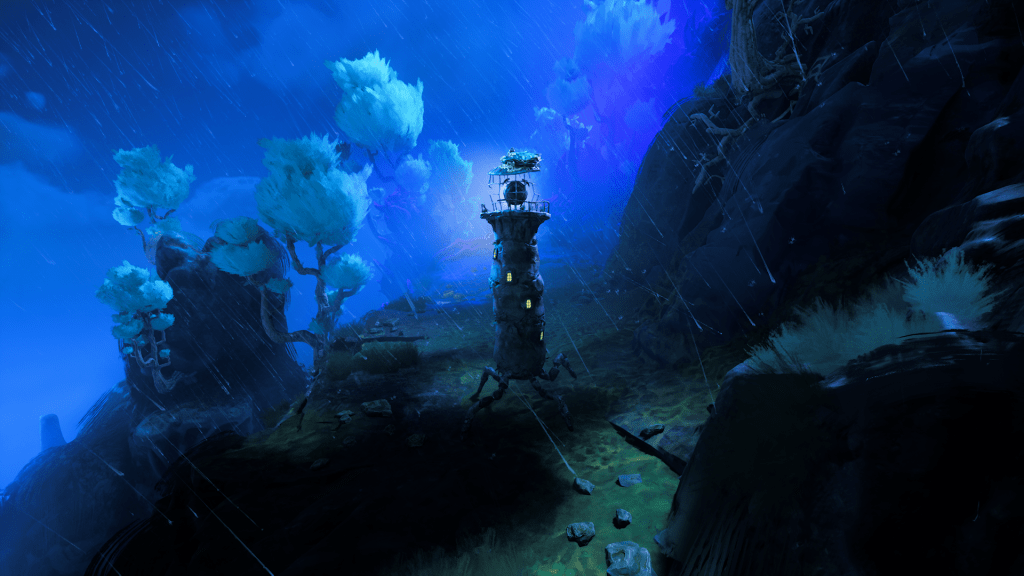
You play Keeper as a lighthouse that is fighting off a corruption of the land of some sort. Yeah, that sentence is kind of weird if you know nothing about the game, but rest assured, it starts feeling normal pretty quickly after you start playing. As the lighthouse, you can walk around with spidery legs, and shine your light on various objects in order to activate them. You also have a bird companion that can activate switches and such. Your goal is to navigate through a treacherous world and find your way to eliminate the source of the corruption. At least, that’s what is heavily assumed, since the game has no dialogue.
It didn’t take long for me to decide that I just didn’t enjoy playing as a lighthouse all that much in Keeper, especially in the early going. Almost everything about it feels incredibly clunky. The lighthouse moves around slowly, and movement doesn’t feel quite as precise as I’d like. The light mechanic in the game is also a bit unwieldy, especially early on. Since this is a lighthouse, the light can move all 360 degrees around your character, and it constantly felt awkward to shine my light on what I wanted. The light will often not go in the direction that you intend. You eventually adjust to these things, but they never felt quite right to me. Doing very basic things can be very annoying in Keeper.
The camera also led to a bit of constant irritation from me. The camera in the game is almost entirely fixed, so you can’t move it. This is common with some narrative-oriented games like this, but it gets weird here because there are plenty of sections where the camera will actually move directly behind your lighthouse. However, if you are doing a puzzle and realize you have to backtrack, the camera will often stay where it is, so you can’t always see exactly where you are going. This was a constant issue for me.
The actual puzzles I was solving didn’t make me enjoy the game either. Mostly because these puzzles aren’t even really puzzles. For the most part, the goal in the game is simply to unlock certain areas by shining your light on various objects or activating a switch. A lot of times, the puzzle solution is simply figuring out exactly where the switch you need is, or where you are supposed to shine your light. The game doesn’t always clearly mark these things, so a lot of the puzzles kind of feel like playing a PS1 Final Fantasy game, where you are traversing a beautiful environment and trying to find something that will advance the game, but the item you are looking for can blend in with everything else. I didn’t get stuck much in the game, but when I did, it was not the fun and challenging kind of stuck that I can enjoy and appreciate. It was more so due to “Where’s Waldo” type of shit, and there’s a reason I never enjoyed “Where’s Waldo.” It’s not the kind of challenge that I personally find stimulating. Safe to say, this combination of factors made it so I wasn’t enjoying my time with Keeper much at all in the first few hours.
Keeper Is Basically Like Legally Blonde. Pretty, But Flawed, And Then Decides To Go To Law School (OK, I Haven’t Really Seen The Movie So I Hope I Got That Right)
But then, after those first few hours, something flips. The game’s mechanics evolve and change a bit. This makes the game much more interesting and far less frustrating to engage with. I’m in the awkward position of not wanting to explain why because I think it would diminish the experience a bit, but as the game goes on, I enjoyed it significantly more. The controls start feeling less clunky, and moving around in the world goes from slow and annoying to being relatively smooth and even fun. The other interesting thing is that after the game evolves once, it’s not done. It will evolve in different ways again that keep things fresh and considerably more engaging. Basically, the longer I played Keeper, the more I started to like it. The last three hours of this five hour experience are way better than the first two hours.
Not that the last 60% of the game is perfect, either. The aforementioned annoyances with the puzzles and camera still persist, even as the game got better for me overall. The second half of the game has some areas that are pretty open ended, so backtracking and exploring is part of the equation, yet I was constantly fighting the camera, and it never seemed to go exactly where I wanted it to. Sometimes, it felt like the camera was trying to guide me in the correct direction, but other times, it just felt random and frustrating. It’s not a dealbreaker by any means, but it’s one of the biggest elements of the game that never fully worked for me.
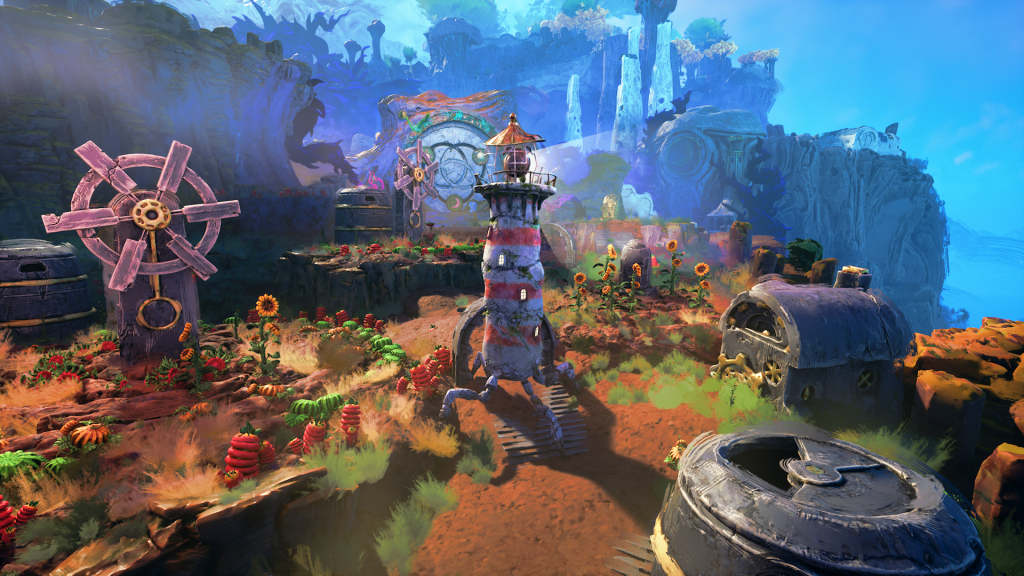
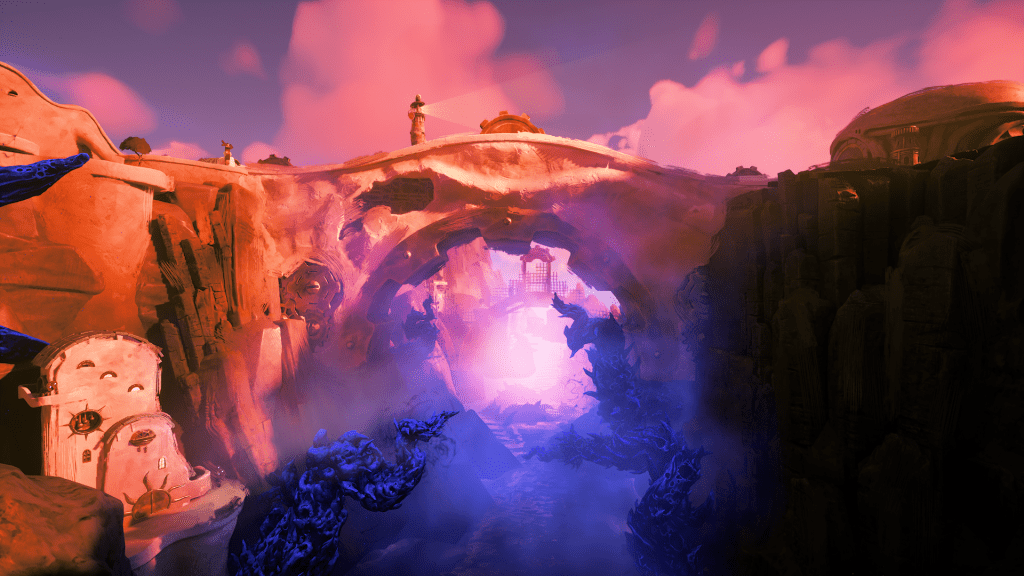
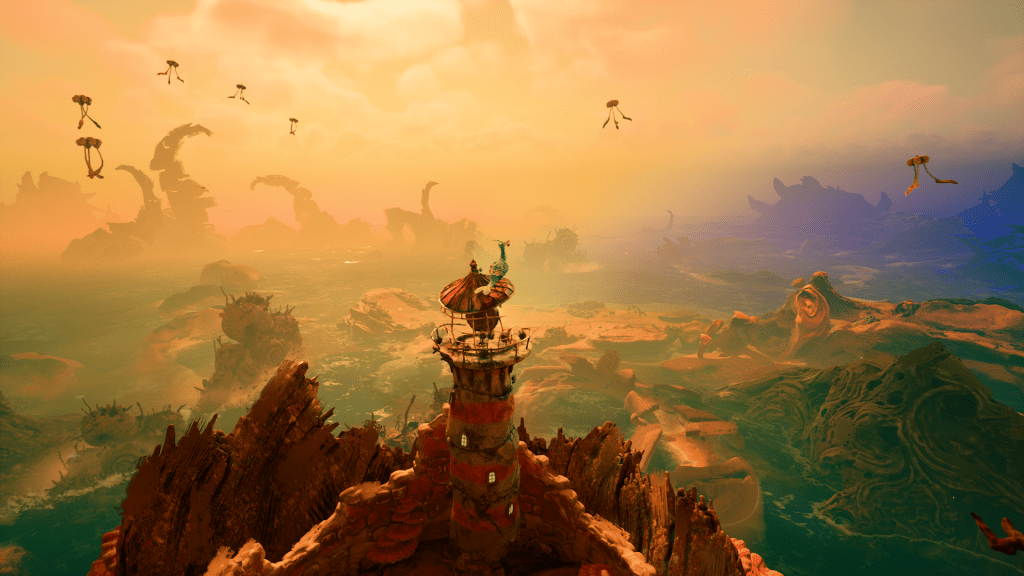
Luckily, even when I wasn’t enjoying the game, and even more so when I was, the visuals in the game always kept me at least somewhat engaged. No matter what was going on, the world of Keeper was really incredible to look at. The classic Double Fine visual style is here, with plenty of imaginative and fun character designs (as you might expect when a lighthouse is the main character of the game). But more than anything, these are easily Double Fine’s most stunning environments to date. They do a great job of giving you a nice mix of locales, and the color schemes are consistently striking. Keeper is what I’d consider an “audiovisual experience” more than simply a game, and the visual aspect delivers and then some. The music also hits all the right notes, but the visuals are what really steal the show.
Despite the lack of dialogue in Keeper, there is a story here. You can pick up certain elements with context clues and such, but the actual details are bizarrely hidden within the various achievement descriptions in the game. This also isn’t a game where you just automatically unlock achievements as you go. You have to find them in at least slightly hidden areas. I only personally unlocked a few of them through my journey. I understand the storytelling challenge here, and it would certainly be awkward to have a lighthouse finding old lore notes in the environment, but I felt like there had to be a better way. Once again, Keeper is more about the audiovisual experience than anything else, so this didn’t bother me all that much.
To Quote The Great Philosopher Rocky Balboa…
One of the hardest things about this review for me is that I can very easily talk about many of the things I didn’t like about Keeper, but it’s tough for me to discuss a lot of the things I actually liked, as these would almost all qualify as spoilers in my view.
So just trust me when I say that if you play Keeper, you need to give the game some time. It’s easy to give up on things in life. It’s easy to assume people you know are unable to change. It’s easy to believe you personally can’t change and get better. And it’s even easier to assume a piece of media is what it is after a few hours.
But it’s not true. As the great Rocky Balboa once said, “If I can change, and you can change, everybody can change!”
There was a time in my life when I would have thrown Keeper aside after a few hours. I’m glad I’ve grown enough that I can reach the ending of a game like this. Despite the flaws, I think it was a journey well worth five hours of my time.
Score: 7.5/10
If you enjoyed this post, please consider following me on social media, or checking out The Big Nerd Gaming Podcast!
The Big Nerd Gaming Podcast on Youtube
 Big Nerd Gaming
Leave a comment