
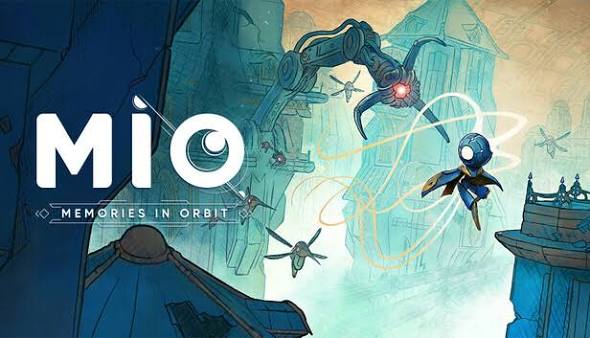
I’ve had several discussions in the past few years about the term “Metroidvania,” and if it should still be how we reference games in that particular genre. The Metroid series isn’t nearly as prolific as it once was, and the Castlevania series has been missing for quite a while (editor’s note: well, not anymore), so it’s a bit odd that we still have these games as the basis point for the genre name. It would be similar to if we still called first-person shooters “Doomlikes.” Many people think we should call these “search action” games, as that term is both a better explainer for what the genre is and feels more relevant in the modern day.
But after playing MIO: Memories in Orbit, I’m starting to think that we genuinely do need new ways to describe the genre, as I’m slowly seeing two very different trains of thought arise within it. We still have many games that seem to take most of their influence from what has generally been the standard of the genre, with clear maps that show tons of detail, not much in the way of runbacks, a reasonable amount of fast travel points, and a more “standard” difficulty. But we also have more and more games that seem to be clearly inspired by Hollow Knight, and soon, Hollow Knight: Silksong. These games take both the search and action elements of the genre to another extreme. They have very vague maps that give hints but don’t always make it perfectly clear how to navigate through each area. Fast travel points tend to be sparse. Runbacks are long, and the difficulty is usually much more Soulslike adjacent.
This fissure feels similar to describing a game as a “roguelike” or a “roguelite.” Technically, both of those types of games are “roguelikes,” but “roguelites” have very different elements than “roguelikes.”
MIO seems to clearly be in the Hollow Knight camp. It has many of the principles that come with those games. Unfortunately, MIO doesn’t quite reach any of the highs that Hollow Knight or Silksong has, but it eases up on things just enough that I’d say it also doesn’t quite reach the same lows either. If you are a fan of the Hollow Knight and Silksong side of the “search action” formula, I think you’ll find plenty to like here.
Going To A Bar Late At Night In Your Early 20s Is The Real Life Version Of The “Search Action” Genre
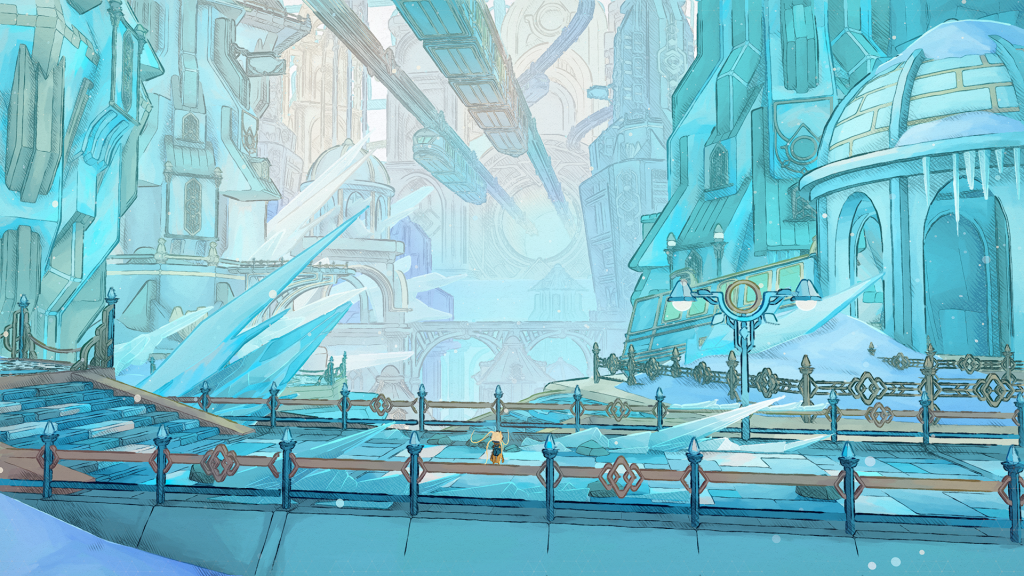
One of the interesting things about this newer wave of “search action” games is that, unlike much of the modern direction for this genre, they actually have a pretty equal weight on both “search” and “action,” rather than slightly favoring action the way many others do. MIO also follows this route. You will spend just as much time wandering around as you will fighting enemies or tackling difficult platforming challenges.
Once you get through the opening area, MIO gives you some light hints as to where you can go (but no direct objective markers on the map), and then sends you on your way. Your goal is to restore various AI caretakers on a ship to prevent it from being destroyed. You can also discover what exactly happened to the ship, but the story is told in that sort of vague Soulslike way where it’s very easy to completely ignore all of it (which is what I did).
In the spirit of not telling you exactly where to go for each objective, MIO also doesn’t automatically uncover the map for you as you enter new areas, so you’ll often be flying blind as you wander around. The map areas that you have explored get uncovered once you reach a save point or when you die. The game is also very light on save points, and even lighter on fast travel points. Between all of this, you will spend quite a bit of time in MIO at least mildly lost, or wandering back through places that you have already been through.
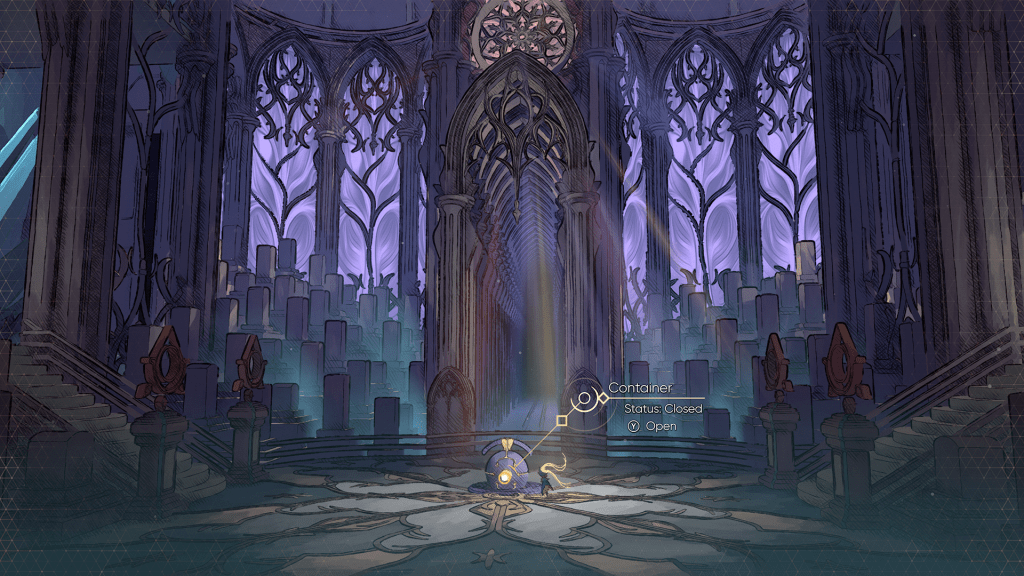
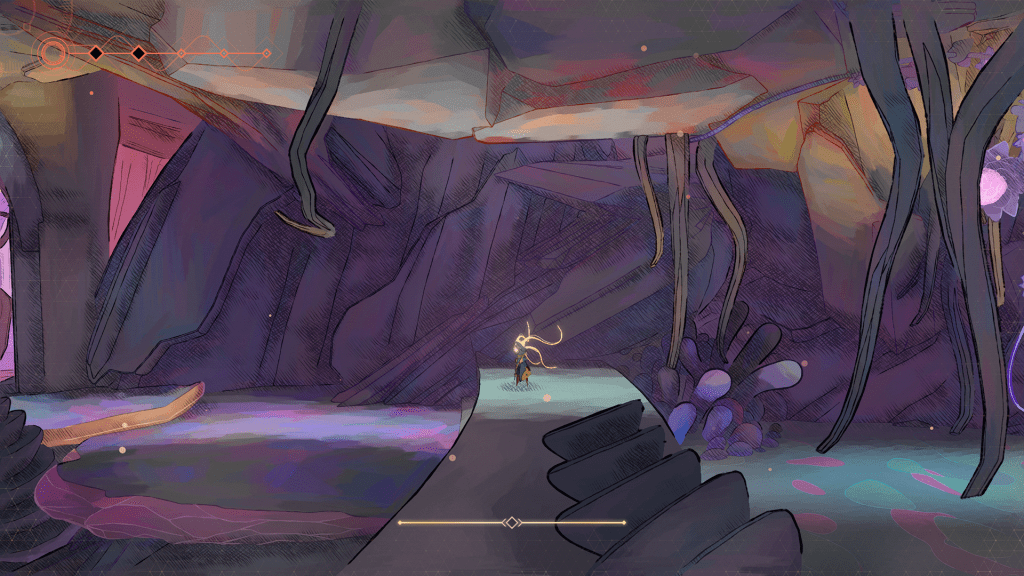
At times, being lost in this world wasn’t the worst thing, because MIO is an absolutely gorgeous game. It has hand-drawn watercolor elements that give it a dreamy look that I really enjoyed. Its music might be even better. The exploration music is relaxed in the best ways, and it transitions to some unique and catchy tunes during boss fights. The entire aura of MIO is very mysterious, which is another element that makes it similar to Silksong. But instead of that mysterious aura being more ominous and foreboding the way that Silksong is, MIO has a more relaxed and tranquil aura that works really well.
When you do uncover the map, it is definitely helpful, but I also wouldn’t call it extremely so. Many parts of the map are giant areas with lots of twists and turns, and the map will often just show you a big square or rectangle in these sections. It shows you the general direction you need to go, but it isn’t always going to easily guide you. The map is also sparse with hints, so if you pass by an upgrade that you can’t reach yet, there is a decent chance you will forget all about it unless you place a marker on the map, which isn’t always possible, as you may not have that section of the map unlocked on your screen yet.
If you’ve played a “search action” game with these kinds of principles before, you probably have a good idea of how this game can feel to play in spots. There are times when the game is incredibly frustrating, and you can end up really spinning your wheels. There are a few times in the game where I was almost happy to die and restart because I was a bit lost and preferred to restart my exploration with more of the map uncovered. There are also times when I died on purpose because it was my quickest way to fast travel back to where I wanted to go, which is always bad design in my view. At one point in the game pretty close to the end, I was completely lost and had no idea what to do. I literally explored every opening on the map that I could reach and was still lost. After looking at a guide, I discovered that I could interact with a certain mechanic in the game in a way I didn’t realize. Odds are, everyone is going to have at least one moment where they have to circle the entire map to look for where to go next, and it’s not something I particularly enjoy, especially with how limited the fast travel in the game is.
And yet, it also makes it extremely glorious when you do break through and make progress. Every time I figured out where I was supposed to go, I felt good about myself. Any bit of progress in the game feels earned, and that’s a feeling Metroidvanias that have different philosophies can’t capture in the same way. Occasional frustration is the price to pay for greater feelings of accomplishment. This is especially true when it comes to the many shortcuts the game has. MIO has some pretty long Silksong-esque runbacks throughout your time with it, where if you die you will have to spend several minutes getting back to where you were. Once you get far enough into an area, you can usually find a shortcut to unlock that will cut that run back down significantly. Unfortunately, even when you do find a shortcut, there is often still a decent runback involved. But going from a 4-minute runback to a 1-minute run-back still feels great, even if that 1-minute runback can still get a bit annoying if you end up having to do it enough times.
I mostly felt similarly about the upgrades in the game. MIO doesn’t tell you where to find its upgrades, and certainly doesn’t mark them on your map if you get close to them, like some games do. It’s all on your own ability to explore every inch of the map to find health and other upgrades. Once again, this can occasionally be frustrating. The maps in the game are so vague that even if you happen to remember to mark the map to find an upgrade later on, it isn’t always simple to find it again. However, when you do find a rare attack or health upgrade, it’s a rewarding feeling, especially since MIO is no slouch in the difficulty department (which we will discuss later).
However, the feeling of breaking through with MIO’s upgrades isn’t always as consistently pleasant as it is with the general exploration. Finding the aforementioned health and attack upgrades definitely feels good, but a lot of the upgrades center around a modifier system that the game has. Unfortunately, most of these upgrades have really high costs, so I wasn’t able to use very many of them throughout the game. This made finding many of these upgrades feel a bit useless. It doesn’t help that you have to use your modifiers just to do basic things like seeing your own health and seeing enemy health (and I think that seeing boss health is extremely important for strategy purposes, so I never wanted to forgo it). I wish that the system was structured in a way where I could feel as good about finding upgrades as I did when I found a new section of the map or a shortcut.
Biding Your Time And Waiting To Make A Move… It’s A Lot Like Going To A Bar Late At Night In Your Early 20s
Admittedly, I also had many issues with the general exploration structure in Hollow Knight: Silksong last year. While I do see some value in these exploration principles, I personally think that they usually do more harm than good. However, I still ended up giving Silksong a 9.5/10 because I thought that highly of its combat, platforming, and various other elements of its design.
Sadly, MIO doesn’t come close to those highs, but I’d still say it is pretty well made overall.
MIO doesn’t give you a lot of offensive capabilities with its combat, but it does provide many navigational skills that are used in both its platforming and to evade enemy attacks. The fun in this game comes from reading enemy attacks, avoiding them, and striking back in limited openings.
You see both the highs and the lows of this during the boss fights. I was very pessimistic about how the boss fights would go after the first several, which were incredibly simple and took minimal effort. Luckily, the bosses slowly ramp up in creativity and get increasingly tricky with their attack patterns as you go on. The bosses have pretty clear tells with their attacks, but there are just enough slight variations and fast enough pacing where they generally meet the prestigious “tough but fair” territory that I like to see with them. However, I thought that the limited amount of offense that you can do holds them back in some of the later sections of the game. Some of the last few bosses felt like they were way too long, and more of a test of patience than skill. I had the attack patterns down pretty well, but a lot of it came down to how willing I was to very slowly whittle the bosses’ health down over trying to sneak that one extra attack in each time.
I’d say MIO’s quality is a bit more consistent with its platforming, as it has many sections with no enemies that feel as intense as any boss fight. The design is devilish in the best ways. You will spend long stretches chaining multiple different platforming abilities together in order to reach the end of each obstacle course put in front of you, and it’s amazing how good it feels to get through them.
MIO gives you a “hairpin” (essentially a grappling hook), a glide ability, and a spider-y wall-running skill. It keeps finding interesting ways to use all of them until the very end of the game. I did have a few occasional qualms, though. I think the hairpin could be slightly finicky at times. Its range always feels a touch shorter than it should, and there are quite a few moments where it would touch the enemy or the object that I was trying to grapple onto, but apparently, the connection wasn’t firm enough, and it would stop working.
The wall-running skill also had a few moments of confusion for me. There are certain sections of walls that you can’t touch, or you get hurt. Sometimes when I was using the wall-running skill, I could touch these sections for a moment before it would hurt me, and other times, it seemed like it would hurt me right away. My theory was that the amount of speed you have built up when you go onto these sections dictates whether it hurts you right away or not. Unfortunately, the game doesn’t explain the rules of it all that well, so I was never totally sure. But there were only a few sections in the game where this came into play, and I was able to get past them, even if it felt like luck a couple of times. Platforming is still probably the strongest overall element of the game despite these occasional issues.
Platforming could also be tricky thanks to some confusing visual design elements in a few specific instances. There are certain terrains that kind of look like water, but more like a blue goo, and these damage you whenever you walk into them. Meanwhile, there are other bits of terrain that look very similar to those blue areas but have purple in them instead. Generally, I would be more concerned about the purple stuff, as that is often correlated with poison in game design, but those were safe. There are several other random design decisions throughout the game that I found odd as well. The way the health bar works is really bizarre and confusing, and left me unsure of how many hits I could take in some scenarios. I felt that for as well made as MIO is in so many capacities, there are a lot of small mistakes around the edges that wore me down at times.
I Really Need You To Know That I Would Occasionally Go To The Bar Late At Night In My Early 20s. Please Give Me Validation
Despite all my complaints, MIO is still a very enjoyable video game. Even though I don’t love every decision it made, it is thoughtful in how it approaches its Metroidvania principles, and it creates a mysterious world that fits in with those mindsets really well. It also has very solid platforming and pretty good combat.
Also, while MIO is definitely difficult in spots, it is not nearly as hard as a game like Silksong. This eases a lot of the frustration that can come with a vague map and long run-backs.
While relying on game comparisons for a review can feel lazy, it genuinely feels like the best way to go about things here because MIO is so clearly inspired by Hollow Knight. If you liked Silksong, I think you’ll find plenty to enjoy here, even if it won’t come close to that high bar in my view. If you liked Silksong’s core gameplay but found it too punishing, this might be a nicer way to experience this sort of Metroidvania formula. If you really despised Silksong and Hollow Knight, then this one is probably a safe pass.
As someone who despised Silksong at times but loved it in many others, I perhaps unsurprisingly come down somewhere in the middle.
Score: 7.5/10
If you enjoyed this post, please consider following me on social media, or checking out The Big Nerd Gaming Podcast!
The Big Nerd Gaming Podcast on Youtube
 Big Nerd Gaming
Leave a comment