
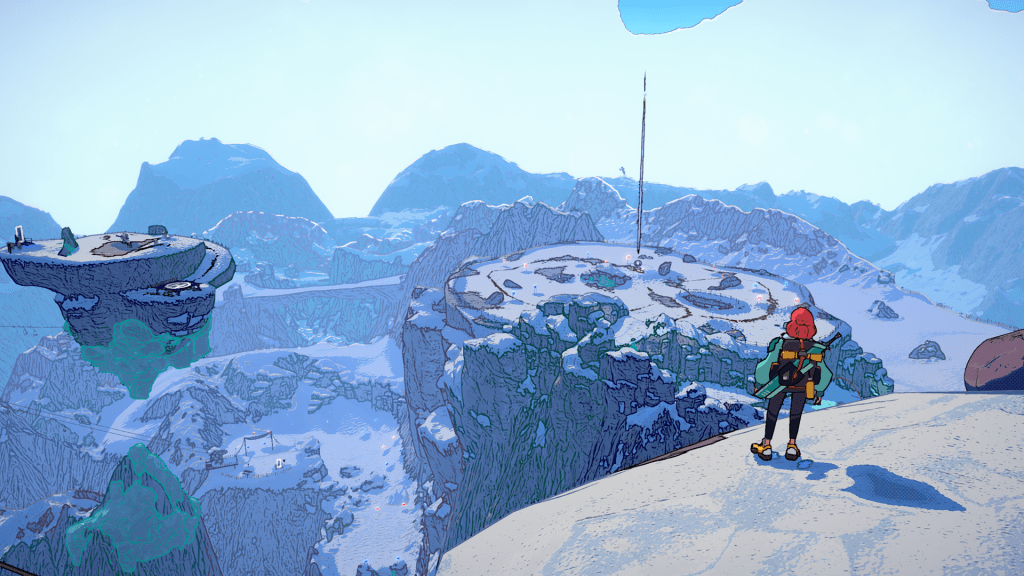
I was overcome by an interesting feeling each time I booted up Dungeons of Hinterberg for this past week. At times, I felt like I was playing something incredibly familiar. Each time I dove into one of the games’ titular dungeons, I almost could have sworn I was playing a Zelda game. Each time I walked around its main hub city, I was overcome by the same relaxed mindset that I usually have when playing a cozy game like Animal Crossing. And each time I decided who I wanted to spend time with in the evening in order to get special stat boosts, I suddenly felt like I was playing the newest Persona game.
When you add all of these varying degrees of familiarity together, I felt like I was playing something not quite like anything else I had ever played before. Dungeons of Hinterberg boldly mixes genres in ways that seamlessly blend together while all standing strong on their own accords. This combination creates a game that is not only my favorite indie game so far this year, but also one of the best overall released in 2024.
Stressed? More like BLESSED

Dungeons of Hinterberg wisely wastes little time throwing you right into that fun and unique gameplay loop. After introducing you to Luisa, a lawyer who is stressed the heck out (seriously, almost any working person will relate HARD to some of her early thoughts on work stress), the game throws you into its first dungeon almost right away. The town of Hinterberg had 25 magical dungeons show up randomly, and now tourists from all over are coming to vacation, learn magic, and tackle these dungeons and the monsters in them. The concept always made me think that this would be a combat heavy action RPG. It was very surprising to discover that it is not like that at all. I’d say that more than anything else, Hinterberg wants to be a Zelda game and goes much harder on the puzzle solving than anything else.
With lots of puzzles across 25 dungeons, I was concerned that Hinterberg might slowly get a little repetitive and dull as it went on, but it works extremely hard to stay fresh from start to finish. It does this in a variety of ways. First off, the dungeons are a nice bite-sized length. I’d say most of the dungeons take somewhere between 20-30 minutes, so they have enough time to get interesting, but you never feel like you are in a dungeon forever. More importantly, all of these dungeons are really varied and interesting. While most of the dungeons have a good chunk of puzzle solving, with doses of combat in-between, the game finds a lot of neat ways to keep you on your toes. Several dungeons have perspective shifts, where the game suddenly goes from a 3D action-adventure into a more isometric game or a 2D game. A few dungeons are mostly just big boss fights that are generally pretty clever. A couple of dungeons essentially have you doing snowboarding time trials. Every time I thought I had Hinterberg figured out, it managed to switch things up on me in fun and unexpected ways.
But even when the game sticks to a more standard Zelda dungeon script, it still manages to be absolutely spot on. I loved the puzzle solving flow in this game a lot. The puzzles feel perfectly balanced for a game like this. They get you thinking, but also rarely slow down your progress significantly. I got through the entire game without using a guide and only really got stumped a couple of times. I would usually encounter a puzzle, poke around with a few different elements of it, and then solve it. There was a constant feeling of progress, but it also never felt too easy either. If this was purely a puzzle game, that might be disappointing, but considering the puzzle solving is one part of a much bigger experience, I thought it was just right, and very adjacent to how I tackle older Zelda dungeons.
The other main part of that experience is the combat. It doesn’t hold up quite as well as the puzzle solving, but I still found it mostly enjoyable. The combat feels like a mix between standard action RPG combat, some Zelda elements, and a very tiny dose of souls with its stamina meter for dodges. The main hook of combat is that the same magic that you use to solve puzzles is also used to fight, and there are quite a few creative spells that can be fun to use. In one area of the game, you can ride in a tornado and use that to hit and knock over enemies. The snowboard that you use in the snowy sections of the game can also be used to leave a damaging magic trail behind that hurts enemies if they walk on it. In the last section of the game, a jelly block that you use to climb on can also be used to trap enemies so that you can attack them freely. Depending on which of the four dungeon hub areas you are in, you use different spells, which keeps combat a little more fresh, since you can’t constantly employ the same strategies from the start of the game to the end. But there are a couple of areas where I was not as thrilled with my spell selection as I was in others.

Hinterberg does offer you more consistency with its “attack conduits,” which are the kind of skills that you’d expect from a more traditional action RPG. I found a lot of fun options here that kept me happy, especially in areas where I didn’t like my magic options as much. I loved the blade wave attack in particular, which cuts through multiple enemies in satisfying ways and even got me a rare sextuple kill at one point. The game gives you a decent amount of options (I believe I counted at least 8), and you can take three with you. You also have a somewhat robust amount of flexibility with how you build your character. You can focus more energy on your magic, physical attack, or attack conduits. So, while the game is more rigid with its magic, you don’t necessarily feel super constricted with how you play the game when it comes to combat.
The dodge and physical attack definitely felt a bit slow and occasionally awkward and janky. This might have been a purposeful design decision, as the main character is a lawyer by trade after all. Regardless, while I wouldn’t say it was bad, the basic attacks never felt totally right either. The focus in Hinterberg is the magic and skills, but you do have to do basic attacks to use those things, so it was slightly disappointing that this didn’t feel better. Despite these complaints, I still found combat fun overall, especially since it isn’t the main focus of the game.
Like any good Zelda game, Hinterberg also has a nice amount of exploration and treasure discovery as well. Much like its dungeons, these are also in satisfying bite-sized chunks. As mentioned earlier, there are four main hubs in Hinterberg that house all of its dungeons. Once again, each of these four hubs has different magic that you can use. The hubs already feel diverse visually, but these shake ups with the spells allow each hub area to feel especially unique from one another mechanically, too. The game doesn’t tell you where each dungeon is, so it’s up to you to explore each area to find them. There are also plenty of hidden spots out there with extra loot that you can find. There was true satisfaction and feelings of discovery as I wandered each area in the game, but it also never got frustrating. If you get on paths, there are sign posts that tell you if you are getting near a dungeon. You can also look through the map and at least figure out where some key buildings are, and probably deduce where some of those dungeons are, too.
Much like the puzzles, the exploration isn’t too over the top, but it is consistently satisfying. Add in some lovely art direction, beautiful cel shaded graphics, and a nice photo mode, and I ended up having a lot of fun exploring each hub world. All the pictures in this review are directly from me.
My Real Life Friends Aren’t Giving Me Good Enough Stat Boosts
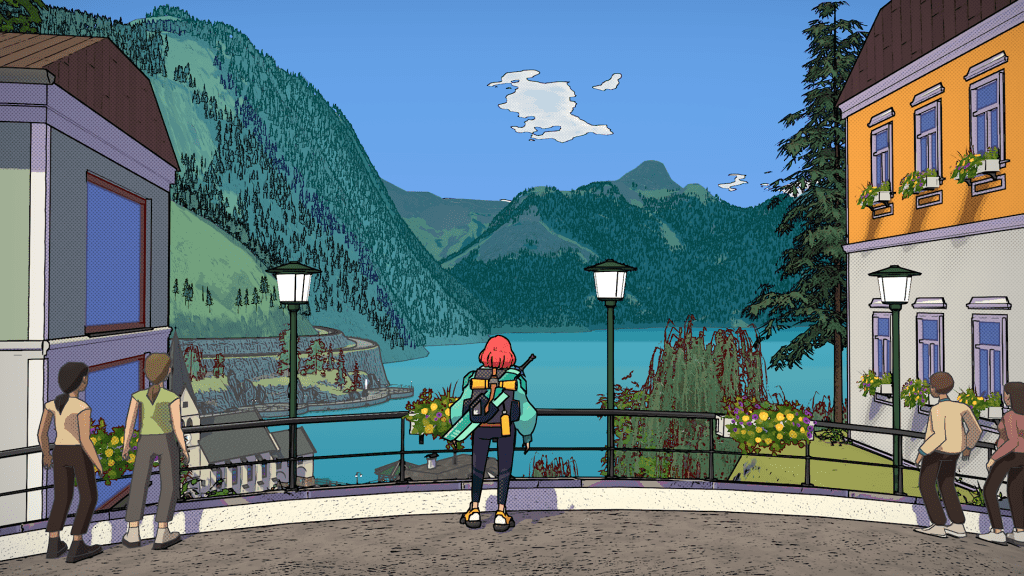
After each day of dungeons and exploration, Hinterberg then transitions to the tourist town life, which is basically straight-up Persona mechanics. You can wander around the town, take in some sights, and hit up the shops to upgrade your character and equipment in various ways. As previously stated, the game actually gives you a pretty nice slate of options to let you customize the way you want your build to be. From there, it’s time to be social. Hinterberg really simplifies its social system and always allows you to see what the next benefit will be for whoever you hang out with. I started out extremely strategic and hung out with people who had benefits that appealed to me the most. Each character also has their own little story arc, and usually a side quest that goes with it.
Like you would expect, not every single one of these arcs is amazing, but I found most of the ones I did to be very enjoyable. The writing in Hinterberg is this wonderful mix of reflective and quirky that leads to a lot of fun encounters. Many of these also address the various ups and downs that come with living in a tourist town. I’ve been to plenty of tourist towns in my day, and it was fascinating to get what felt like an authentic look at how that life can be. As I continued on with Hinterberg, I went from being almost entirely strategic with my hangouts, to hanging out with people whose story I enjoyed, because there are some really cool ones where I needed to see the ending.
While the hangout portion of Persona games can feel “cozy”, there is always added stress because of the time limits attached to those games. I did not encounter even a hint of any deadlines for Hinterberg, so you appear to have all the freedom in the world to max out each character at your leisure. This definitely fits the general vibe of the game better, and it was a great design decision by the developers.
That solid writing with the character arcs also extends to the main story. At first, Hinterberg mostly feels like a look at how important getaways and nature are for the soul, even in our increasingly technology driven lives. The plot actually ends up with a few twists that had me pretty engaged and excited to see how things would end, even if I wasn’t always on the edge of my seat or anything. That ending is very satisfying in multiple ways, and made all the work I had put in feel worth it.
With how well it executes on everything else, it’s probably not surprising to hear that I also enjoyed the music in Hinterberg. While it’s not really something I’d listen to on its own, it fits the vibe of the game perfectly, and is a big reason why everything feels so relaxed, even when you are slaying dozens of monsters.
I Always Return To My Favorite Vacation Spots
Dungeons of Hinterberg was one of my most anticipated games for the back half of this year, and easily my most anticipated indie game. With high expectations comes a high bar, and somehow, this game managed to clear that bar almost every time.
I was constantly impressed by how seamlessly this game draws together some very disparate genres. When I read about everything this game was trying to do, I felt like it was shooting for the stars. Sometimes, that can be disastrous. This is one of those rare times when the execution matches the ambition that the developers had. Because of that, this is one of the best games of 2024 in an absolutely loaded year. And it has enough general appeal where I think almost any type of gamer can enjoy it. Do not miss this one.
Score: 9.5/10


 Big Nerd Gaming
Leave a reply to Westen Cancel reply