
Whenever I see complaints about video game remakes, I like to remind people that video games are still a relatively new artform. It might be ridiculous for Hollywood to come out with a remake on a movie that came out in 2004. But for video games? Video games were something like a teenager at that point. Capable of brilliance, but still not fully formed. Along with the obvious graphical improvements, games have generally implemented more depth and more interesting gameplay design as time has gone on. Often with better quality of life elements as well.
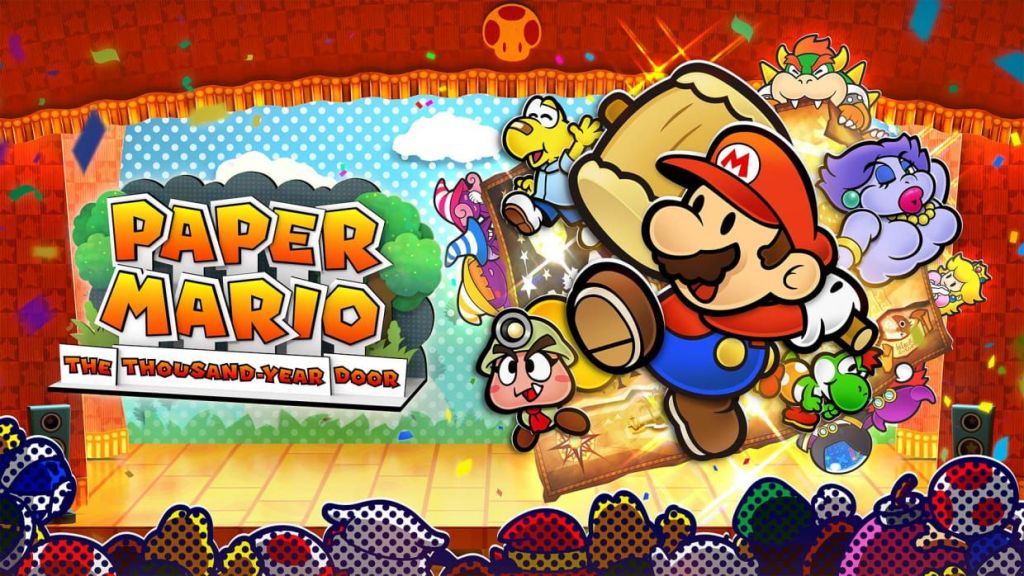
Paper Mario: The Thousand Year Door is a great example of how fast video games have grown. It has a brilliant battle system that is very well balanced and interesting. It’s clearly leagues beyond what Super Mario RPG and the original Paper Mario did. Unfortunately, some annoying elements that were more common in the mid 2000s still remain and hold the game back from truly living up to its potential. Despite these misses, TTYD is still a game well worth playing.
Surprising Depth

The core of TTYD is its battle system, and it is easily the best aspect of the game. I almost view it more like a puzzle game than a traditional RPG, and that is a high compliment. Mario has two basic attacks he can use to fight foes, his jump, and his hammer. Based on the enemy design, it’s pretty easy to figure out which way you should attack each foe. You should clearly jump on flying enemies, and you should definitely use a hammer on spiky foes. It’s simple, but the game continually builds on this as you go. As you get deeper into the game, you might come across spiky enemies who are also flying. Or enemies with defense that make them difficult to damage with basic attacks.
From there, you have to get creative. You have more powerful attacks linked to the hammer and jump that consume “FP” (basically, the MP of the game), and you also have special attacks linked to a meter that charges in various ways as you fight. Additionally, the game heavily encourages you to use special items to attack certain foes. You end up having a pretty surprising amount of options in each battle. You also want to conserve your FP and special attacks as you can only use them so much, so there is always a balance in deciding when to go full blast on an enemy, or go with a more basic approach.
You also have a lot of options with the allies that Mario gains throughout the game. You can recruit up to seven other characters, and you can fight with one of them at a time in each battle. You can also swap your allies at will (I highly recommend equipping the badge that allows you to swap them without a turn penalty). Depending on the foe, I was constantly switching which ally I had on the field. I really enjoyed how rarely I had any one specific ally in battles with me. It makes sense to switch them a lot, and it adds a lot of fun decision-making to each fight.
The other twist is that the RPG elements are simplified to a major extent, which ends up being a huge asset to the game. I spent most of the game with an HP of around 25. Most opponents you fight will have less than 10HP. In a world where RPGs will have you doing thousands of points of damage with every sword swing by the end, TTYD has you pumped up when you do something like 10 points of damage. The game also gives you a nice amount of flexibility with how you build your character. Each time you level up, you can increase your HP by 5, your FP by 5, or your “badge points” by 3. The badges are basically your equipment. Some of them do standard things like increasing your attack. Some of them give you those special FP attacks that I mentioned earlier. There is a lot of interesting decision-making that goes into what to level up each time it happens. I personally kept my HP and FP somewhat low, but really went hard on the badge points so that I could get other advantages.
These two factors are what make every fight truly feel like a puzzle. You have tons of options for going at each enemy, but because even taking 5 points of damage can be a big blow, you want to be as efficient as possible when taking out enemy groups. I really thought about each action I wanted to take, because if battles linger on too long, you can take a fair bit of damage fast. With all the different options for building my character, picking my allies, and picking which types of moves I wanted to use each battle, I was pretty satisfied with the battle system the whole way through.
That doesn’t even include the other fun part of battles, which are the action elements. With every attack and special move, there is some sort of action command that you can do to enhance the attack. In many games that include this, these end up being pretty simple. But TTYD goes above and beyond, with lots of clever and unique action commands that kept me on my toes. I was rarely just mindlessly pressing the A button on attack impact the way a lot of games with action commands do. You can also get a first strike on enemies by jumping on them or using the hammer on them before battles start, which also added a little extra action fun to the proceedings. The game constantly kept me on my toes in excellent ways when it came to combat.
It’s Time to Backtrack… Again

Unfortunately, the game is generally not as perfect when it comes to everything outside of combat. The story here is pretty typical Nintendo fare. As Mario, you need to collect seven crystal stars in an attempt to save the world and Princess Peach. While the writing is consistently cute, there is nothing here that is all that compelling. The game devotes a bit more time to the story than it probably should, most notably with little vignettes with Princess Peach that often dragged on. But there are some stand-alone chapters that have interesting moments to help make up for this as well.
The real problem with many of these chapters is a seemingly constant need to backtrack, combined with very limited fast travel elements. I never felt like the map in any of the “biomes” in the game were all that big, but the game is just constantly finding ways to make you go back the way you came, often for reasons that seem incredibly unnecessary. It was grating and struck me as padding the hour count of the game for some insane reason. Paper Mario: TTYD took me about 30 hours to complete, but the game very easily could have been 25 or less. A few areas are particularly egregious, like a train level where the game forces you to go from the front of the train to the back around a dozen times, and often makes you to go into every room on the way to investigate things.
The game also tries to have some diverse mechanics and settings across each of its chapters. Some of these are awesome, like a chapter where you spend the whole time in a tournament fighting your way to a title. Others, like a level with some super janky and awkward Pikmin mechanics or the aforementioned train level, are a real drag. I respect that TTYD didn’t want to just have each chapter follow a standard formula, but unfortunately, while there are some high highs, this also ends up creating some pretty low lows when those ideas miss the mark.
Since this is a Mario game, plenty of platforming and exploration elements are also thrown into the fold. I ended up being pretty hot and cold on both of these. TTYD is a 3D game, but with a fixed camera that makes it feel 2D in ways. This can lead to some awkward platforming where it is really difficult to judge your depth. But the game does have some cool platforming skills you can use as well, with one where you turn into a paper airplane being a highlight for me. You can use these skills to solve various little navigation puzzles, which are usually simple and fun. You also use them to explore and uncover secrets, which can often feel a bit unrewarding. You have a very strict item carry limit, so you will constantly find items that you have to toss away, which is pretty annoying. There are some more useful things tucked away, too, like collectibles that allow you to power up your allies and ones that let you buy some cool badges. This helped a little bit, but I still never felt like trying to find most of the secrets in any world was all that worth it.
These are all the areas where it’s disappointing that the game didn’t take a few more liberties to make things a bit more modern and to trim some of the fat. The Super Mario RPG remake last year cut several hours off the original experience, and I really wish TTYD followed a similar path. It also seems silly that the game didn’t just give you a more convenient fast travel system.
At least the developers didn’t skimp on the visuals, as this is a really cool looking game. The classic Paper Mario style is, of course, here, but the environments are really nicely detailed in ways that made it at least a little more bearable to do some of that backtracking. The soundtrack is also as solid as you would expect.
Fun With Or Without Nostalgia
I actually never played the original TTYD, so I did not come to this game with any nostalgia whatsoever. Despite this, it still made me feel the way I did when I was a teenager playing video games. Sadly, some of those memories are ones of annoyance. But it also reminded me of a time when Nintendo was one of my favorite game developers. There’s so much joy and ingenuity here. Nintendo set out to make RPGs in their very own Nintendo way with this franchise, and TTYD seems to be when they truly put it all together in a lot of facets. While this easily could have been a lot better, there’s still a lot of the classic charm and fun that anyone would expect out of a classic Nintendo game. It’s well worth a try from those who have never played it before, and I imagine even more so for those who have fond memories of the past with it.
Score: 8.0/10
 Big Nerd Gaming
Leave a comment