

A review code was provided by Keymailer and PQube Games.
One of the most famous pictures of the 1980s has to be of Boris Yeltsin’s trip to a random American grocery store in Houston, Texas, back in 1989 (picture at the bottom of the review). Yeltsin was a Russian politician, which was a communist country at that time. When Yeltsin arrived, he was astonished at the wide variety of items this store had, and especially at how many of these items were stocked to the brim.
It’s a picture that I will still see on occasion to showcase the power of capitalism and globalization. Yeltsin made several stops on his tour of America, but it was reported in his biography that this random foray into a grocery store was the most impactful thing he saw on his entire trip. The grocery stores in Russia had next to nothing in comparison to what American grocery stores did.
But also, politics and economies aside, there’s just something incredibly aesthetically pleasing about seeing a fully stocked grocery store. Perhaps it’s because I worked in a grocery store as my first job and at another one after college, but seeing hundreds of products stocked and faced properly on a grocery shelf just looks really nice to me. I think in that moment, Yeltsin felt the exact same way.
I’ve been thinking about that picture quite often in the past week or so because I have been playing Discounty. Discounty is a new management-sim/cozy supermarket game from the rookie studio Crinkle Cut Games.
Discounty makes me think about Boris Yeltsin because it genuinely captures some of the thrills of working at a supermarket (look, I met my freaking wife at a supermarket, it wasn’t all that bad!), but it also has some of the most interesting commentary on capitalism that I’ve seen across the medium. Discounty has an absolutely addictive formula, but it sneaks in a narrative that is much more nuanced than I ever expected, especially for a game in this genre. These elements combine to make Discounty my favorite “cozy” game in a year that has had several strong ones, and it also has me half considering working at my local grocery store a few days a week for funsies.
“Honey, Why Is Your Fictional Grocery Store Better Organized Than Our Freaking House???”

You play Discounty as a character who is moving to a small town where his aunt lives to help her launch a new grocery store (a chain called Discounty). After a short introduction, you are let loose to run the store. Your goal is obviously to manage the store as efficiently as possible and make as much money as you can.
The key to Discounty is being organized. If things are a mess, everything gets harder, and it becomes way more difficult to make money (much like a real grocery store).
The first step once you have your items to sell is to set up your storefront and your backroom. You have a lot of items to sell, so every inch of your retail space is valuable (once again, just like the real thing). You want to set up your store in a way where both you and your customers can navigate through the store easily. While you technically don’t need to do things like put all of the produce together the way your local grocery store might, doing so makes it a lot easier for you to keep track of things. Same with the backroom. As you order new items and put them in your backroom to store, it’s essential that you have a logical layout for everything.
Organizing both is a bit of an art. You don’t really get much direction in terms of how to lay everything out, so you have to imagine it and then make it happen. It took a lot of thinking and tweaking for me to figure out how I wanted to do both, and as your store grows, you’ll have to continue to reimagine your layouts. But getting this done is so unbelievably satisfying. If you’ve ever re-organized a storage room or even a messy closet in your house, it kind of feels like that to get this done. First off, having your backroom and showroom laid out in a nice way is just cool to look at, as we discussed before. But also, getting this done pays off big time with the amount of time saved whenever you need to find a specific item in the backroom and restock it.
With that out of the way, you are ready for business. Once your store opens, there are two main tasks you need to work on. First off, restocking. Each customer comes in with a grocery list. If you don’t have an item they are looking for stocked out, it costs you money you would have gotten from a sale. Plus it makes them unhappy, which can have minor consequences. So, as customers grab items, if you start to get low on something, it’s important to grab it from the backroom and stock it out. Usually, I didn’t have to do tons of stocking mid-shift, as if you have everything stocked out fully beforehand, you shouldn’t run out of items in the middle of a shift too often.
Luckily, The Game Doesn’t Have A “Worst Small Talk You’ve Ever Heard” Simulator To Go With Its Cashier Elements

If the gameplay of Discounty was simply to watch customers grab and pay for items, and then restock the shelves, I think things would get boring pretty fast. Discounty’s secret sauce with its grocery gameplay is that you also function as the cashier. You check out customers with two different minigames as the story progresses, and they are both surprisingly fun.
In the early going, you just have a cash register that requires you to type in the quantities and the price of each item that gets placed on the grocery conveyor belt. You are given a price list as well. So you have to reference the price list and type everything in by selecting each button on the register. It’s important to go as fast as possible, as customers will get upset and potentially leave if you take too long. Early on, I fumbled with this a bit, as typing in prices actually takes a little bit of practice to get good at, and finding the prices of each item can take a second. After a few hours, it was kind of amazing how quick I got. I even naturally started memorizing prices, so if something like a banana ended up in front of me, I could type in its price without even looking at the price list, which saved me precious time.
I was having so much fun with this mechanic that I was almost disappointed when the game let me upgrade to a barcode scanner. However, as the game goes on and you offer more items and customers buy more items, this new mechanic becomes pretty necessary. Luckily, I found it equally fun. The scanner requires you to flip each item to where its barcode is. Each type of item has its barcode in a different direction. It’s not hard, but it’s just engaging enough to stay interesting. If you memorize where the barcodes are for each type of item (the game has a reference sheet for you), you can do this incredibly fast as you keep getting better at it. This mix of restocking items and checking out customers really creates a great flow that I enjoyed for my entire time with the game.
My only complaints with the grocery store mechanics are mostly nitpicks that might be fixed with patches pretty quickly. I ran into a couple of bugs with the barcode scanner, where it wouldn’t let me flip an item in the direction I wanted. I found that if I flipped it a different way, and then the correct way, this would fix it, but this caused some frustration at times until I figured that out. The customer AI is also pretty stupid. Sometimes customers will stand in line and wait for other customers who are still shopping to go ahead of them (I assume the AI is trained for customers to check out in the order they entered the store). This could, at times, cause customers to wait longer, which would then affect their satisfaction rating at the end. Some customers also come in with only a short time left to go in the shift. When the store closes, these customers will go straight to the checkout, even if they don’t have everything on their list. This would also cause them to be more unhappy with their visit. These problems were greatly exacerbated at the end of the game when I had more customers coming in with longer lists. Luckily, I also never really faced any punishments for unhappy customers. I believe you have to be below 50% satisfaction in order for the game to penalize you with less customers coming into the store, and there was only one shift where I even got close to being that low. So, in the end, my only complaints were things that barely affected me.
Working Off The Clock? This Is The Capitalism Simulator We’ve All Dreamed Of!
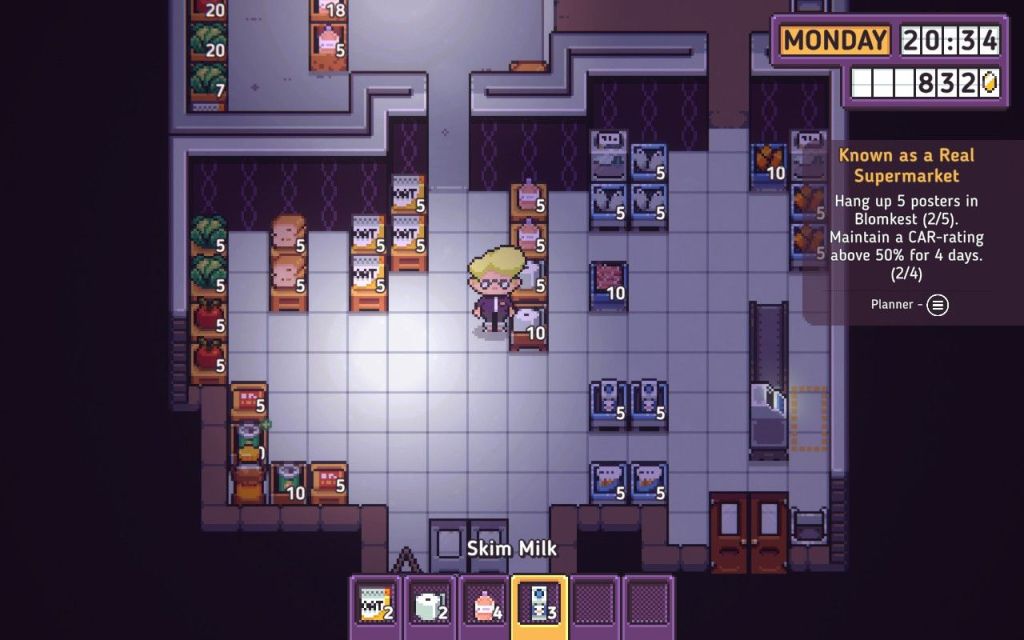
The work is rarely done after a shift is over. Doing the cashier work can keep you pretty busy, so I’d often find myself restocking the store in full after the store was closed down for the night. You can also order more items as you start to get low on stock. Early on, there’s a bit of strategy here, as sometimes you might not have enough money to really load up on every item you want to have, but as the game went on, I generally had more than enough money to order anything I was low on.
Once the grocery store work is done, you are able to spend some time in the little town of Blomkest. There are a few things related to business that you can do in town. You can buy shelves for your store that you’ll need to display everything, and you can buy upgraded shelves later on as well. You can also buy decorations for your store and the trailer that you live in (which I never did because space is valuable). Additionally, you can get items for your store through “trade deals” with certain people. The town is also where you’ll complete a lot of the objectives that help you advance the story. Finally, you can interact with all of the people in town, many of whom are pretty entertaining, and several of them actually have some decent little story arcs as the game progresses.
While that may sound like a decent amount of activities, in practice, I found the town to be a bit lacking (which fits the story themes we will talk about next). The grocery store elements of the game kept me quite busy, so I didn’t always have tons of time to spend in town, but there were several days when I was caught up on my store and went to bed pretty early because there isn’t all that much to gain from exploring the town most days. If you don’t need to buy anything from shops or advance the story in some way, about the only thing you have to do is pick up random cans, which can give you a very small amount of money if you recycle them.
Talking to people in town can be fun, but most conversations involve something like 6-7 different text bubbles to go through, and there are a lot of repeat conversations, so I didn’t do this as much as I might have otherwise. It’s pretty annoying to spend an extra 5-10 seconds skipping through a conversation you’ve already seen every single time you talk to someone.
You can also unlock various story moments with each character, but the game isn’t super clear on how to unlock most of them outside of the location where you can do so, so I wasn’t able to figure out how to get to as many as them as I would have liked. This was a shame, as there were definitely some story beats I enjoyed from this.
I also really wished there were a few extra things I could do with my money. Once I got about 1/3rd of the way through the game, I almost never struggled for money in order to run my business. From that point on, the vast majority of the money I earned was just to get past certain money thresholds that are needed in order to progress the game. Because of this, I rarely felt like I was truly rewarded for running my grocery store well. All of the upgrades and new items in the game are unlocked with “reward points” that you achieve by completing certain tasks (like selling 5 household items in one shift). I think I would have felt more rewarded for my work if I used my actual money to unlock things like the barcode scanner instead of these points.
Everyone Hates An Abandoned Building Until It’s Time To Actually Replace It With Something

While I didn’t always love the town element of the game for its actual gameplay, I was definitely very into it for the story.
Like many small towns, Blomkest does not appear to be in the best shape. There are several abandoned buildings in town, with no hope in sight for any of them to be restored. The local government doesn’t have enough funding to take care of many different issues in town. Almost everyone goes to other towns to shop, and the kids in town all prefer to hang out in nearby cities instead of Blomkest.
When you see the state that Blomkest is in, the new Discounty store seems like a bit of a bright light. It seems to be the nicest building in town by far. It also brings in some out of towners who actually spend money in the city. It is also bringing in new revenue to several of the local businesses that provide goods to it.
But things are rarely so simple. After you have some early success with your grocery store, you start to look into expanding. Expansion leads to a lot of pushback from the people in town, even though that expansion is happening entirely into areas that are abandoned and dilapidated. It seems clear that this town needs the progress that a big business can bring. And yet, the citizens don’t seem to want that, even if it seems like the city is marching towards a slow death. But also, it’s very clear that the big businesses, and the other businesses in town you deal with, do not actually care about the people in town one bit outside of how they can make more money from them. There are consequences from that mindset for the entire town.
It’s an interesting push and pull that I don’t want to dive too much deeper into for fear of spoiling. I generally wouldn’t think that a game in this genre would produce a story that I’m trying to be careful about, but I think Discounty has rare power with its narrative.
I think the most compelling part of the story is that your character is actively working to make money and grow this corporation every day, even if they occasionally notice shady elements about its business practices. In Stardew Valley, the invading Joja Corporation seems like a very clear evil that is taking away the character of the town. It’s a town that has its flaws but seems to be doing well for the most part. In Discounty, you essentially play as a Joja Corporation employee, but the town you are “invading” is not thriving. It is clearly dying, and there is no relief in sight.
Thus, I feel like there’s a much more even hand with this narrative than most games that talk about capitalism. Discounty critiques capitalism, but it also has some critiques for those who cling to the past and don’t allow things to grow and change. I’m almost skeptical that I’m fully reading the writer’s intention correctly because most games handle capitalism in a very hamfisted and one-dimensional way. It seems odd to see even a mildly more evenhanded approach. This approach leads to some very interesting commentary on both small town politics and the pursuit of growth. This kept me engaged until the very end, when you have to make one final decision at the end of the game. The decision I made led to a conclusion that I once again felt was much more nuanced than most games would dare to be when tackling similar themes, and it actually made me think a fair bit about which side of the debate was “right”.
Westen Lore Drop; I Once Made Out With My Now Wife In A Grocery Store Office. That Might Be The Only Element Of The Grocery Store Experience That This Game Is Missing
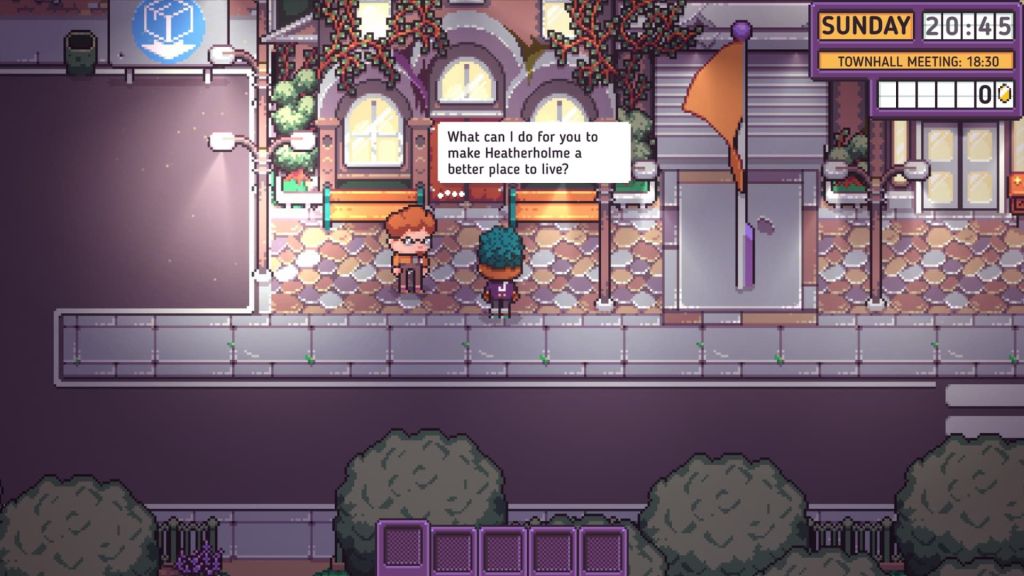
The time I spent with Discounty absolutely flew by, and I broke my bedtime rules several times to complete it faster (which is something I generally don’t do anymore as a father of two). The mix of addictive gameplay and interesting story themes had me incredibly engaged throughout my entire experience.
Discounty also manages to get you out of its game just in the nick of time. I think I was close to losing at least some of my interest if the game went on even an hour longer, but it seemed to know exactly when to get in and get out.
On top of everything else, Discounty also has cute and colorful visuals and solid music that complements the entire experience and helps round out a game that I consider very well done in almost every way.
It has been over 35 years since Boris Yeltsin came to America. Not long after he left, it probably felt like a grocery store had potentially ended a lot of the discourse about capitalism. Obviously, as anyone living in a capitalist economy can attest, the debates are far from done. But much like 35+ years ago, grocery stores remain one of the most interesting ways to talk about the subject.
Score: 9.0/10

If you enjoyed this post, please consider following me on social media, or checking out The Big Nerd Gaming Podcast!
The Big Nerd Gaming Podcast on Youtube


Leave a Reply